APIScrapy vs Promptcloud Comparison | Which one is better?
Quick Answer: APIScrapy vs PromptCloud
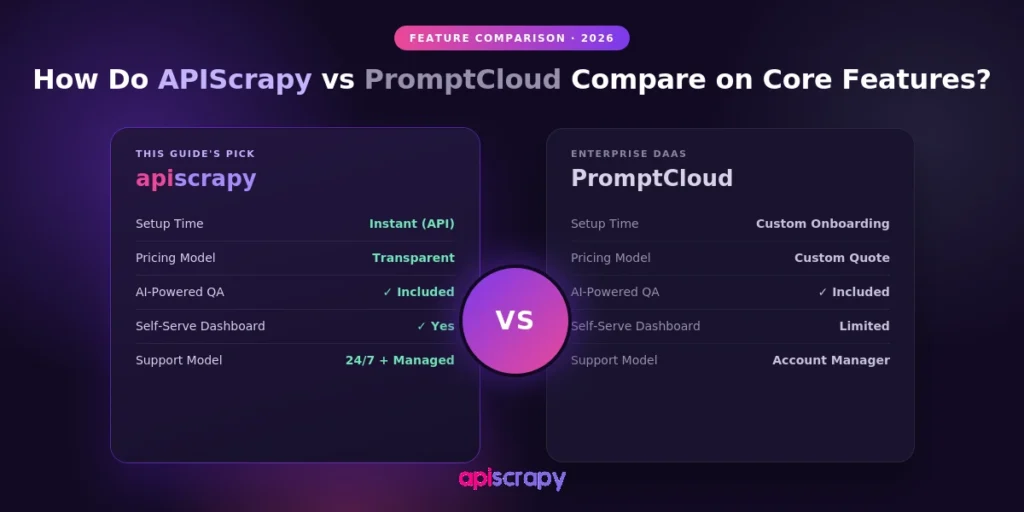
- Setup speed: APIScrapy is self-serve and no-code, live in hours to a few days. PromptCloud requires scoping and engineer-built crawlers, typically 1-3 weeks.
- JavaScript rendering: APIScrapy includes headless rendering by default in every plan. PromptCloud supports it, but only through custom-configured crawlers per project.
- Proxy and anti-bot handling: Automated and included at the infrastructure level with APIScrapy. Handled per project by PromptCloud’s engineers instead.
- Pricing: APIScrapy publishes tiered plans with a clear entry point. PromptCloud quotes custom pricing after a scoping call.
- Compliance certifications: APIScrapy holds ISO 9001:2015, ISO/IEC 27001:2013, HIPAA, GDPR, and AICPA SOC 2. PromptCloud follows GDPR-aligned practices but lists no public certifications.
- Technical overhead: No in-house data engineer needed for APIScrapy’s no-code interface. PromptCloud changes route through its delivery team.
- Best fit: APIScrapy suits teams wanting speed, predictable cost, and self-serve control. PromptCloud suits enterprises needing heavily customized, white-glove crawl builds.
APIScrapy and PromptCloud both offer managed web scraping, but they solve the same problem in opposite ways. APIScrapy wins on speed and cost transparency, while PromptCloud wins on deep, engineer-led customization. The right choice depends less on marketing claims and more on how each service handles turnaround time, JavaScript-heavy sites, compliance, and pricing as data volume grows. This comparison breaks down where the two actually differ, based on publicly available documentation, verified customer reviews, and pricing pages.
| Feature / Category | APIScrapy | PromptCloud |
|---|---|---|
| Service model | Fully managed web scraping, no-code Data-as-a-Service (DaaS) services | Managed, project-based web scraping service with custom builds |
| JavaScript rendering | Built-in headless rendering for dynamic and JS-heavy sites | Supports JS rendering through custom-configured crawlers |
| Anti-bot & proxy handling | Automated proxy rotation and anti-bot layer included in every plan | Proxy and anti-bot handling managed per project by engineers |
| Turnaround for new sources | Self-serve setup, typically live within hours to a few days | Requires scoping and engineering setup, often 1-3 weeks |
| Delivery formats | API, CSV, JSON, direct database and cloud storage push | API, CSV, JSON, and custom formats on request |
| Compliance certifications | ISO 9001:2015, ISO/IEC 27001:2013, HIPAA, GDPR, AICPA SOC 2 | GDPR-aligned practices; certifications not publicly listed |
| Pricing model | Transparent tiered plans with a clear entry point | Custom quotes based on scope and volume |
| Best fit | Teams that want speed, self-serve control, and predictable cost | Enterprises needing heavily customized, white-glove crawl builds |
How Do APIScrapy vs PromptCloud Compare on Core Features?
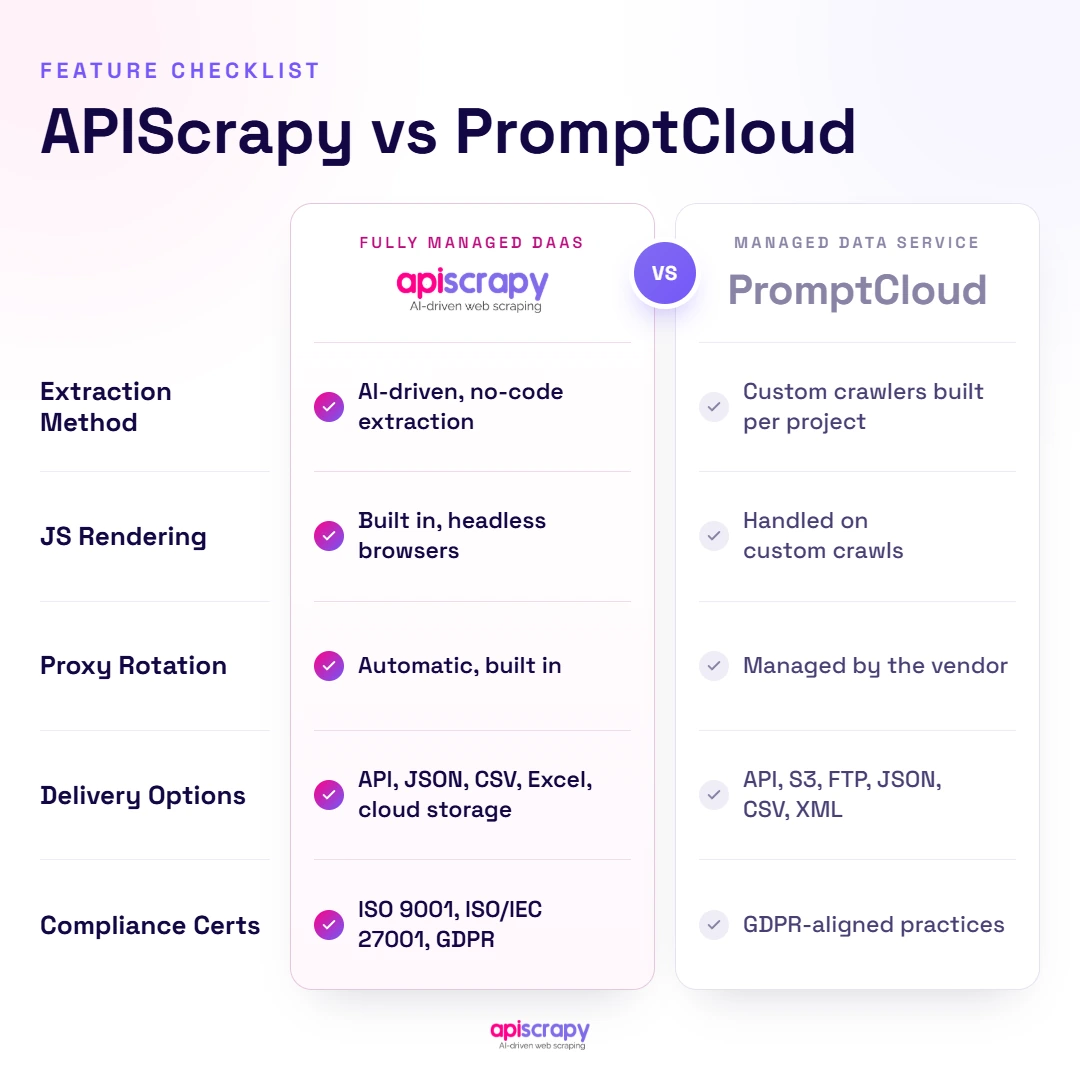
Both services extract structured data from websites at scale, but the way they get there is different. APIScrapy is built as a self-serve, no-code Data-as-a-Service service, so a business team can configure a new data source without waiting on an engineering queue. PromptCloud, by contrast, positions itself as a fully managed service where its own engineers scope, build, and maintain each crawler on a client’s behalf.
- Extraction method: APIScrapy offers point-and-configure setup for non-technical users; PromptCloud assigns engineers to build custom crawlers per project.
- JavaScript rendering: both handle dynamic, JS-heavy pages, but APIScrapy bundles headless rendering into every plan by default.
- Proxy and IP rotation: APIScrapy automates rotation at the infrastructure level; PromptCloud configures proxy strategy per client engagement.
- Delivery: APIScrapy supports direct push to databases and cloud storage in addition to API and file exports.
- Compliance: APIScrapy publishes ISO 9001:2015, ISO/IEC 27001:2013, HIPAA, GDPR, and AICPA SOC 2 certifications, giving regulated industries a documented audit trail.
For teams that need to launch a new data feed quickly without a procurement cycle, the self-serve model tends to win. For a single, highly unusual, deeply customized crawl requirement, PromptCloud’s engineering-led approach can be a better fit.
What Are the Major Key Differences Between APIScrapy and PromptCloud?
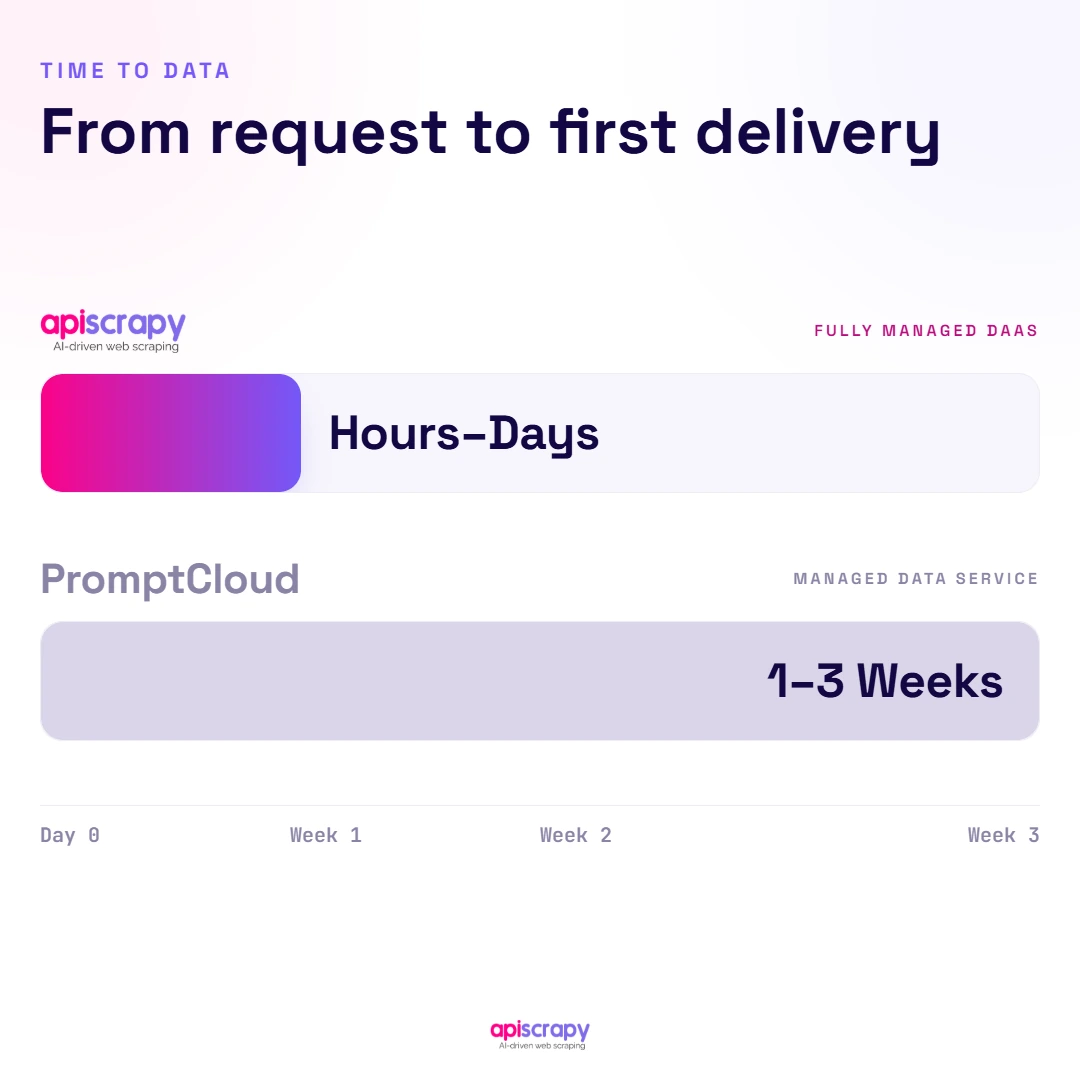
The clearest difference is philosophical: APIScrapy behaves like a product, while PromptCloud behaves like a service engagement. That single distinction cascades into onboarding speed, cost predictability, and how much technical overhead a client team carries.
Time-to-data: new sources typically go live within hours to a few days on APIScrapy, versus one to three weeks for a scoped PromptCloud build, since custom crawlers require discovery and QA cycles.
Technical overhead: APIScrapy’s no-code interface removes the need for an in-house data engineer to manage source configuration; PromptCloud engagements usually route change requests through their delivery team.
Cost predictability: APIScrapy’s published tiers make budgeting straightforward, while PromptCloud’s custom-quoted pricing means cost isn’t fully known until scoping is complete.
Contract flexibility: APIScrapy allows incremental scaling within a plan; PromptCloud engagements are commonly structured around a fixed project or retainer scope.
Fast-moving product and growth teams tend to prefer the predictability of a self-serve model, while enterprises with one complex, ongoing data pipeline sometimes prefer a dedicated engineering partner instead.
Competitive Pricing Analysis: Where Does APIScrapy Stand in the Market?
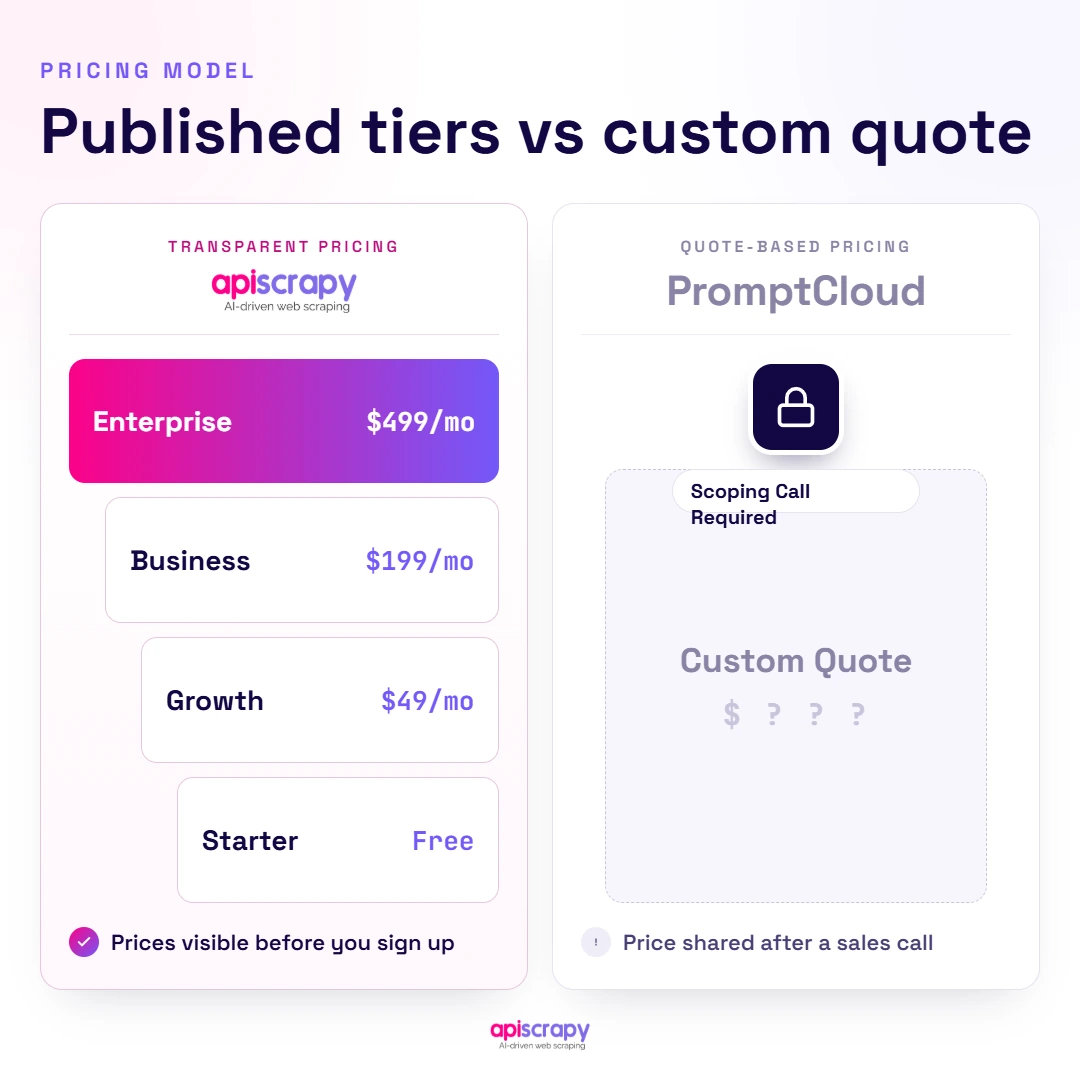
Pricing philosophy is where the two services diverge most visibly. APIScrapy publishes tiered plans with a defined entry point, so a team can estimate cost before committing. PromptCloud, like most fully managed scraping services, quotes pricing per project after a scoping call, which is common for engagements involving heavy customization but makes upfront budgeting harder.
APIScrapy’s tiers are structured to scale with request volume and number of data sources, so cost increases predictably as usage grows rather than requiring a fresh negotiation each time. PromptCloud’s custom-quote model can work in a client’s favor for very large, well-defined enterprise volumes, but it makes it harder to compare costs across vendors without first going through a sales conversation.
- APIScrapy: transparent tiers, self-serve upgrade path, cost scales predictably with usage.
- PromptCloud: custom quotes, enterprise-first positioning, pricing tied to project scope.
For budget-conscious teams or those benchmarking multiple vendors quickly, a published pricing structure removes a meaningful amount of friction from the buying process.
Which Service Scales Better for High-Volume Web Scraping?
Scalability in web scraping isn’t only about handling more pages. It’s about sustaining throughput as anti-bot defenses tighten, as source sites change layout without warning, and as concurrency needs spike during seasonal demand. APIScrapy’s infrastructure is built to absorb these variables automatically, with elastic scaling and SLA-backed uptime built into the service rather than negotiated per contract.
Developer communities that discuss scraping at scale consistently flag the same bottlenecks: hitting rate limits, absorbing IP bans from unmanaged proxy pools, and scrapers silently breaking when a target site updates its front-end. These are exactly the failure points an automated infrastructure layer is designed to absorb, since retries, backoff logic, and layout-change detection happen without a client needing to raise a support ticket.
PromptCloud addresses the same problems, but because crawlers are built and maintained per client, a layout change or a new anti-bot measure on a priority source can require a support request and an engineering fix cycle before delivery resumes. That’s a reasonable trade-off for a handful of complex, low-frequency sources, but it becomes a bottleneck when a business depends on dozens or hundreds of sources refreshing daily.
For enterprise teams running high-frequency, high-volume monitoring across many domains, a service-level scaling model generally holds up better under sustained load than a per-project service model.
Choosing the Right Web Scraping Solution for Your Needs
The better service depends on team structure, technical resourcing, and how often data requirements change, not on a single universal winner.
Team Size and Technical Expertise
Lean teams without a dedicated data engineer benefit from a no-code, self-serve service that doesn’t require writing or maintaining scraper code.
Data Volume and Refresh Frequency
High-frequency, high-volume monitoring across many sources favors an automated, elastic infrastructure over a per-project build cycle.
Compliance and Data Handling Needs
Regulated industries should prioritize a service with documented, verifiable certifications such as ISO 27001, HIPAA, and GDPR alignment.
Budget Predictability
Teams that need to forecast cost in advance are better served by published, tiered pricing than by custom quotes.
Why Choose APIScrapy Over PromptCloud?
APIScrapy is best suited for product, growth, and data teams that want to launch and scale data feeds without depending on a vendor’s engineering queue for every change. Its core strength is combining self-serve control with enterprise-grade infrastructure, so a small team can operate at a scale that would otherwise require an internal data engineering function.
Where APIScrapy clearly outperforms PromptCloud is turnaround time and cost transparency: new sources go live faster, pricing is visible upfront, and scaling up doesn’t require a renegotiation. It also carries a documented compliance stack, ISO 9001:2015, ISO/IEC 27001:2013, HIPAA, GDPR, and AICPA SOC 2, backed by AIMLEAP’s track record serving 700+ clients.
It’s the stronger fit for teams that need predictable, ongoing data pipelines across many sources rather than a single, one-off custom crawl.
Start Building Your Web Crawler Today
Conclusion
PromptCloud remains a credible choice for enterprises with a narrow set of highly customized, low-frequency crawl requirements that justify a dedicated engineering engagement. APIScrapy is the stronger fit for teams that need speed, transparent pricing, and infrastructure that scales automatically as data volume and source count grow.
The goal here isn’t to declare a universal winner but to help you match the service to your actual workflow, team size, and compliance requirements.
Ready to see the difference in your own workflow? Book a demo with APIScrapy today and get a live look at how fast a new data source can go from request to delivery.
Frequently Asked Questions About APIScrapy vs PromptCloud
Which web scraping service offers better value for money?
APIScrapy offers better value with predictable, scalable pricing and no custom sales cycle. PromptCloud can be cheaper, but only for very large, tightly scoped enterprise volumes.
Is APIScrapy cheaper than PromptCloud for large-scale web scraping?
APIScrapy's published tiers are usually more cost-efficient than a custom quote for standard large-scale use. PromptCloud can compete at high volumes, but pricing depends on a scoping conversation first.
Which is easier to scale for high-volume scraping, APIScrapy or PromptCloud?
APIScrapy scales automatically as request volume grows. PromptCloud can scale too, but per-client crawlers often need extra engineering coordination for major increases.
Which handles dynamic websites and JavaScript-heavy pages better, APIScrapy or PromptCloud?
APIScrapy includes headless rendering by default on every plan. PromptCloud handles JS-heavy sites through custom-configured crawlers requiring per-project setup.
Which service requires less technical expertise for building and managing scrapers?
APIScrapy needs the least expertise, letting non-engineers configure sources through a no-code interface. PromptCloud removes technical burden too, but changes route through their delivery team.
Which offers better reliability against website changes, rate limits, and anti-bot protection?
APIScrapy's automated proxy rotation and layout-change detection hold up well under continuous, high-frequency load. PromptCloud manages these per project, but fixes often depend on support tickets and engineering turnaround.