Types of AI Data Extraction
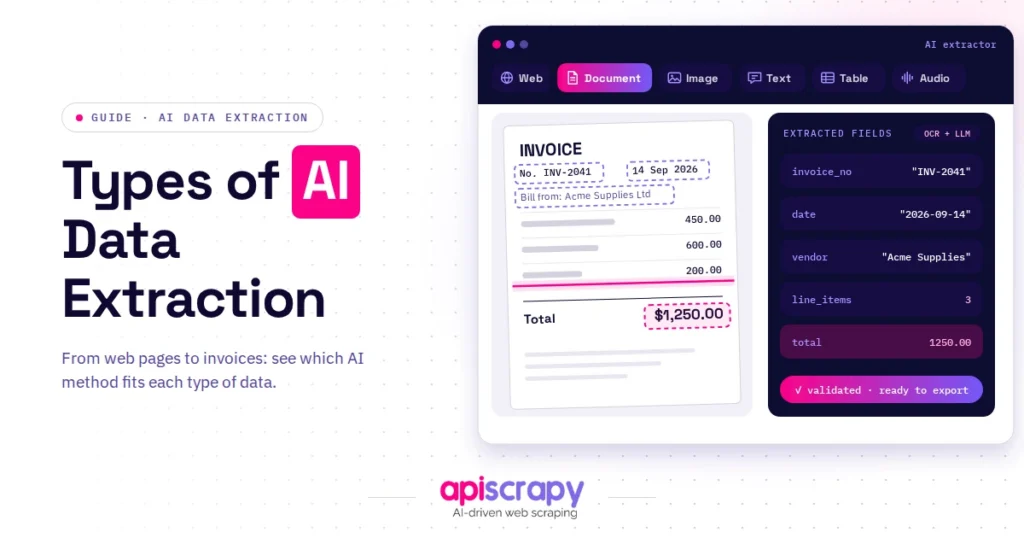
Manual data entry once handled most business data needs, but growing data volume and messier formats have pushed teams toward AI driven extraction. Structured tables, scanned PDFs, images, and free flowing text all need a faster, more reliable way to become usable data.
This guide breaks down the core types of AI data extraction, how each one works, and where it fits best. Use it as a quick reference before choosing an approach for your own pipeline.
In simple terms, AI data extraction is:
- The use of machine learning or language models to pull structured information from unstructured sources
- Capable of handling documents, web pages, images, and scanned files without manual re-typing
- A way to scale data collection without a proportional rise in headcount or review time
- Central to research, compliance, pricing intelligence, and market monitoring workflows
What are the Core Types of AI Data Extraction?
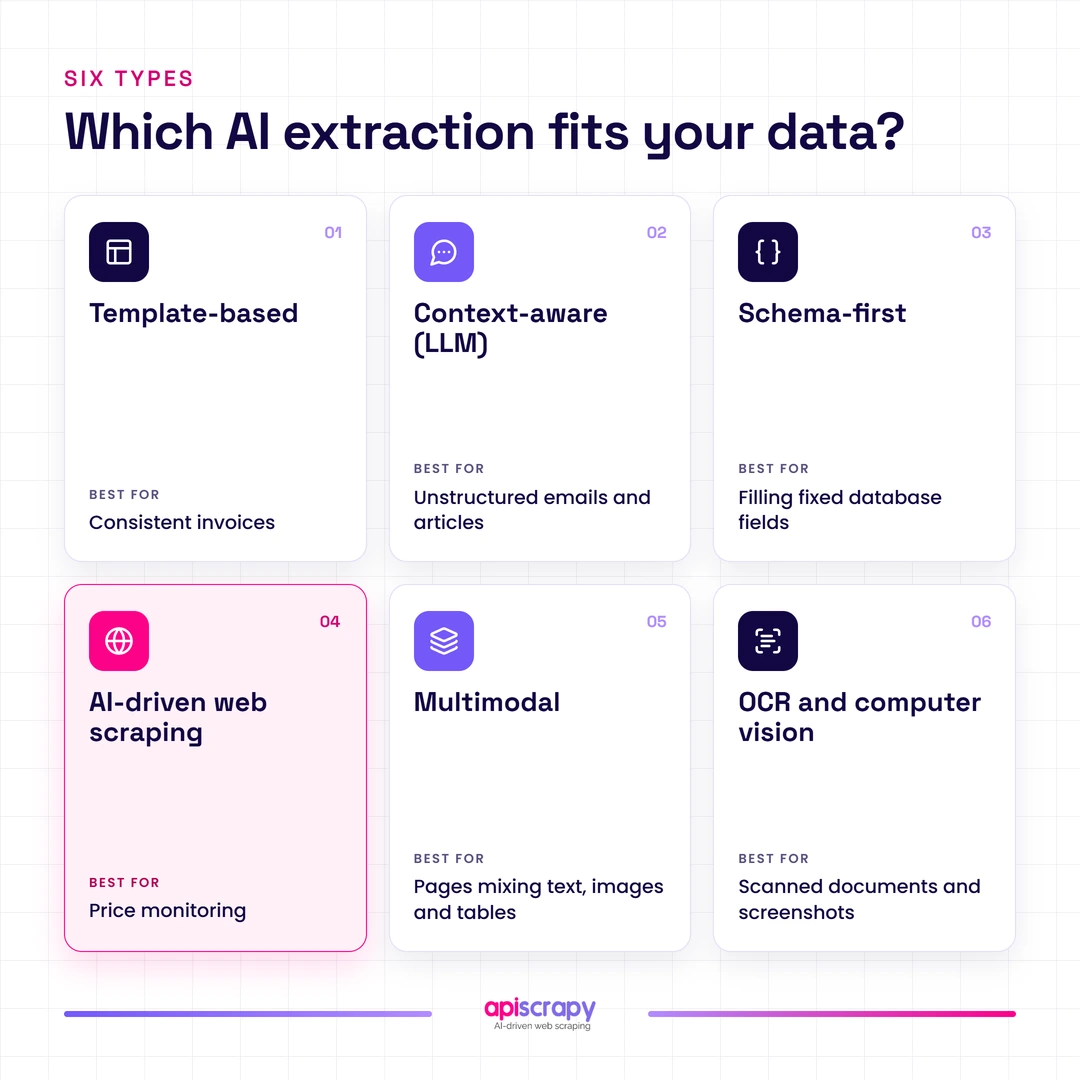
There is no single method that works for every data source. A structured invoice, a scanned contract, and a product page each demand a different approach, since accuracy needs and input formats vary widely.
Each type below covers what it is, how it works, and where it fits best, so you can match the right method to your own data source.
Template-Based / Rule-Augmented Extraction
Template based extraction uses predefined layouts or fixed patterns to locate specific fields in a document. It works well when the source format stays consistent, such as standardized invoices or government forms.
This method leans on pattern matching rather than deep language understanding. A built template can process thousands of similar files at high speed, but accuracy drops fast once the layout changes.
Key Characteristics
- Relies on fixed coordinates or regex patterns tied to a known layout
- Fast and inexpensive to run once the template is built and tested
- Breaks down when vendors or page layouts change without notice
- Best for high volume, low variation documents like receipts
Best For: Teams processing large volumes of documents that follow one consistent, unchanging format.
Context-Aware / LLM-Based Extraction
Context aware extraction uses large language models to understand a document as a whole rather than matching fixed positions. The model reads surrounding text and structure to figure out what information actually means, which lets it adapt to new layouts without retraining.
This reasoning based approach handles variation across vendors and formatting styles far better than rule based systems. It needs more compute and some quality checks, but most modern workflows now lean on it as the default for unstructured content.
Key Characteristics
- Understands context and field relationships instead of fixed positions
- Adapts to new or varying layouts without manual template updates
- Needs validation since models can occasionally misread ambiguous text
- Works well across contracts, resumes, emails, and free form documents
Best For: Teams handling documents from many different sources or formats that change often.
Schema-First AI Extraction
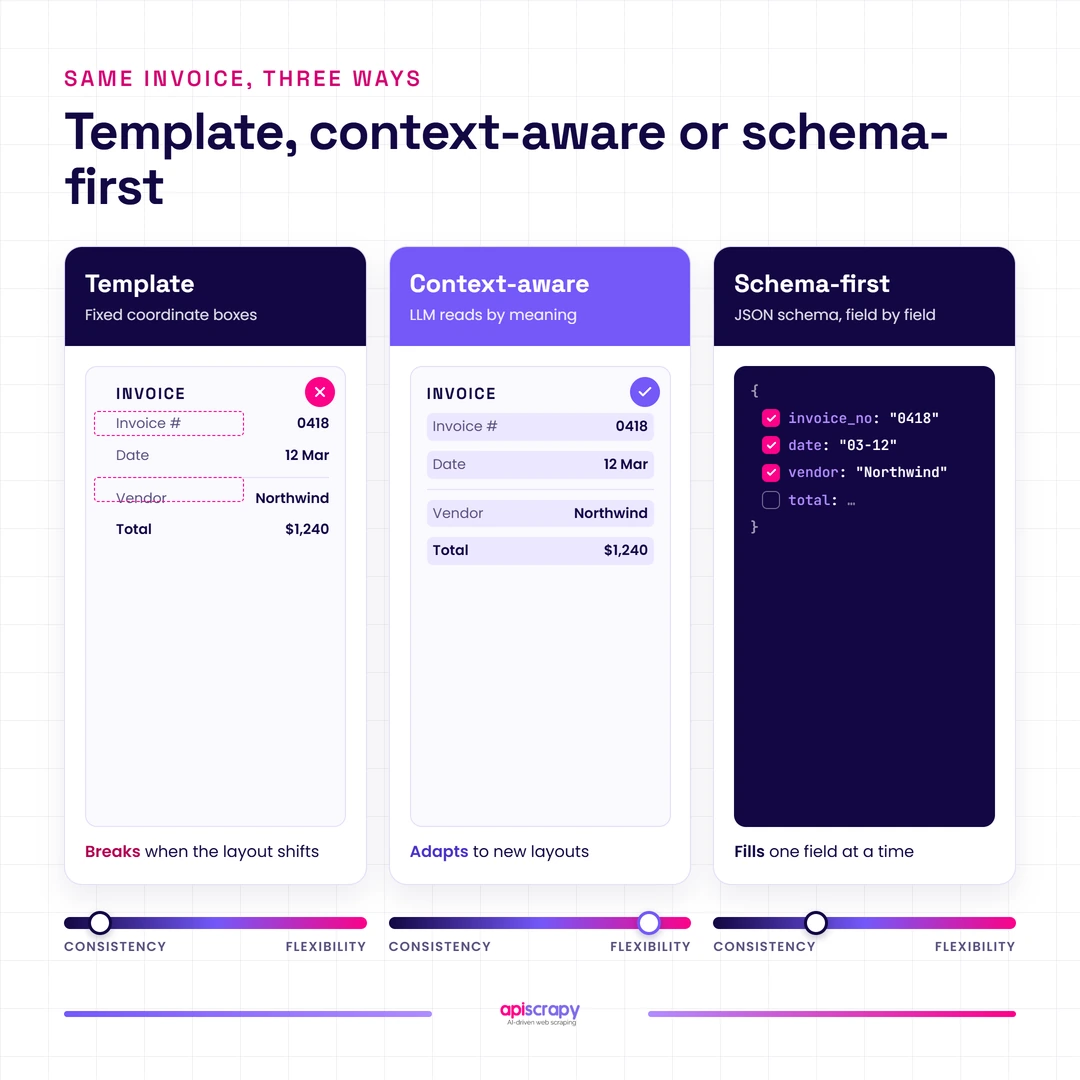
Schema first extraction starts with a predefined output structure, such as a JSON schema, and instructs the AI model to fill it consistently every time. The team decides in advance exactly what fields and data types the output should contain.
This keeps outputs consistent and easy to validate, which works well when output feeds straight into a database. The tradeoff is less flexibility when a source contains information outside the predefined schema.
Key Characteristics
- Defines exact fields and structure before extraction begins
- Produces consistent output suited for direct database ingestion
- Reduces post processing since the schema enforces compliance
- Less adaptable when documents contain unmapped information
Best For: Teams feeding extracted data straight into applications, dashboards, or structured databases.
AI-Driven Web Scraping
AI driven web scraping applies machine learning to pull structured data from websites, including pages with dynamic content, anti bot defenses, or frequently changing layouts. Traditional scrapers relied on fixed CSS selectors that broke the moment a site redesigned, while AI driven scraping adapts by understanding page structure and content patterns instead.
This method has become the backbone of modern pricing intelligence and competitor monitoring. A managed web scraping service like APISCRAPY typically pairs this AI layer with proxy rotation and data cleaning, so teams get structured output without maintaining scraper infrastructure themselves.
Key Characteristics
- Adapts to layout changes without manual selector rewrites
- Handles anti bot defenses and rendering challenges at scale
- Often paired with proxy management and data cleaning in a managed service
- Suited for continuous data collection over one time extraction jobs
Best For: Teams running ongoing price monitoring, competitor tracking, or large scale web research.
Multimodal Extraction
Multimodal extraction processes multiple content types together, such as text, images, tables, and charts within one document. Instead of running separate tools for each type, one model reads the full page and understands how the pieces relate.
A product spec sheet with an image next to a table is a common example, since the image often clarifies what the numbers describe. Multimodal models read both together, which reduces the fragmented pipelines older methods required.
Key Characteristics
- Processes text, images, tables, and charts in a single pass
- Preserves relationships between visual and textual elements
- Reduces the need for separate tools per content type
- Suited for spec sheets, research papers, and mixed media reports
Best For: Teams extracting data from documents where images, tables, and text carry combined meaning.
OCR and Computer Vision
OCR converts scanned documents into machine readable text by recognizing individual characters and words. Computer vision goes a step further, identifying layout elements like tables and checkboxes, and together they form the foundation for digitizing paper records.
Modern OCR pipelines increasingly pair with language models to catch errors in ambiguous scans that pure character recognition would misread. This hybrid setup improves accuracy on low quality scans and handwriting, though OCR alone still struggles with poor scans and unusual fonts.
Key Characteristics
- Recognizes text and layout elements from scanned documents
- Forms the entry point for digitizing paper and legacy archives
- Increasingly combined with language models to correct errors
- Struggles alone with low quality scans and handwriting
Best For: Teams digitizing scanned paperwork, old archives, or handwritten records.
Start Building Your Web Crawler Today
Conclusion
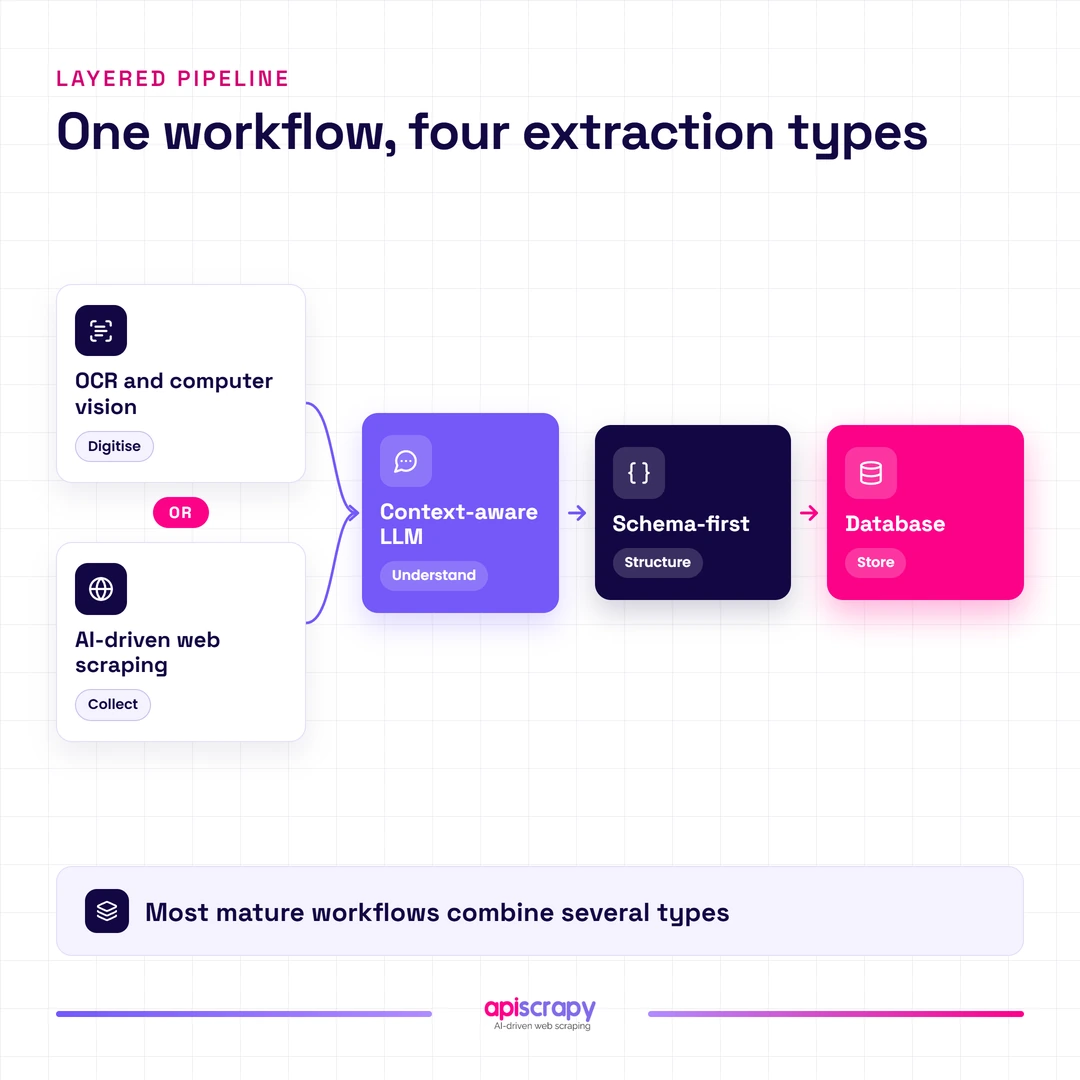
No single extraction type works best across every data source, since accuracy and structure needs vary by document and format. The right method depends on how consistent your source layout is and how much variation to expect over time.
Most mature data workflows combine several of these types rather than relying on just one, such as pairing AI driven web scraping with schema first extraction for consistent output. Extraction methods also continue to converge, with multimodal and context aware models increasingly handling tasks that once needed separate tools.
If your team is evaluating which method fits your data sources, a managed service like APISCRAPY can help match the right extraction approach to your use case. Book a demo to see how this works for your data.
FAQs
How accurate is AI data extraction compared to manual data entry?
AI data extraction generally reaches higher consistency than manual entry, since it does not suffer from fatigue across large volumes. Manual entry error rates typically climb as volume increases, which AI based methods avoid.
What is template-based vs. template-free (context-aware) extraction?
Template based extraction relies on fixed layouts and predefined field positions to pull data. It works well only when every document in a batch follows the same consistent format. Template free, or context aware, extraction uses language models to understand document meaning instead of position. This lets it handle varying layouts without a new template for each source type.
Can AI extract data from unstructured sources like PDFs and scanned documents?
Yes, AI can extract data from unstructured PDFs and scanned documents using OCR, computer vision, and language model interpretation together. These methods convert scanned images into machine readable text, then structure that text into usable fields. Accuracy depends on image quality, font clarity, and layout complexity. Hybrid pipelines combining OCR with LLM based correction generally perform better on low quality or handwritten scans.
What technologies power AI data extraction?
AI data extraction typically relies on large language models, computer vision systems, and optical character recognition working together within one pipeline. Named entity recognition and layout detection models often support specific field level tasks.
Is AI data extraction legal?
AI data extraction is generally legal when applied to publicly available data and used in compliance with data protection and copyright regulations.