Top 5 Best Web Scraping Service: Quick Comparison
Web scraping have moved from an occasional tool to a core requirement for teams that need reliable, ongoing access to external data. Websites now deploy more sophisticated anti-bot defenses, page structures change without warning, and AI-driven products depend on clean, structured data instead of raw HTML dumps. Picking the wrong scraping service no longer just means slower turn around, it can mean blocked IPs, broken pipelines, and gaps in the data your business depends on.
This guide breaks down the five strongest web scraping services, based on:
- Analysis of vendor documentation, pricing pages, and verified reviews across G2, Trustpilot, and developer communities
- Evaluation of anti-bot handling, JavaScript rendering, and structured data output across formats, delivery frequency, and quality assurance
- Comparison of managed versus self-serve workflows, support quality, and compliance posture (GDPR, CCPA, SOC 2)
- Review of pricing models and scalability for solo developers, growing teams, and enterprise data operations
APISCRAPY is our own product and appears in this list as the Service we build and maintain. Its placement reflects our documented feature set, not a paid slot, and every comparison made against the other four services below relies on their public pricing pages, documentation, and independently verified customer reviews rather than our own opinion of them.
All service descriptions and comparisons rely on publicly available documentation, verified customer feedback, and documented performance outcomes.
Vetting Methodology: How We Evaluated These Web Scraping Services
We scored every service against the same six weighted criteria, using vendor documentation, public pricing pages, and verified reviews from G2, Capterra, Trustpilot, and developer communities such as r/webscraping.
| Criterion | Weight | What We Checked |
|---|---|---|
| Anti-Bot Handling and Success Rate | 25% | Proxy rotation, CAPTCHA solving, and JavaScript rendering, judged against documented success rates and user reports on heavily protected sites. |
| Data Quality and Structured Output | 20% | Whether the service returns clean JSON, CSV, or database-ready records instead of raw HTML, plus the QA and validation steps it applies before delivery. |
| Pricing Transparency and Scalability | 20% | Cost per usable record, credit multipliers for JS or premium proxies, rollover rules, and how pricing holds up as volume grows. |
| Ease of Use and Workflow Model | 15% | Setup effort for technical and non-technical teams, and whether the managed or self-serve model matches how the service is positioned. |
| Compliance and Security Posture | 10% | Published GDPR, CCPA, and SOC 2 commitments, and how clearly the vendor documents its approach to personal and protected data. |
| Support and Verified User Feedback | 10% | Support channels and response times, weighed alongside verified reviews on G2, Capterra, Trustpilot, and developer forums. |
| Total | 100% |
Each service was scored 1 to 5 per criterion, then weighted to reach its final ranking.
How this Web Scraping Service Comparison Helps You Choose?
| Service | Best For | G2 Rating | Capterra Rating | Starting Price |
|---|---|---|---|---|
| APISCRAPY | AI-driven, no-code scraping with managed data delivery | 4.0 | 5.0 | Starts at $1 |
| ScraperAPI | Budget-friendly developer scraping API | 4.4 | 4.6 | From $49/mo |
| Diffbot | AI/computer-vision extraction, structured knowledge graph data | 4.4 | 4.4 | From $299/mo |
| Octoparse (Octopus Data Inc.) | Non-technical users, visual point-and-click scraping | 4.8 | 4.7 | Free tier, then ~$83/mo |
| ScrapeHero | Fully managed, done-for-you scraping services | 4.8 | N/A | Custom quote |
Choosing a web scraping service comes down to three things: how much technical setup you can handle, how reliably the tool bypasses anti-bot defenses, and what you’re actually paying per usable record. Here’s a practitioner breakdown of five providers, including one built specifically for teams that want managed delivery over raw API access.
1. APISCRAPY
APISCRAPY is an AI-powered managed web scraping and Data-as-a-Service Service built for teams that want structured data delivered, not just raw scraping infrastructure to manage.
Features
- AI-driven, no-code scraping setup for non-technical teams
- Managed data delivery in structured formats rather than raw HTML
- Suited to e-commerce, DaaS, and continuous monitoring use cases
Pros
- Low technical barrier to entry compared to developer-first APIs
- Managed delivery model reduces the need for in-house maintenance
- Entry pricing is accessible for small-scale testing
Cons
- Newer market presence means fewer independent, large-sample reviews than established players
- Best suited to managed use cases rather than teams wanting full API control
Pricing
Starts at $1. Custom tiers scale with data volume and delivery frequency.
2. ScraperAPI
ScraperAPI is a web scraping service that returns clean HTML from any website through a single API call. It handles proxy rotation, CAPTCHA solving, and JavaScript rendering automatically, removing the need to build or maintain in-house scraping infrastructure. This makes it a practical choice for developers who want reliable web data extraction without managing headless browsers, IP blocks, or anti-bot systems themselves.
Features
- Automatic proxy rotation across a pool of residential and datacenter IPs
- JavaScript rendering for dynamic pages
- Structured data endpoints for select targets including Amazon, Google, and Walmart
- Geotargeting across roughly 50 locations, with country-level targeting on higher tiers
Pros
- Straightforward API integration with strong documentation
- Failed requests are not billed, which controls waste
- Async endpoints support bulk jobs well
Cons
- Credit system is not 1:1. JavaScript rendering and premium proxies can multiply the cost of a single request several times over
- Geotargeting on entry-level plans is limited to US and EU regions
- Credits do not roll over month to month
Pricing
Free plan with 1,000 credits. Hobby plan starts at $49/month (100,000 credits). Higher tiers run $149, $299, and up, with custom Enterprise pricing above that.
3. Diffbot
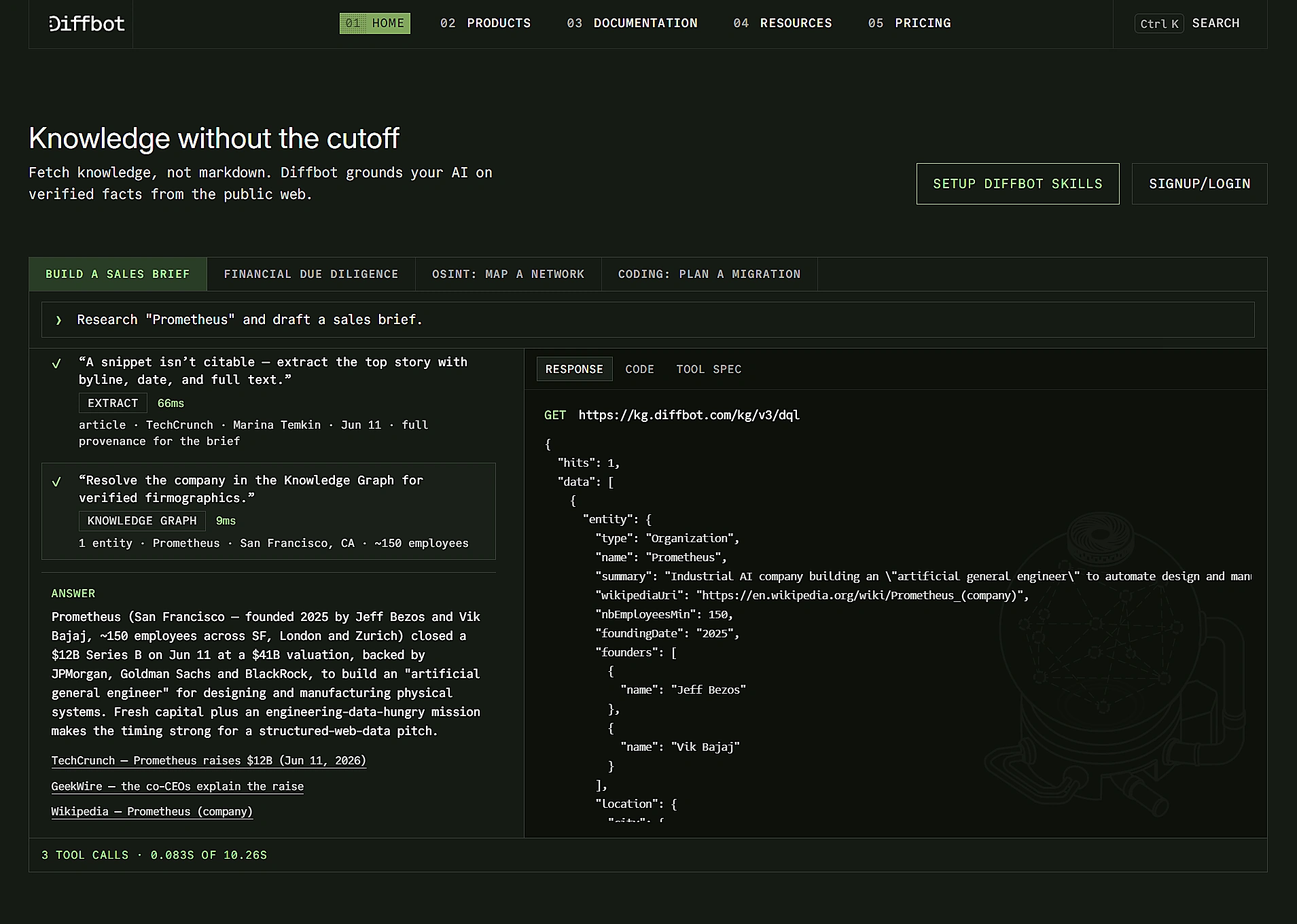
Diffbot is a web scraping and data extraction service that uses computer vision and machine learning to identify and pull structured data automatically, without relying on site-specific rules or manual configuration. On top of raw extraction, it maintains a large knowledge graph connecting organizations, articles, and products, adding context and relationships that go beyond a single page. This makes it a strong fit for teams that need structured, entity-linked data at scale rather than raw HTML output.
Features
- Automatic structured extraction using AI and computer vision, no manual selectors needed
- Knowledge Graph covering hundreds of millions of organizations and over a billion articles
- Crawlbot for full-site or multi-page crawling
- Natural language processing for entity, relationship, and sentiment analysis
Pros
- Strong fit for structured, entity-level data rather than raw page scraping
- Reduces ongoing selector maintenance since extraction is model-driven, not rule-based
- Integrates directly with Excel, Google Sheets, Tableau, and Zapier
Cons
- Entry-level paid plan is significantly more expensive than developer-first APIs
- Credit-based billing needs active monitoring to avoid overages
- Learning curve for teams new to knowledge-graph style querying
Pricing
Free plan with 10,000 credits. Startup plan is $299/month (250,000 credits). Plus plan is $899/month (1,000,000 credits). Enterprise is custom priced.
4. Octoparse (Octopus Data Inc.)
Octoparse is a no-code web scraping tool designed for non-technical users who need repeatable data extraction without writing scripts. It uses a point-and-click interface, letting users build scraping workflows visually instead of coding selectors or handling requests manually. This makes it a practical option for marketers, researchers, and analysts who need structured web data but don’t have development resources on hand.
Features
- Visual workflow builder with auto-detection of page elements
- Cloud-based extraction with 24/7 scheduling
- Built-in IP rotation and CAPTCHA handling
- Over 400 free pre-built templates for common sites
Pros
- Genuinely accessible for users with no coding background
- Cloud version runs reliably for scheduled, recurring jobs
- Pre-built templates cut setup time on common targets
Cons
- Pricing is task- and device-gated rather than usage-gated, so heavier workflows push you into higher tiers fast
- Not a true API-first product, which limits pipeline automation
- Performance can be inconsistent on complex, heavily dynamic sites
Pricing
Free plan available. Standard plan runs roughly $99 to $119/month. Professional plan runs roughly $249 to $299/month. Enterprise is custom priced.
5. ScrapeHero
ScrapeHero is a fully managed web scraping service built for teams that want finished data, not a tool to run themselves. Instead of providing an API or self-serve platform, its team builds, maintains, and monitors the scraper on the client’s behalf. Data is delivered on a set schedule, in the format the client needs, with no scraping infrastructure to manage in-house.
Features
- Fully managed extraction, maintenance, and delivery, with no infrastructure for the client to run
- Custom scraper builds for e-commerce, financial, and real estate data sources
- AI-assisted data processing and cleaning included in the service
Pros
- Zero engineering overhead since ScrapeHero handles blocking, maintenance, and format changes
- Good fit for teams that need clean, ready-to-use data rather than a tool to operate
- Scales to complex, high-maintenance targets that self-serve Service struggle with
Cons
- Higher cost than self-serve Service for equivalent volume
- Less real-time control since you’re dependent on their delivery schedule
- Turnaround for new scraper builds is slower than spinning up a self-serve API
Pricing
Subscription-based plans start around $199/month. On-demand scraping projects run $550/month and up. Enterprise contracts are custom quoted.
Key Factors to Consider Before Choosing a Web Scraping Service?
Scalability
A service that works for 500 pages a month can fall apart at 500,000. Check concurrency limits, proxy pool size, and whether pricing punishes growth.
Data Accuracy and Reliability
Broken selectors and incomplete extractions cost more time than the scraping itself. Look for success rate benchmarks on sites similar to yours, not just marketing claims.
Integration and API Support
The best scraper is not very useful if the data cannot reach your warehouse, spreadsheet, or BI service without manual exports. Check for native connectors to Google Sheets, S3, Snowflake, or your existing database before committing.
Compliance and Legal Handling
GDPR and CCPA exposure is real when scraping data that touches personal information. Favor vendors who publish their compliance certifications rather than vague statements.
Support and Pricing Model
Credit-based pricing looks cheap until a JavaScript-heavy site multiplies your cost by ten. Compare support responsiveness too, since a stuck scraper at 2 a.m. needs a real answer, not a ticket queue.
How to Choose the Right Web Scraping Service?
Choosing a scraper is less about finding the single “best” one and more about matching the service to your team’s technical comfort and data volume.
- How much data volume do you need weekly, and does the service’s pricing scale sensibly with it
- Does your team have developers, or do you need a fully visual, no-code interface
- How often does your target site change layout, and can the service adapt without manual fixes
- Do you need raw HTML, or structured JSON ready for a database or AI pipeline
These questions matter more than any single feature on a list. That is also why AI-driven scraping is quietly becoming the default answer for most of them.
Why Is AI Web Scraping Replacing Traditional Web Scraping Service?
Traditional scrapers rely on fixed rules like CSS selectors and XPath. The moment a target site redesigns a single page, the scraper breaks silently and stops delivering data.
Maintaining these rule-based scrapers eats real engineering time. Someone has to notice the failure, inspect the new HTML, and rewrite the extraction logic before data flows again.
AI-driven scrapers read a page more like a human does. They identify prices, titles, and reviews by context rather than by a brittle selector, which means far less babysitting when a site changes layout.
The result is fewer silent failures and less maintenance overhead for teams running scrapers continuously, not just once.
Practitioners on r/webscraping frequently describe rule-based scrapers as breaking the moment a target site redesigns a page, while AI-based service are seen as needing far less manual fixing.
What Makes APISCRAPY the Best Web Scraping Service?
APISCRAPY is built for teams that want structured data without owning scraper maintenance. It suits pricing analysts, market researchers, and product teams who need ready-to-use APIs, not raw HTML to parse themselves.
The service combines AI-augmented extraction with no-code workflow building. Data lands directly in your database or dashboard on a schedule you set, with no infrastructure to manage on your end.
Where APISCRAPY differs from rule-based competitors is resilience. Layout changes on target sites do not require you to rebuild anything, since the AI adapts extraction logic automatically.
It fits teams already past the DIY-scraper stage, particularly in e-commerce, real estate, and competitive pricing intelligence, where consistent data matters more than raw speed.
Mini Case Study
A mid-size e-commerce retailer needed daily competitor pricing across hundreds of SKUs but had no engineering capacity to maintain custom scrapers.
APISCRAPY’s managed workflow delivered structured pricing data on schedule without requiring the retailer’s team to touch a single line of code.
Start Building Your Web Crawler Today
Final Thoughts: What Is the Best Web Scraping Service?
There is no single best web scraping service for everyone. Developers comfortable with Python may prefer Diffbot, while non-technical teams often do better with a visual, no-code service.
If your priority is structured data delivered without ongoing maintenance, APISCRAPY is worth a closer look. Book a demo to see how it handles your specific use case before you commit to a subscription.
Frequently Asked Questions About Web Scraping Service
What is the best web scraping service for beginners?
For beginners with no coding background, a fully managed service like APISCRAPY is the easiest starting point since a team builds and delivers the data for you. AI-driven, no-code Services can shorten that learning curve even further for teams that want more control.
Apiscrapy vs ScraperAPI, which should I use?
Playwright is a free, open-source browser automation library, so you write and maintain the code yourself. APISCRAPY suits teams that want structured data delivered on schedule without owning that engineering overhead.
Has anyone actually used web scraping service for real multi-step data workflows?
Yes, multi-step flows like login, navigation, and pagination are standard in production pricing intelligence and lead generation work. APISCRAPY handles these natively and its AI adapts automatically when a step in that workflow changes.
What is the easiest way to automate complex web scraping workflows?
The easiest path is a service that schedules runs, rotates proxies, and reformats output on its own instead of you stitching Service together. A no-code, AI-driven builder is ideal here since it handles all of this without requiring any code.
What should you consider before choosing a web scraping service for production use?
Check success rates on sites similar to your actual targets, not just a clean demo, since production reliability is what matters. Also weigh compliance certifications, support responsiveness, and whether pricing stays predictable as volume grows.