How to Scrape Google Search Results (SERP) in 2027
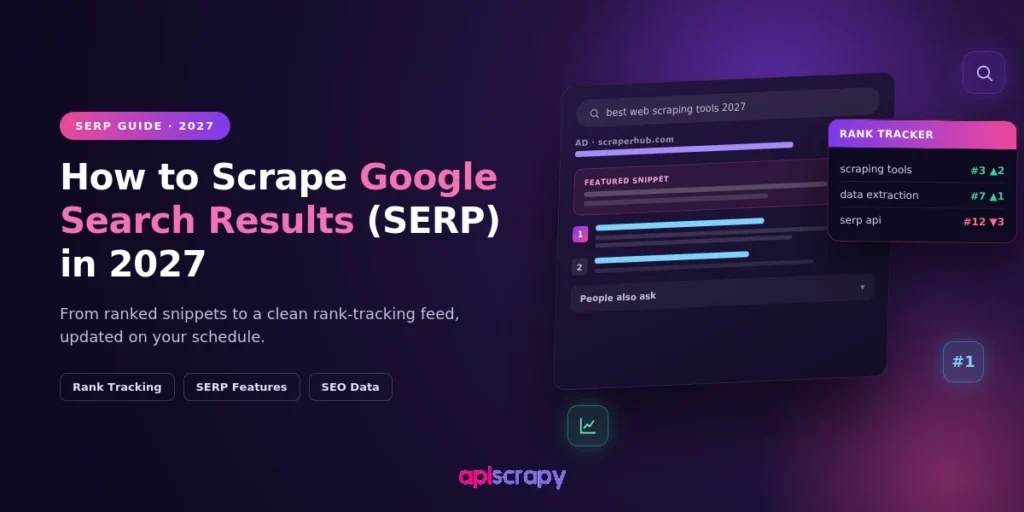
Google search results can reveal exactly what your buyers see, what competitors rank for, and where new opportunities are hiding—but the challenge is collecting that data reliably at scale. If you want to scrape Google search results, choose an approach that matches your search volume and technical resources, while planning for changing SERP layouts, CAPTCHAs, and automated-traffic restrictions from the start.
- Teams scraping continuously: Use a dedicated SERP API. It returns pre-parsed JSON for organic results, ads, and SERP features, and absorbs proxy rotation, CAPTCHAs, and markup changes.
- Non-technical teams: Use a no-code or AI agent extractor for ad hoc research. Setup is fast, but control is limited and costs climb at high volume.
- Engineering-led teams: Build with Python and Playwright only if you have a non-standard need. Randomize timing, rotate proxies, store raw HTML, and log failed requests.
- Target the right data: Use q, gl, hl, start, tbm, and udm to localize results, paginate, switch verticals, and control AI Overviews.
- Know the legal line: Google’s terms prohibit automated queries. Rulings like hiQ v. LinkedIn address federal hacking law, not terms-of-service breaches, so civil and IP-block risk remains.
- Past a few thousand queries a day: DIY maintenance usually outgrows its value, and a managed service like APISCRAPY takes that load off your team.
Why You Might Want to Scrape Google Search
Google still decides what most buyers see first, so its search results double as the most reliable proxy for demand and visibility in any market. Teams scrape this data to track rankings, watch competitors, spot content gaps, and feed structured search data into AI and analytics pipelines. This guide walks through the methods that actually work in 2027, the legal ground rules, and what to do when Google pushes back.
- Tracking keyword rankings across markets, devices, and languages on a recurring schedule
- Monitoring competitor visibility, featured snippets, and ad placements over time
- Feeding fresh, structured search data into content gap analysis or AI training pipelines
- Auditing how AI Overviews and other SERP features affect organic click-through
Whichever reason applies, the method has to survive Google’s blocking systems and stay inside the legal boundaries covered next.
The Legal and Structural Landscape in 2027
Google’s Terms of Service explicitly prohibit automated queries to its search service, and its robots.txt file disallows crawling the /search path. Courts have treated scraping public web data differently from breaching a private system. The hiQ Labs v. LinkedIn rulings found that scraping public, logged out data does not by itself violate the U.S. Computer Fraud and Abuse Act, even where it breaches a site’s terms.
That said, breaching Google’s terms can still expose a business to civil claims, IP blocks, or account termination. Most production use cases run through a licensed API or a service that absorbs that operational and legal load directly.
Method 1: The Modern No-Code & API Approach (Recommended for Scale)
For any team running SERP scraping continuously rather than as a one-off experiment, a managed approach beats maintaining scraping infrastructure in house. It removes the CAPTCHA solving, proxy rotation, and constant selector maintenance that Google’s changes force on DIY scrapers.
1. Dedicated SERP APIs (Structured JSON Output)
Dedicated SERP APIs send your query to Google, handle the rendering and blocking challenges, and return clean structured JSON instead of raw HTML. This removes the need to rebuild parsers every time Google changes its markup or rolls out a new SERP feature.
- Results arrive pre-parsed into organic listings, ads, and SERP features as separate fields
- Providers typically handle geo-targeting through the gl and hl parameters automatically
- Most support pagination workarounds now that Google’s num parameter was deprecated
- Usage is billed per successful query, which keeps costs predictable at scale
2. No-Code & AI Agent Extractors
No-code extractors and AI browsing agents let non-technical teams pull SERP data through a visual interface or a natural-language instruction instead of writing scraping code. They trade some flexibility for setup speed.
- Faster to launch for small, ad hoc research tasks without engineering involvement
- Limited control over edge cases like localized results or unusual SERP layouts
- Costs can climb quickly at high query volumes compared with a dedicated API
- Best suited to periodic research rather than an always-on production pipeline
Method 2: Building a Custom Scraper (Python + Playwright)
Building your own scraper gives full control over parsing logic and output format. It also means owning every fix when Google changes its HTML structure or rolls out a new anti-bot check. This route makes sense mainly for teams with dedicated engineering time and a specific, non-standard extraction need.
Key Parameters to Build Your Target URL
- q holds the search query itself and supports Google’s standard search operators
- gl sets the two-letter country context used to localize results
- hl sets the interface language independently of the gl country setting
- start controls pagination in increments of ten results per page
- tbm selects a search vertical such as news, video, or shopping results
- udm controls display mode, including stripping AI Overviews from the response
Python Implementation Strategy
A Playwright-based scraper needs a real headless browser rather than a simple HTTP client, since Google increasingly requires JavaScript rendering to serve a complete page. Build in randomized delays between requests, rotate user agents and proxies, and parse results with resilient selectors that tolerate minor markup shifts.
- Store raw HTML alongside parsed output so a markup change does not cost historical data
- Log failed requests separately so blocked queries do not silently disappear from a dataset
- Rebuild selector logic on a schedule, since Google’s markup changes without notice
What You Need Before You Start Scraping Google
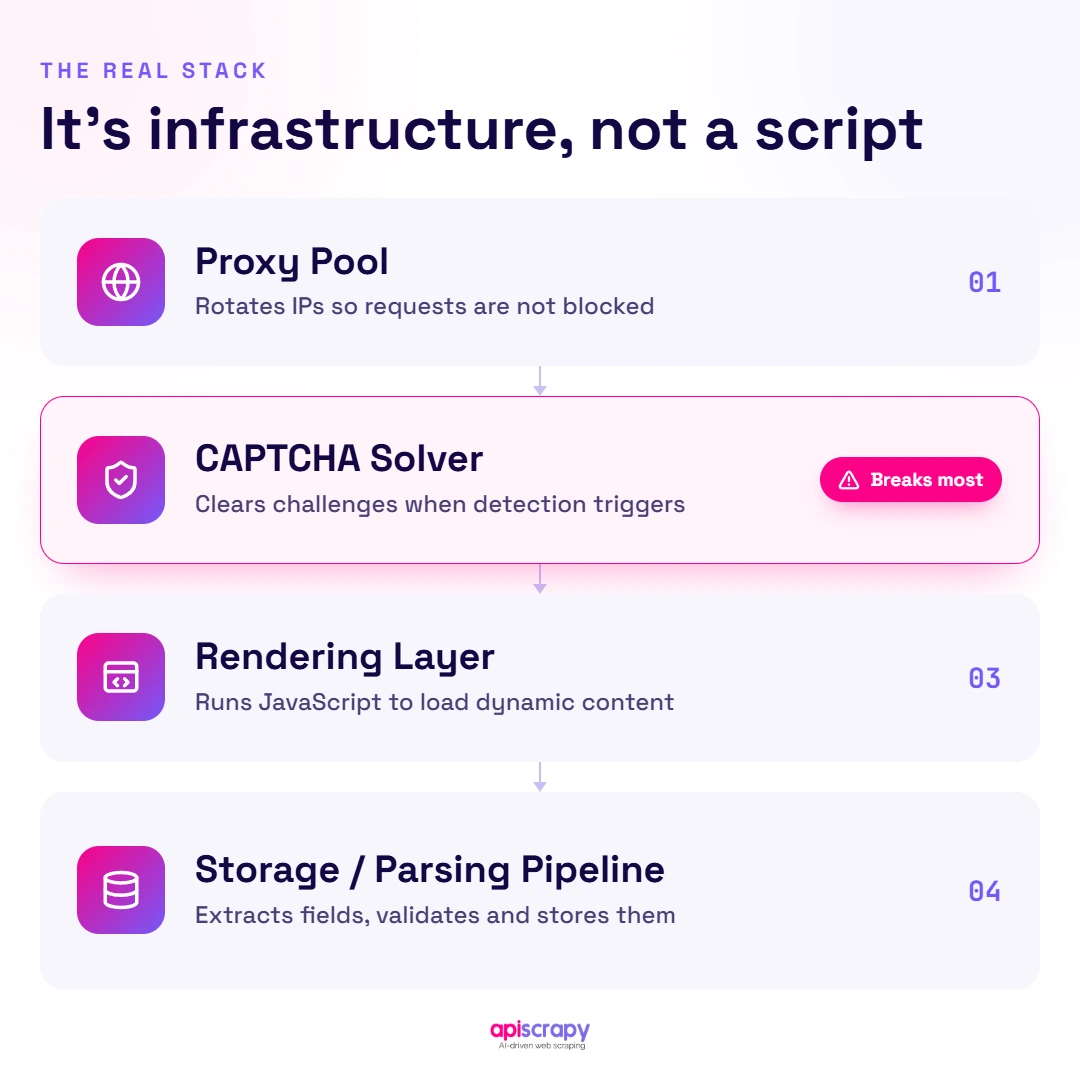
Getting reliable Google SERP data at any volume depends on a few pieces of infrastructure working together, not just a script.
- A pool of rotating residential or datacenter proxies to avoid IP-based blocking
- A CAPTCHA-solving service or fallback strategy for when challenges appear
- A rendering layer capable of executing JavaScript for modern SERP layouts
- A storage and parsing pipeline that can absorb schema changes without breaking
Which Sections of the Google Search Page Can You Scrape?
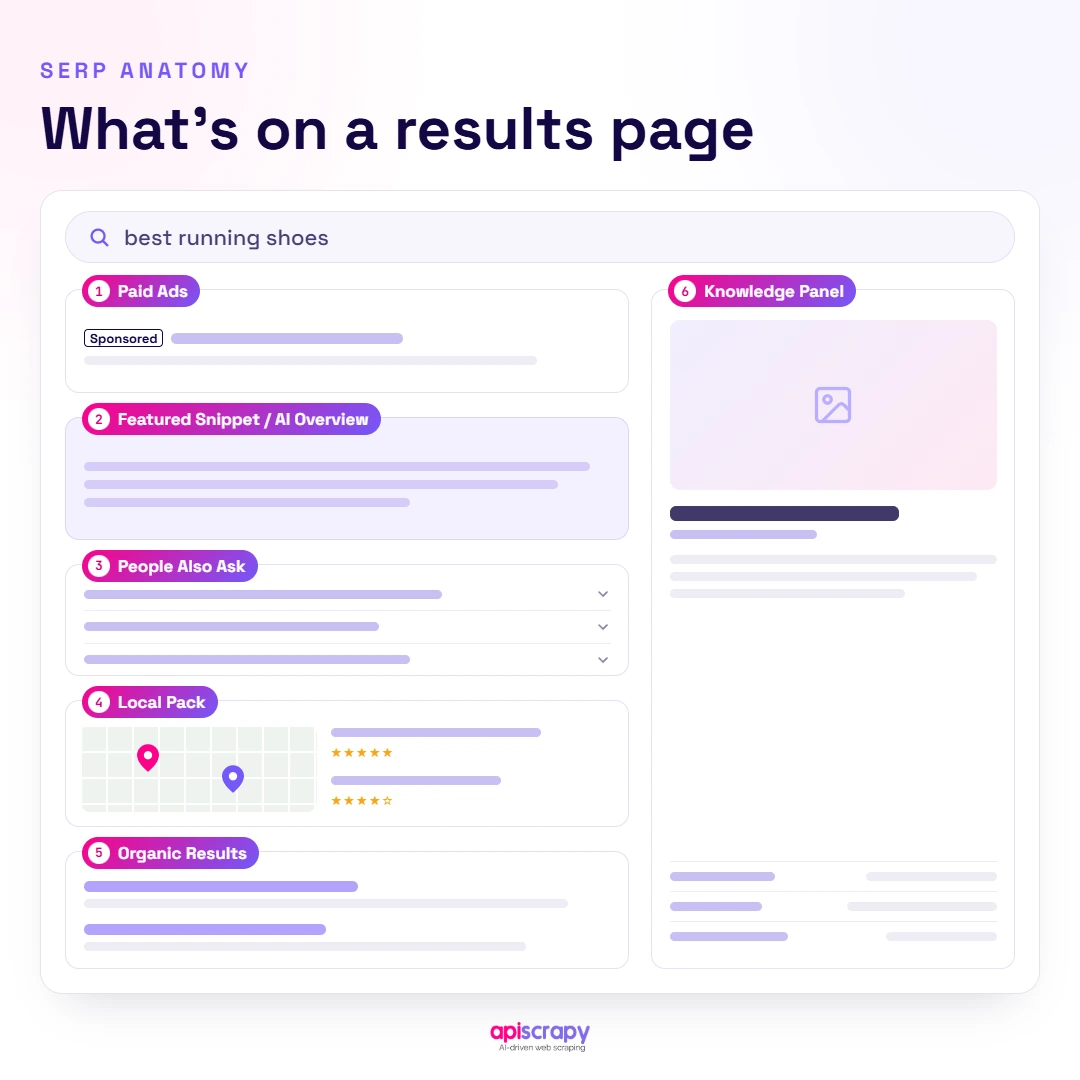
Modern Google results pages are made up of several distinct blocks, and a complete scraper needs to account for each one separately.
- Organic results: standard listings with title, URL, and description
- Featured snippets and AI Overviews: summarized answers pulled from source pages
- People Also Ask: expandable related-question accordions
- Knowledge panels: structured facts about entities like people, places, or brands
- Local pack and Maps results: business listings tied to a geographic query
- Paid ads: sponsored listings that appear above or beside organic results
What Data Can You Actually Extract From a Google SERP?
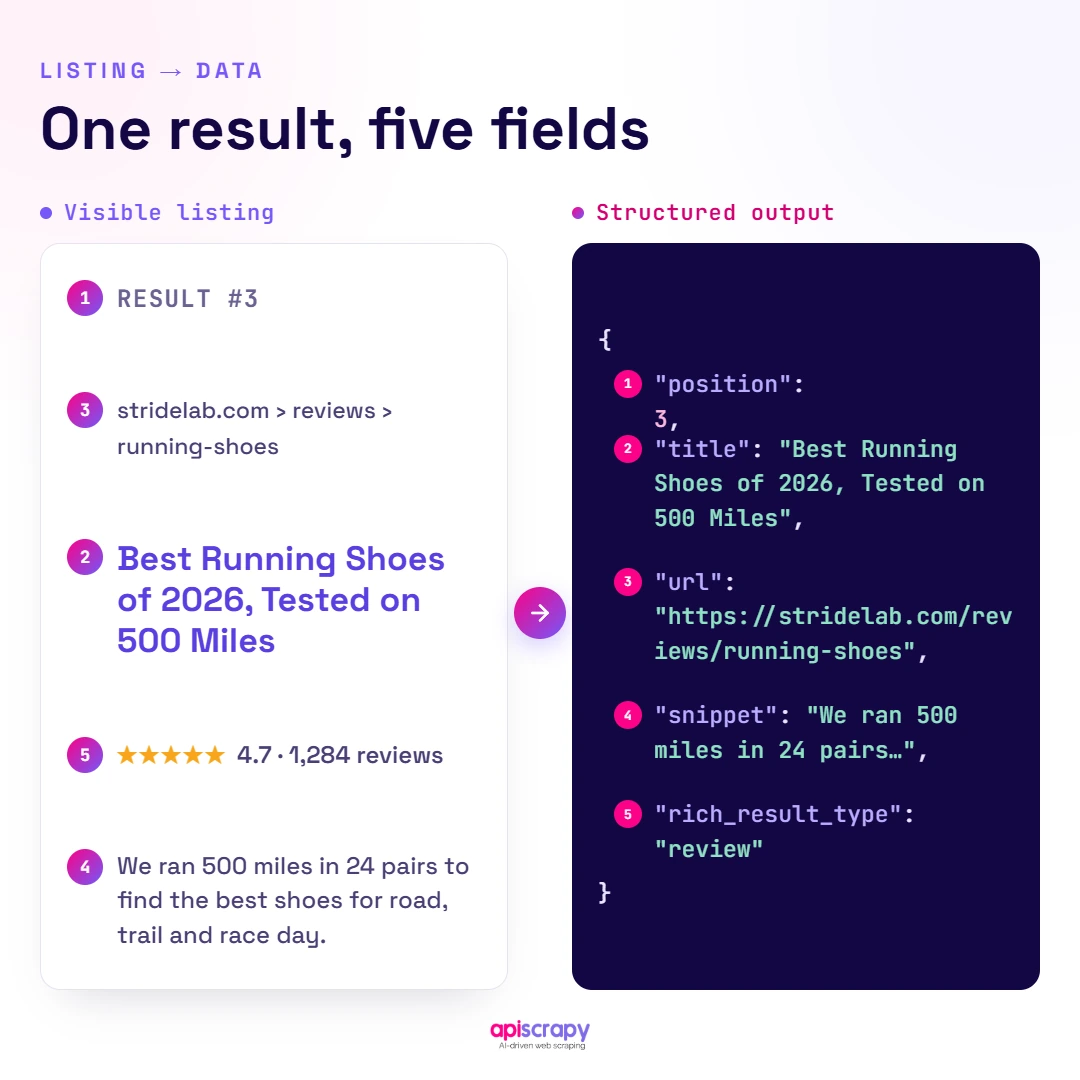
Beyond the visible listing, each result block carries structured fields worth capturing on their own.
- Position, title, and URL for every organic listing on the page
- Meta description or snippet text shown beneath each result
- Rich result type, such as review stars, recipe cards, or FAQ dropdowns
- AI Overview text and its cited source domains, when present
- Ad copy, display URL, and sitelink extensions for paid placements
Bypass Google Search Web Scraping Blocking
Google’s anti-bot systems combine IP reputation checks, behavioral analysis, and CAPTCHA challenges, and they grow more aggressive as request volume rises. Rotating proxies across residential IP pools spreads requests so no single address triggers a rate limit. Randomizing request timing, headers, and user agents helps requests look like distinct human sessions rather than a single automated client.
CAPTCHA challenges still appear even with careful rotation, so most production pipelines route through a solving service or fall back to a managed API when a challenge blocks a request. Managed SERP APIs absorb this entire layer automatically, which is why most teams scraping at real volume move away from raw DIY scrapers once query counts climb past a few thousand per day.
Start Building Your Web Crawler Today
Conclusion
Scraping Google Search results is entirely achievable in 2027, but the method that fits a one-off research task rarely survives at production scale. Dedicated SERP APIs remove the proxy, CAPTCHA, and parsing maintenance that make custom scrapers expensive to run reliably over time. Teams that need clean, structured SERP data without maintaining that infrastructure themselves typically move to a managed service built for exactly this problem.
If your team is ready to stop maintaining scrapers and start working with reliable, structured SERP data, book a demo with APISCRAPY to see how a managed service handles the scale for you.
Frequently Asked Questions About Scraping Google Search Results
How do I scrape Google search results without getting blocked?
Rotate proxies across a residential IP pool and randomize request timing, headers, and user agents so requests do not resemble a single automated client. Route persistent CAPTCHA challenges through a solving service, or use a managed SERP API that already handles blocking behind the scenes.
Is it legal to scrape Google search results?
Google's Terms of Service prohibit automated queries, and rulings like hiQ Labs v. LinkedIn generally protect scraping of public data from federal hacking law claims rather than terms of service claims. Businesses scraping at scale typically use a licensed API or managed service to avoid the civil and operational risk of a direct terms violation.
What is the best way to scrape Google SERPs at scale?
A dedicated SERP API is the most reliable option at scale, since it returns structured JSON and absorbs proxy rotation, CAPTCHA solving, and markup changes on your behalf. Custom scrapers work for small, specific use cases but require ongoing engineering time as Google's page structure evolves.
What is the best free alternative to scraping Google Search directly?
Google's own Custom Search JSON API offers a limited free tier for basic query volume within its documented terms. For anything beyond light, occasional use, a paid SERP API or managed service is usually more reliable than staying within a free tier's query limits.