Web Scraping Challenges in 2026 (And the Solutions That Actually Work)
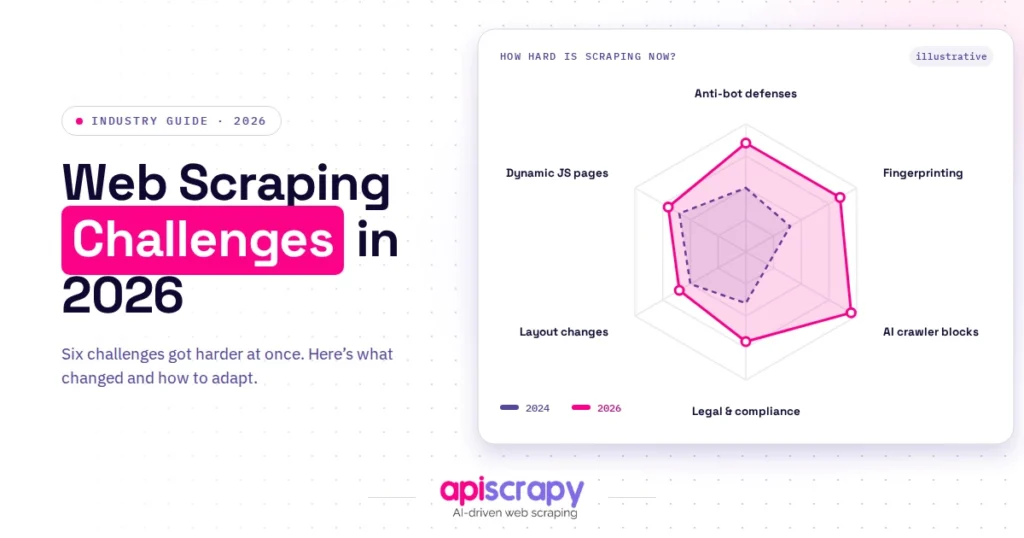
Web scraping used to be a matter of writing a script, pointing it at a page, and pulling the HTML you needed. That approach barely survives contact with the modern web anymore. In 2026, scraping is closer to an ongoing engineering discipline than a one-time task, shaped by AI-polluted content, adaptive anti-bot systems, and websites that redesign themselves without warning.
This guide breaks down the biggest web scraping challenges teams face today and pairs each one with practical, tested solutions. Whether you run scrapers in-house or rely on a managed data extraction service like APISCRAPY, the goal is the same: reliable, compliant, high-quality data at scale.
What Are the Major Web Scraping Challenges?
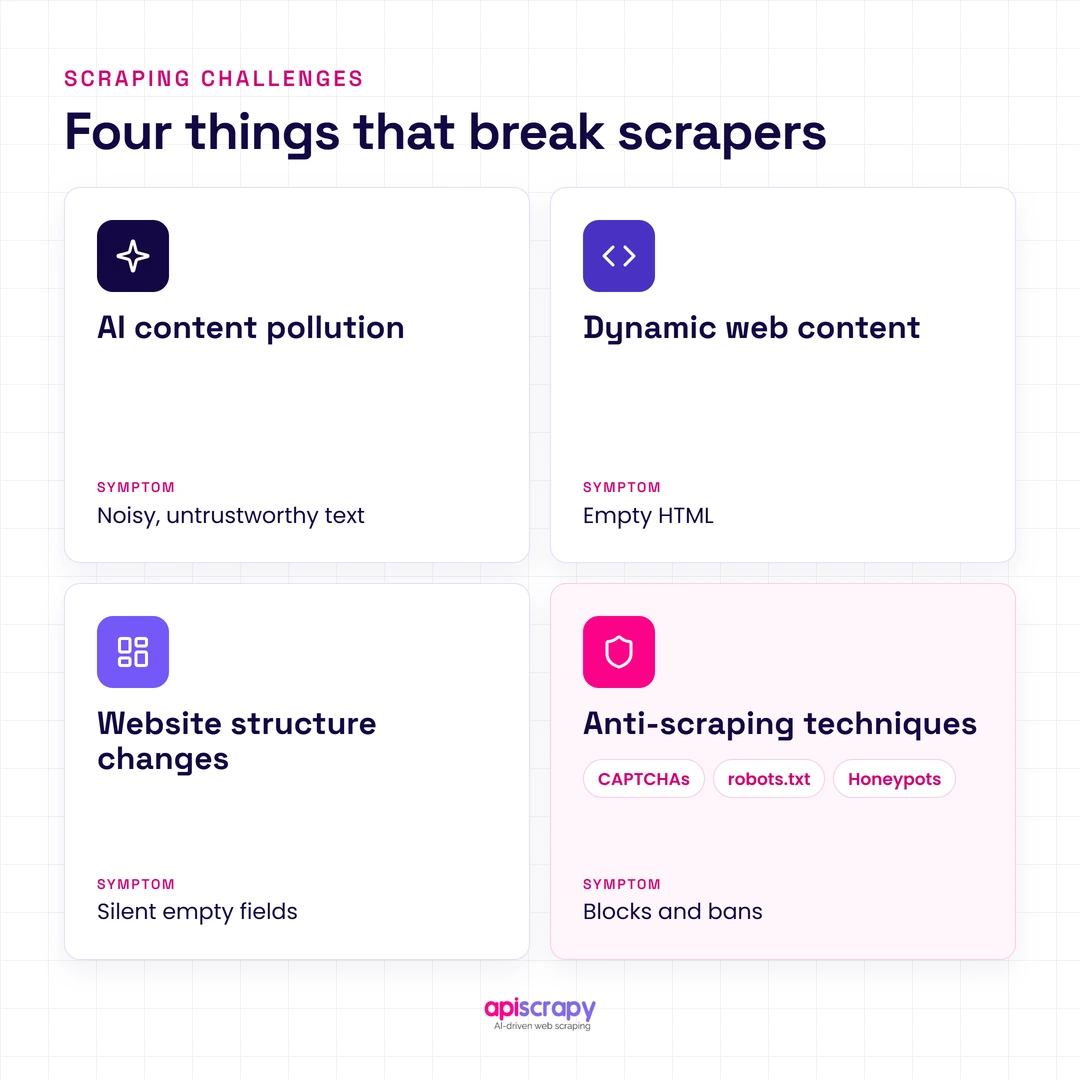
Scraping has gotten harder not because the underlying idea changed, but because the web around it did. Websites now assume incoming traffic could be automated and design accordingly, from layered bot detection to constantly shifting front-end frameworks.
Data teams, growth marketers, and engineering groups running scrapers at any real volume feel this first. A scraper that worked last month can quietly start returning empty or corrupted data with no error message at all.
The challenges generally fall into four buckets: content quality issues introduced by AI, dynamic pages that hide data behind JavaScript, structural changes that break selectors, and anti-scraping defenses built specifically to detect and block bots. Each is covered in detail below, along with the practices that address it.
What Are the Modern Solutions and Practices We Can Use?
The old playbook of static requests and hardcoded selectors is fading fast. Teams are shifting toward adaptive, AI-assisted approaches paired with managed infrastructure that absorbs the operational overhead.
- Headless browser automation that renders pages the way a real visitor’s browser would, capturing JavaScript-driven content.
- Rotating residential proxies and session management to distribute requests and avoid IP-based blocking.
- AI-based parsing that identifies data by context rather than fixed selectors, so minor layout changes do not break extraction.
- Managed data-as-a-service platforms that handle rendering, retries, and compliance so teams focus on the data itself.
- Continuous monitoring and alerting that flags broken scrapers within hours instead of weeks.
- Compliance-first design that checks robots.txt and regional data rules before a single request goes out.
AI-Generated Content Pollution
A growing share of the open web is now written or rewritten by AI, and much of it is repetitive, low-signal, or simply inaccurate. For scraping pipelines built to extract facts, prices, or reviews, this is a genuine data quality problem, not a minor annoyance.
The practical impact shows up as noisy datasets, boilerplate phrasing repeated across unrelated pages, and inconsistent facts pulled from what looks like a single authoritative source. Teams that scrape product descriptions or news content are seeing this most acutely.
Detection is harder than it sounds because AI-written text increasingly mimics natural human tone. Simple keyword or pattern-based filters that worked a year or two ago catch far less than they used to.
As one data engineer put it in a recent industry discussion, the real challenge is no longer finding text online, it is trusting that the text reflects reality once it has been found.
Solution
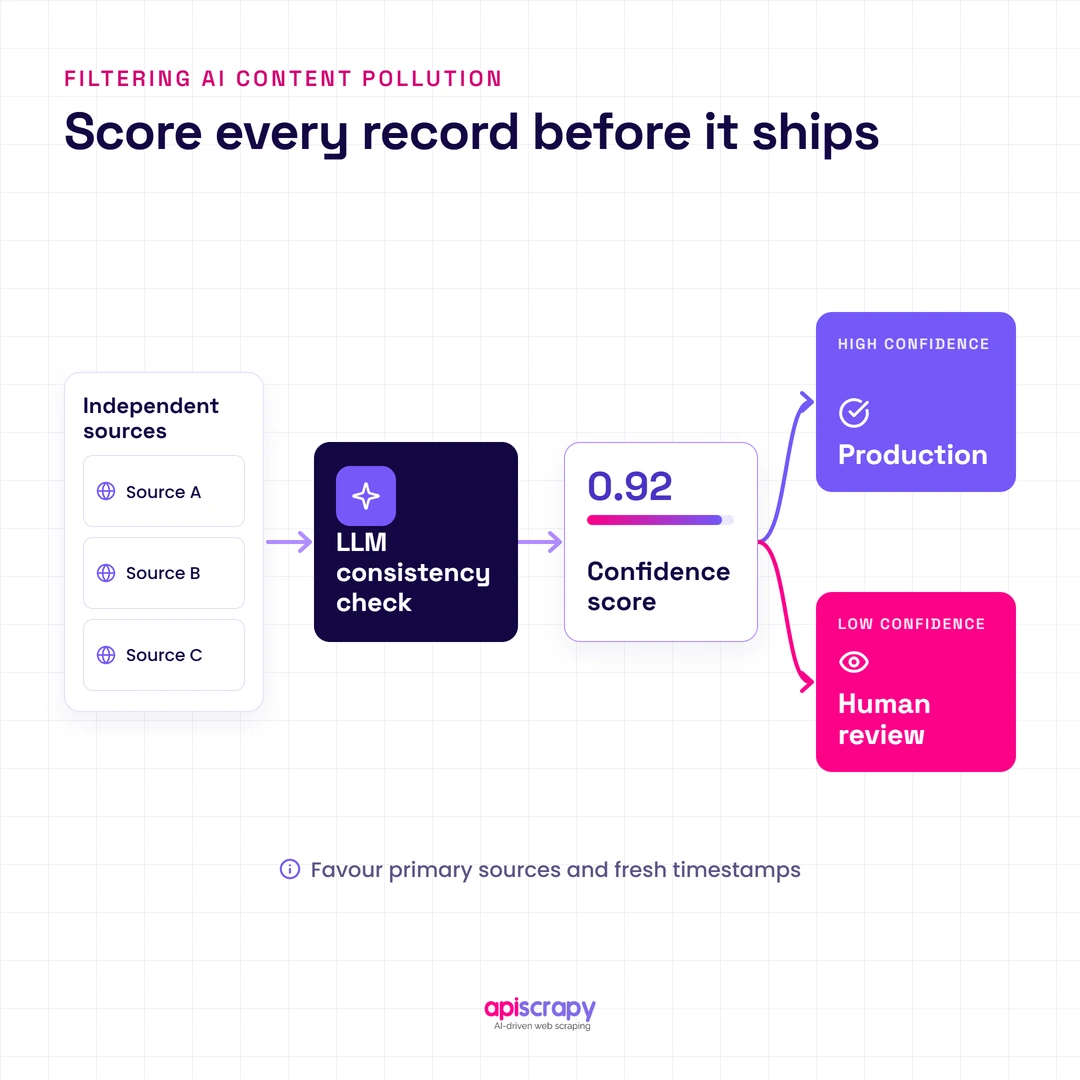
- Cross-reference the same data point across two or three independent sources before treating it as verified.
- Use LLM-based content verification to flag text that reads as templated or internally inconsistent.
- Prioritize primary sources, such as official pricing pages, over aggregator or syndicated content.
- Route low-confidence extractions to human review instead of pushing them straight into production data.
- Weight freshness and timestamp signals so outdated or recycled content carries less influence on results.
Dynamic Web Content
Modern websites render most of their content client-side using JavaScript frameworks, which means the raw HTML a basic scraper requests often arrives nearly empty. Infinite scroll, lazy-loaded images, and content that only appears after a click all compound this.
Traditional parsers that expect complete HTML on the first request simply cannot see this content. Frameworks like React and Vue also generate DOM structures that shift between builds, making fixed extraction logic fragile.
Single-page applications add another layer of unpredictability, since the same URL can display entirely different content depending on prior user interaction within the session.
None of this is free from a resource standpoint either. Rendering pages properly requires more compute per request and slower request cycles than simple HTTP calls ever did.
Solution
- Use headless browser automation such as Playwright or Puppeteer to render pages the way a human visitor’s browser would.
- Wait for network-idle states rather than fixed timers, so content that loads asynchronously is captured reliably.
- Favor API-first extraction where a site exposes underlying data endpoints, since it avoids rendering overhead entirely.
- Build hybrid pipelines that fall back to full rendering only when a lightweight request fails.
- Consider a managed rendering service like APISCRAPY when in-house infrastructure struggles to scale headless browsing.
Website Structure Changes
Sites redesign layouts, rename CSS classes, and restructure their DOM far more often than most scraping teams plan for. None of this is announced in advance, and most of it has nothing to do with blocking scrapers specifically.
Scrapers built on fixed selectors or XPaths break silently the moment a site changes, often returning empty fields instead of a clear error. That silence is exactly what makes this challenge dangerous.
Detection usually lags behind the break itself. Teams often only notice once a downstream report looks wrong or a client flags missing data weeks later.
Solution
- Use AI or machine learning based element detection that identifies data by context instead of hardcoded selectors.
- Run automated schema validation on every scrape to confirm expected fields and data types are present.
- Schedule regular scraper health checks rather than waiting for downstream teams to report problems.
- Apply visual or DOM diffing tools to catch structural changes before they cause silent failures.
- Build fallback selector strategies so a single broken element does not take down the entire extraction.
Anti-Scraping Techniques
Modern anti-bot systems no longer rely on simple IP or user-agent blocking. They combine behavioral analysis, browser fingerprinting, TLS profiling, and machine learning models trained on each protected site’s own traffic patterns.
This creates a real tradeoff for teams collecting public data. Push too aggressively on evasion and you risk IP bans, wasted infrastructure spend, and reputational or legal exposure, so balance matters more than raw persistence.
CAPTCHA Blockers
CAPTCHA and similar systems like reCAPTCHA v3 exist to separate human visitors from automated ones, and they increasingly trigger based on behavioral signals rather than a single suspicious request.
Modern versions assess mouse movement, scroll velocity, and click precision in the background, often blocking silently instead of showing a puzzle at all. Automation that clicks with mathematical precision is an easy flag for these systems.
Solution
- Use human-in-the-loop CAPTCHA-solving services for cases where a challenge cannot be avoided outright.
- Reduce request patterns and timing regularities that tend to trigger behavioral trust scoring in the first place.
- Rotate sessions and browser fingerprints instead of reusing the same identity across many requests.
- Rely on a managed scraping service with built-in CAPTCHA handling rather than building this in-house from scratch.
Robots.txt
Robots.txt is a voluntary directive that tells crawlers which parts of a site the owner would prefer not be accessed. It is not a technical barrier, but ignoring it carries real ethical and legal weight.
Regulators and courts increasingly treat robots.txt compliance as a baseline expectation, not an optional courtesy. Since mid-2025, major infrastructure providers have also started blocking non-compliant AI and scraping traffic by default at the network level.
Rules vary widely from one site to another and change without notice, which means compliance cannot be a one-time check performed at project kickoff.
Solution
- Parse and respect robots.txt automatically before every crawl rather than relying on manual review.
- Treat disallow directives as a default block unless there is a documented, legitimate exception.
- Maintain an audit log of compliance checks for each domain scraped, useful for both internal review and client transparency.
- Build in manual review for ambiguous cases, such as mixed permissions across subdomains.
Honeypot Traps
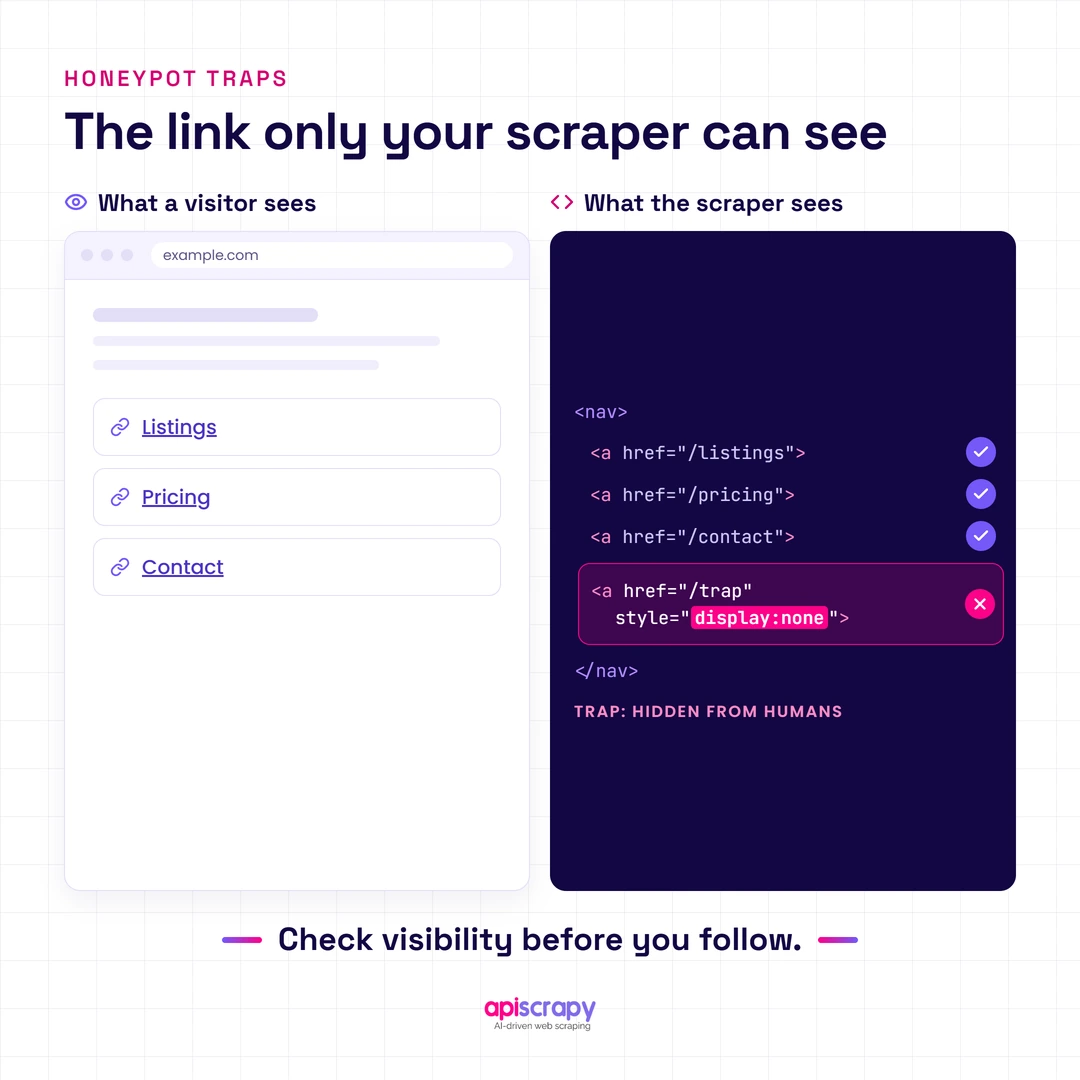
Honeypot traps are hidden links or form fields that are invisible to a human visitor but present in the raw HTML, designed specifically to catch scrapers that follow every link they find.
Triggering one often leads to an instant IP ban or, in some cases, deliberately poisoned data meant to corrupt whatever the scraper collects next.
Practitioners who have dealt with crawl logs at scale describe honeypots as one of the more frustrating failures to diagnose, since the scraper appears to be working right up until the data quietly turns unreliable.
Solution
- Check CSS visibility properties before following any link, since honeypot elements are typically hidden via display or opacity rules.
- Avoid blind link-following and instead work from a curated, pre-validated set of crawl paths.
- Monitor for abnormal response patterns, such as unusually uniform content, that suggest a trap has been triggered.
Start Building Your Web Crawler Today
Conclusion
Web scraping in 2026 rewards teams that treat it as an adaptive, ongoing discipline rather than a static script written once and left alone. AI-driven content, evolving anti-bot defenses, and constant structural change all point in the same direction.
No single fix solves every challenge covered here. Resilience comes from combining validation, modern rendering, compliance checks, and monitoring into one pipeline rather than treating each as a separate afterthought.
The landscape will keep shifting as both websites and AI systems evolve further. Teams that build flexibility into their approach now will spend far less time firefighting later.
If maintaining this in-house is pulling your team away from actually using the data, book a demo with APISCRAPY that handles the extraction layer as a managed service, so you can focus on what the data tells you instead of how to get it.
Frequently Asked Questions About Web Scraping Challenges
What are the biggest challenges in web scraping today?
The biggest challenges are AI-generated content pollution, JavaScript-heavy dynamic pages, and adaptive anti-bot systems that combine behavioral analysis with browser fingerprinting.
Website structure changes and honeypot traps add further risk, since both can break a scraper silently without any visible error message.
How can I scrape modern, JavaScript-heavy websites reliably?
Use headless browser automation such as Playwright or Puppeteer, and wait for network-idle states instead of fixed timers so asynchronous content loads fully.
Where possible, favor API-first extraction over full rendering, and fall back to a managed rendering service when in-house infrastructure cannot scale.
How can I prevent my web scraper from being blocked by anti-bot systems?
Rotate residential proxies and browser fingerprints, mimic natural interaction patterns, and avoid timing regularities that trigger behavioral trust scoring.
Pairing these practices with a managed scraping service that handles CAPTCHA and session identity reduces block rates significantly compared to a fully in-house setup.
How can I scale web scraping without compromising speed, reliability, or data quality?
Combine cloud-managed browser infrastructure with automated schema validation and scheduled scraper health checks, so breaks are caught within hours instead of weeks.
Cross-referencing data across multiple sources also protects quality as volume increases, catching AI-polluted or outdated content before it reaches production.
Is web scraping legal, and what privacy and compliance requirements should I consider?
Scraping publicly available data is generally lawful, but compliance depends on respecting robots.txt, regional privacy regulations, and any terms specific to the site.
Ignoring robots.txt or scraping personal data without a legal basis carries real regulatory risk, so building compliance checks into the pipeline is essential rather than optional.