How to Build a Web Scraper (Architecture Guide)
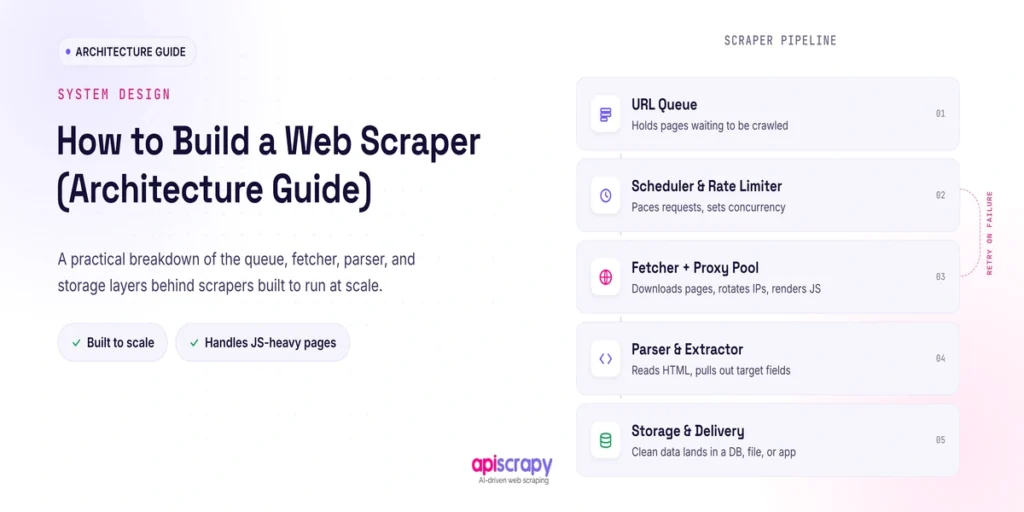
Every scraper starts the same way. One script, one quiet afternoon, a few hundred pages, and that small thrill when clean data finally fills your terminal. If you’ve ever searched for how to build a web scraper, you know the feeling.
This guide walks through the five layers that make a scraper production-ready, the technologies commonly used at each layer, and the checks that separate a fragile prototype from a system that runs reliably for months.
- Architecture beats scripting at scale: a single script works for a few hundred pages, but volume, anti-bot defenses, and multi-site targets demand a proper five-layer system: orchestration, compute, evasion, extraction, and storage.
- Define scale before building: volume/concurrency, target complexity (static vs. JS-rendered vs. API-backed), and freshness requirements should shape every architecture decision upfront, not get retrofitted later.
- Resilience matters most for extraction: selector drift alerts, schema validation, and AI-assisted fallback extraction protect against the frequent layout changes common on job boards.
- Production-readiness hinges on three checks: robots.txt compliance, circuit breakers, and hidden API discovery separate a working prototype from a system that survives real traffic.
- Maintenance is ongoing, not one-time: proxy pools degrade, selectors drift, and compliance rules shift, so daily selector monitoring and monthly audits keep the system healthy over months.
What Is the First Step in Architecting a Web Scraping Solution?
The first step is defining scale, target complexity, and data freshness before choosing any component. A scraper built for 500 pages a day looks nothing like one built for five million, and the wrong starting assumption forces a rebuild later.
Three planning questions shape every downstream decision:
- Volume and concurrency: How many pages or listings need to be pulled per hour, and how many can run in parallel without triggering blocks?
- Target complexity: Are the sites static HTML, JavaScript-rendered, or backed by an internal API that can be called directly?
- Freshness requirement: Does the use case need real-time updates, such as job listings that change hourly, or is a daily batch enough?
A job listing aggregator pulling from ten career sites, for example, needs different infrastructure than a single-site price monitor. The aggregator has to normalize inconsistent formats across sources, handle ten different anti-bot postures at once, and deduplicate listings that appear on multiple boards.
Once scale, complexity, and freshness are defined, the rest of the architecture follows layer by layer.
What Does Each Layer of the Architecture Do?
A production scraper has five layers: orchestration, compute, proxy and evasion, extraction, and storage. Each layer solves one specific failure mode, and skipping any single layer is the most common reason scrapers break once they hit real traffic.
Think of these layers as a pipeline. A job enters through orchestration, gets executed by a worker, passes through evasion controls to avoid detection, gets parsed into structured data, and lands in storage ready for use.
Orchestration and Queue Management (The Control Plane)
This layer schedules jobs, manages the URL queue, and coordinates retries across workers. It is the control plane that decides what gets scraped next and how failures get handled.
- Job scheduling: Systems like Celery, RabbitMQ, or Kafka assign URLs to available workers and prioritize high-value targets, such as job pages that update most frequently.
- Deduplication logic: Prevents the same job listing or page from being re-crawled when it appears across multiple source sites.
- Retry and backoff policies: Automatically re-queue failed requests with increasing delays rather than hammering a site that just blocked a request.
- Horizontal scaling: Adds more workers as queue depth grows, without redesigning the scheduling logic itself.
For a multi-site job scraper specifically, orchestration also needs to track which source each listing came from, since job boards often list the same posting with slightly different formatting or salary ranges.
Worker Engine (The Compute Plane)
Workers execute requests and render pages when needed. This is where the actual scraping happens, and the choice of worker type has the biggest impact on cost and speed.
- Headless browsers: Tools such as Playwright render JavaScript-heavy pages, which is essential for job boards that load listings dynamically after the initial page load.
- Lightweight HTTP clients: Faster and cheaper for static pages or sites with accessible internal APIs, avoiding the overhead of a full browser.
- Resource limits: Memory and concurrency caps per worker prevent one heavy page from starving the rest of the pool.
- Auto-scaling: Worker count adjusts automatically based on queue depth, keeping infrastructure cost proportional to actual load.
Most job scraping systems end up running a mix of both worker types, since some boards serve listings as static HTML while others require full rendering.
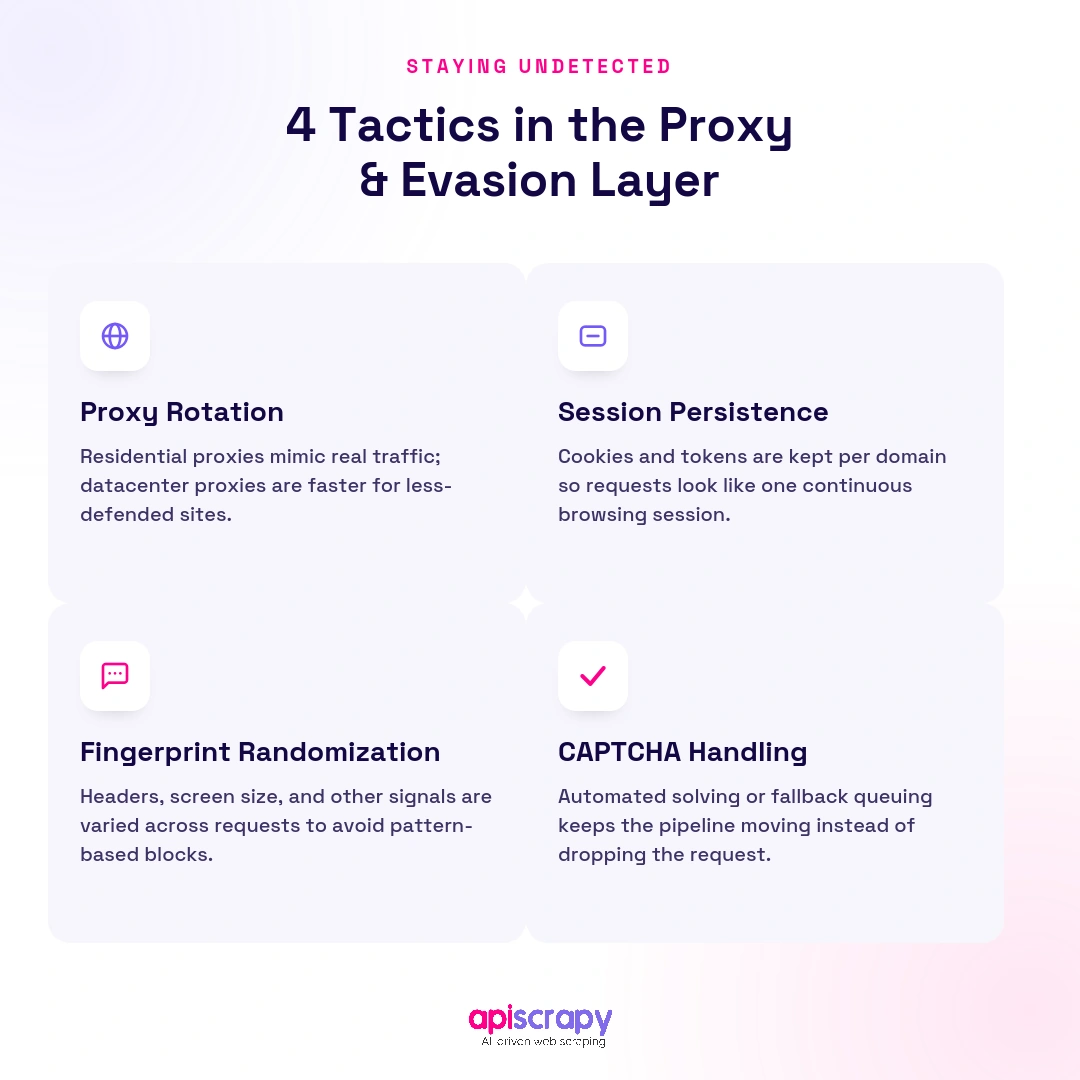
Proxy and Anti-Bot Evasion Layer
This layer rotates IPs, manages sessions, and mimics human browsing patterns to avoid detection. Job boards in particular have invested heavily in bot detection, since scraping is common in this space.
- Proxy rotation: Residential proxies mimic real user traffic and work well against aggressive detection, while datacenter proxies are faster and cheaper for less-defended sites.
- Session persistence: Cookies and session tokens are maintained per target domain so requests look like a continuous browsing session rather than isolated hits.
- Fingerprint randomization: Browser headers, screen size, and other fingerprint signals are varied across requests to avoid pattern-based blocks.
- CAPTCHA handling: Automated solving or fallback queuing keeps the pipeline moving when a CAPTCHA appears rather than dropping the request entirely.
This layer is usually the most expensive and the most frequently updated, since anti-bot techniques on the target side change often.
Data Extraction and Resilience Layer
Raw HTML becomes structured data at this layer, using selectors, parsers, or AI-assisted extraction. This is also where the system detects and adapts to layout changes without the entire pipeline breaking.
- Selector-based parsing: CSS or XPath selectors extract specific fields like job title, salary, and location from known page structures.
- AI-assisted extraction: Useful when target sites change layout frequently or when scraping across many different site templates at once, as is common with job boards.
- Schema validation: Every extracted record is checked against an expected schema before it moves downstream, catching malformed or partial data immediately.
- Selector drift alerts: Automatic notifications fire when a selector stops matching expected content, flagging a layout change before it causes silent data loss.
For job listings specifically, resilience matters more than almost any other use case, since career sites redesign their listing pages more often than most e-commerce or news sites.
Storage Pipeline
Extracted data moves into storage through a defined pipeline covering raw retention, transformation, and delivery.
-
- Raw data lake: Stores unprocessed HTML or JSON for auditing and reprocessing if extraction logic changes later.
- Structured storage: Databases or data warehouses hold query-ready, normalized records, such as deduplicated job listings with consistent field names.
- Delivery formats: JSON, CSV, or webhook delivery push finished data directly into a client’s applicant tracking system or internal dashboard.
What Technologies Are Needed to Build a Reliable Job Scraping System?
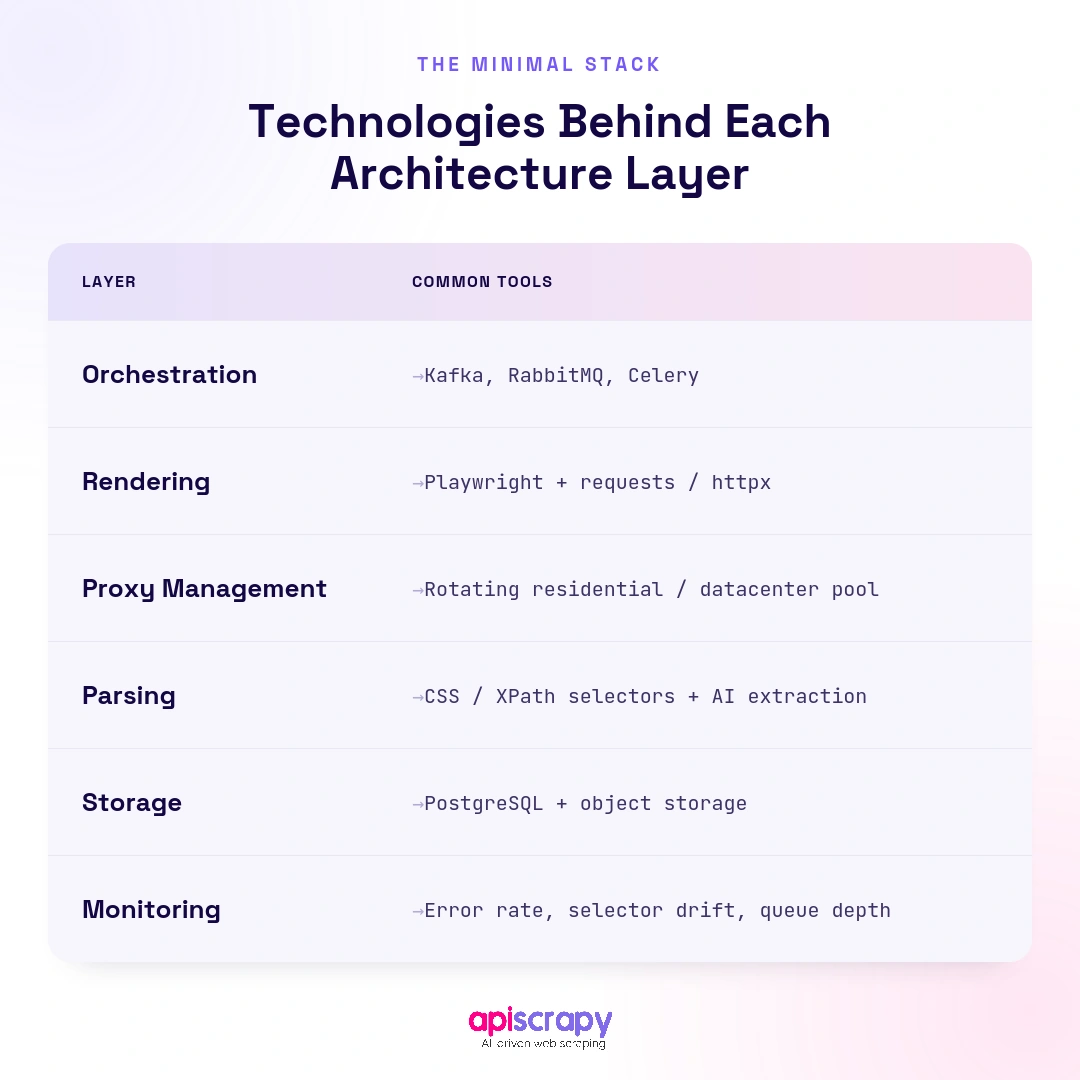
A reliable job scraping system generally combines a small, well-tested set of technologies rather than a large stack of point solutions.
- Queue and orchestration: Kafka or RabbitMQ for job scheduling, paired with a scheduler like Celery or a custom worker pool.
- Rendering: Playwright for JavaScript-heavy job boards, with a lightweight HTTP client such as requests or httpx for static pages.
- Proxy management: A rotating residential or datacenter proxy pool, often managed through a dedicated proxy provider rather than built in-house.
- Parsing: CSS or XPath selectors for known templates, supplemented by AI-assisted extraction for less predictable or frequently changing page layouts.
- Storage: A relational database such as PostgreSQL for structured records, paired with object storage for raw HTML archives.
- Monitoring: Alerting on error rates, selector drift, and queue depth, since job scraping systems fail quietly far more often than they fail loudly.
Teams building this in-house typically spend more time on the proxy and resilience layers than on the actual parsing logic, since job boards actively defend against automated access.
How to Handle Dynamic Websites and Changing Job Page Structures?
Job boards change layouts more frequently than most other website categories, since they run frequent design and conversion experiments. Handling this reliably requires a few specific practices.
- Resilient selectors: Target stable attributes like data-testid or semantic HTML roles instead of brittle class names that change with every redesign.
- Layout-change detection: Automated alerts should fire the moment a selector’s match rate drops, rather than waiting for a human to notice missing data.
- Fallback extraction: AI-assisted extraction can step in when selectors fail, using the page’s visible text and structure to identify fields like title and salary even after a redesign.
- Scheduled audits: A recurring manual or automated check against each source site catches slow, incremental layout drift that alerts alone might miss.
Sites that render listings through client-side JavaScript also need periodic checks to confirm the rendering approach itself hasn’t changed, since some boards shift between server-rendered and client-rendered pages during redesigns.
What Should You Consider Before Running in Production?
Three checks separate a working prototype from a production-safe scraper, and skipping any of them tends to surface as an outage rather than a warning.
Robots.txt and Rate Limiting
Every crawl should parse robots.txt automatically before hitting a domain, respecting any disallowed paths the site defines. Rate limiting should adapt to the target site’s response times rather than running at a fixed, arbitrary speed.
Circuit Breakers
A circuit breaker pauses a crawl automatically when error rates or block signals spike past a defined threshold. Rather than continuing to hammer a site that has started blocking requests, the system should back off and resume gradually after a cooldown period.
Hidden API Discovery
Many job boards load listings through an internal API that is faster and more stable to call directly than scraping rendered HTML. Inspecting network requests in a browser’s developer tools often reveals these endpoints. The tradeoff is that undocumented APIs can change without notice.
How to Build a Scalable Web Scraper Architecture?

Scalability comes from making each of the five layers independently scalable rather than tying them together into one monolithic script.
- Decouple orchestration from execution: Workers should scale up or down based on queue depth without any change to the scheduling logic itself.
- Separate proxy management from parsing: A dedicated evasion layer means proxy strategy can be updated without touching extraction code.
- Design for horizontal worker scaling: Stateless workers that pull jobs from a shared queue can scale from ten to a thousand without architectural changes.
- Plan storage for growth: Partitioned or sharded storage prevents a single database instance from becoming a bottleneck as data volume grows.
- Build monitoring in from day one: Queue depth, error rates, and selector health should be visible before scale becomes a problem, not after.
A scraper architected this way can grow from a single job board to fifty without a redesign, since each layer absorbs additional load independently.
How to Scale and Maintain a Web Scraping System in Production?
Maintenance is a different problem from initial scale, since it’s about keeping a running system healthy over months rather than handling a traffic spike.
- Auto-scale workers against queue depth: Infrastructure cost should track actual load rather than running fixed capacity around the clock.
- Monitor selector health continuously: Job page redesigns are frequent enough that selector drift alerts need to run daily, not weekly.
- Rotate and refresh proxies regularly: Proxy pools degrade over time as IPs get flagged, so refreshing the pool is an ongoing task, not a one-time setup.
- Review compliance posture periodically: Robots.txt rules and site terms can change, so a recurring review keeps the system aligned with each target site’s current policies.
- Schedule regular audits: A monthly review of extraction accuracy, error rates, and proxy performance catches slow degradation before it becomes a production incident.
What Factors Are Considered When Architecting a Web Scraping Solution?
Architecture decisions come down to scale, target complexity, freshness needs, build-versus-buy tradeoffs, and compliance. Each of these factors maps directly back to one of the five layers covered earlier, since every layer exists to answer one specific factor.
Developers discussing this exact challenge on Reddit’s r/vibecoding community describe how quickly a simple script turns into a maintenance burden once anti-bot defenses and layout changes enter the picture. That thread is worth reading for anyone starting with little scraping experience, since it captures the gap between a working demo and a system that survives contact with a real target site.
Start Building Your Web Crawler Today
Conclusion
Building a reliable scraper, especially one pulling job listings from multiple sources, means layering orchestration, compute, evasion, extraction, and storage correctly rather than writing a script that happens to work once. Most production failures trace back to skipped checks like robots.txt compliance, circuit breakers, or selector monitoring, not broken scraping logic itself.
Teams that prefer not to build and maintain this stack in-house can rely on a managed service like APISCRAPY instead, which handles the orchestration, evasion, and resilience layers so internal teams can focus on using the data rather than maintaining the pipeline.
Book a demo to see this architecture running on real job board data.
Frequently Asked Questions
How to build a web scraper for job listings from multiple websites?
Use a modular scraper with site-specific parsers, a shared queue, and a normalized data schema so listings from different job boards map to one consistent structure.
How to build a scalable web scraper architecture?
Layer orchestration, distributed workers, proxy rotation, resilient extraction, and structured storage so each component scales independently as volume grows.
What technologies are needed to build a reliable job scraping system?
A reliable system needs a job queue such as Kafka, headless browsers like Playwright, rotating proxies, a validation-backed parsing layer, and a database or warehouse for storage.
How to handle dynamic websites and changing job page structures?
Use resilient selectors, automated layout-change alerts, and periodic selector audits, backed by AI-assisted extraction as a fallback when structures shift.
How to scale and maintain a web scraping system in production?
Scale by auto-scaling workers against queue depth, catching failures with circuit breakers, and scheduling regular audits of proxies, selectors, and compliance rules.