Web Scraping Best Practices in 2027
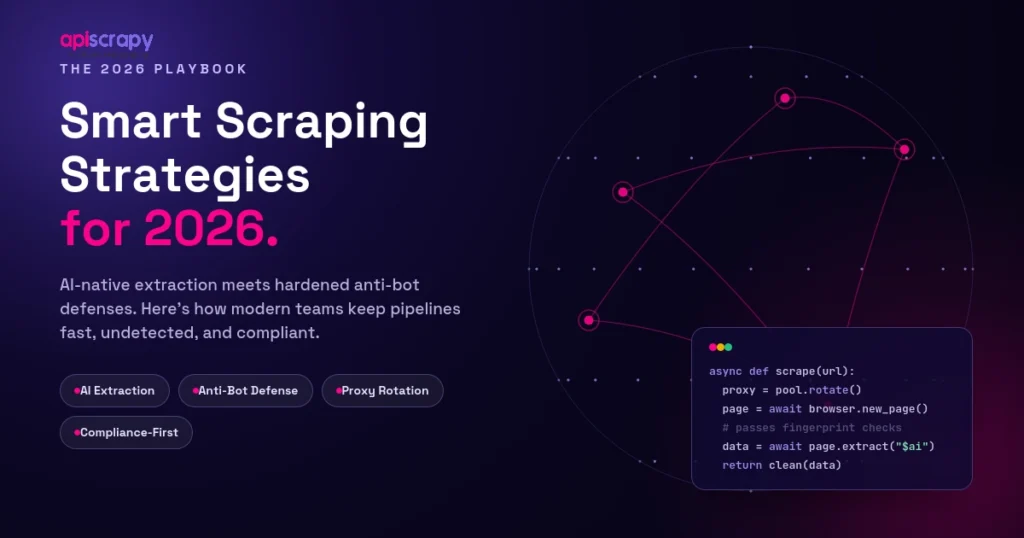
This guide breaks down the operational practices, challenges, and technology shifts every scraping team should understand right now.
- Anti-bot systems are now the biggest scale barrier: IP reputation checks, TLS/browser fingerprinting, and behavioral scoring have made blocks harder to avoid than ever, ahead of infrastructure cost or data volume challenges.
- Consistency beats brute force against blocks: keeping TLS handshake, headers, and fingerprint aligned within a session, plus randomized timing, prevents flags more reliably than simply rotating proxies.
- Data quality degrades silently: scrapers can keep running while returning empty or malformed fields after a site redesign, so schema validation and continuous monitoring are non-negotiable.
- Scraping has become infrastructure, not a script: scheduling, retry logic, and monitoring are now core architecture components, with the industry trending toward fully managed extraction layers.
- Responsible practices protect long-term access: respecting robots.txt, rate limits, and data minimization isn’t just compliance, it’s what keeps sites from escalating against you and cutting off access entirely.
This guide draws on:
- Conversations with data engineering teams running production scraping pipelines
- Analysis of practitioner reviews and forum discussions on scraping reliability
- Hands-on testing of extraction workflows against real, actively defended websites
APISCRAPY, a managed web data extraction service, is referenced in this guide where relevant. The perspective here stays practical and vendor-neutral.
The goal is simple: help your team scrape reliably, responsibly, and at scale, whichever approach or service you ultimately choose.
What Are the Best Operational Practices for Web Scraping?
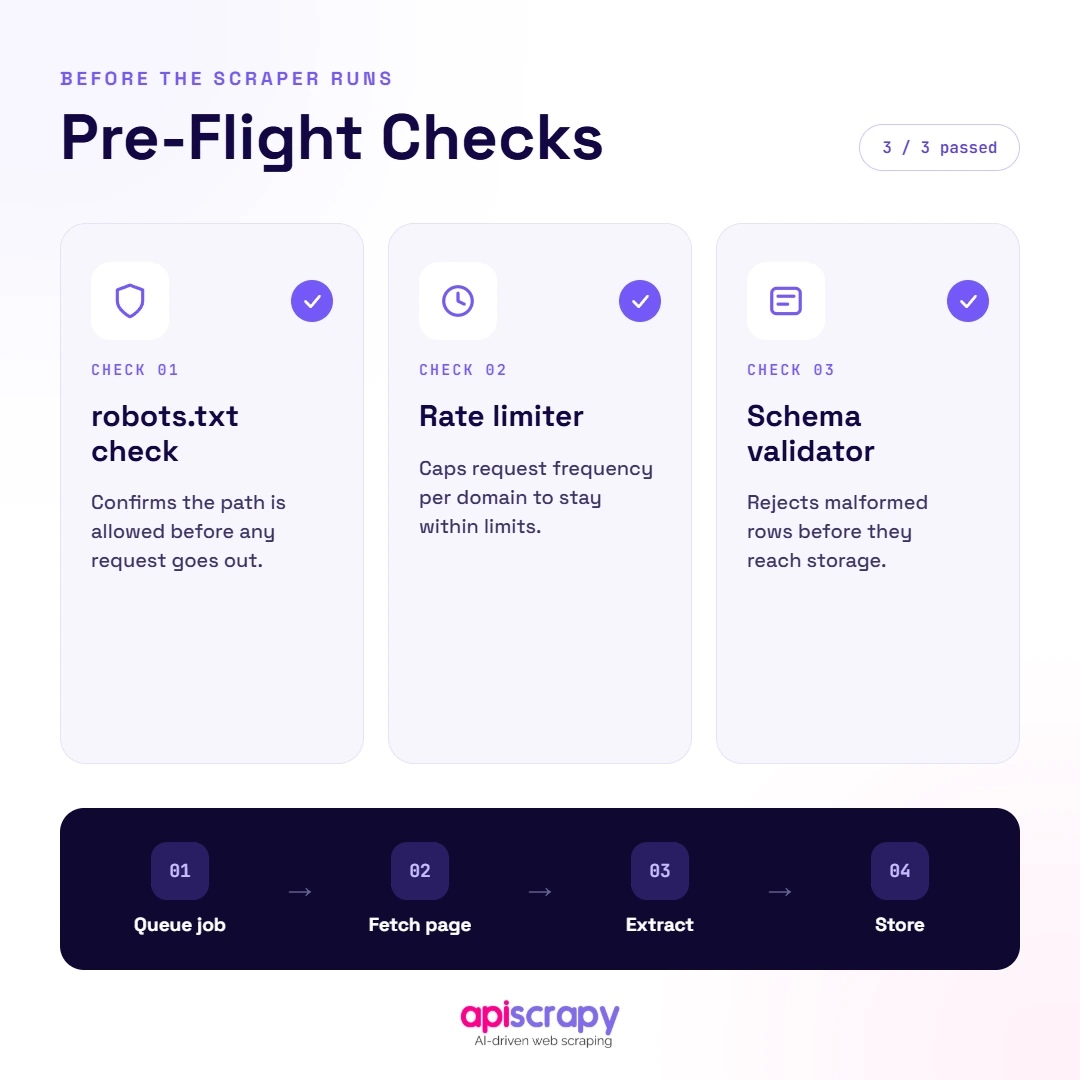
- Check robots.txt and terms of service before building any scraper, and document what each site permits for your records.
- Set conservative rate limits, generally no more than one request per second per domain, to avoid overloading target servers.
- Use a real, identifiable User-Agent string with contact information rather than spoofing a browser with no way to reach you.
- Cache responses and scrape incrementally, pulling only new or changed records instead of re-collecting entire sites on every run.
- Validate extracted data against expected schemas immediately, so a broken selector shows up as a failed test, not silent bad data.
- Log every request outcome, including status codes and response times, to catch blocking patterns before they become full outages.
What Are the Main Challenges of Scraping Websites at Scale?
Scraping a handful of pages is simple, but teams quickly hit new problems once they scale to thousands of pages across many target domains.
Infrastructure costs rise fast, since reliable scraping at volume needs proxy pools, rendering capacity for JavaScript-heavy pages, and storage for growing datasets.
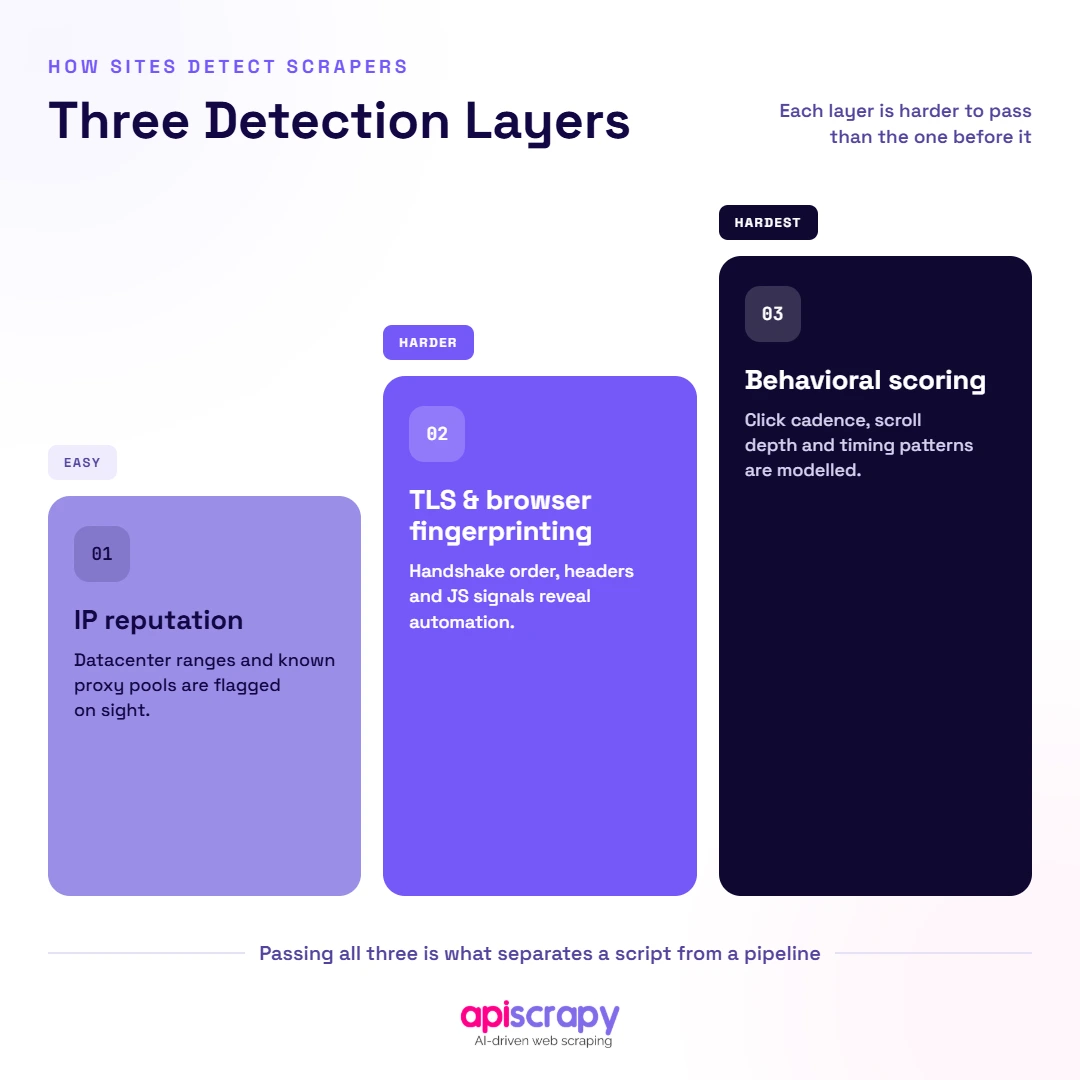
Anti-bot systems have become the biggest scale barrier, layering IP reputation checks, TLS and browser fingerprinting, and behavioral scoring that flags anything that does not move like a real visitor.
Data quality also degrades quietly, since sites redesign layouts often, and a scraper can keep running while silently returning empty or malformed fields.
Developers who scrape at scale often describe the same pattern on technical forums: a scraper works cleanly in testing, then starts failing within days once it hits real production traffic and defenses.
How Is Web Scraping Technology and Architecture Evolving?
Scraping has shifted from single scripts toward managed, orchestrated systems built to survive constant changes on the target side.
Headless browser automation has matured considerably, with tools now handling JavaScript-heavy, dynamically loaded pages that static HTML parsers cannot read.
AI-assisted parsing is increasingly used to structure messy or inconsistent page layouts, reducing the manual work of rewriting selectors after every site redesign.
Scheduling, monitoring, and retry logic have become core architecture components, not afterthoughts, as teams treat scraping as ongoing infrastructure rather than a one-time script.
The direction for the rest of 2026 points toward fully managed extraction layers that absorb anti-bot complexity so teams can focus on the data itself.
How Can You Prevent Getting Blocked While Web Scraping with APISCRAPY?
Overview
Getting blocked usually comes down to rate-based triggers, fingerprint mismatches, or behavioral signals that mark a request as automated rather than human.
APISCRAPY, as a managed extraction service, is built to absorb this complexity for teams that need reliable data without maintaining anti-bot infrastructure themselves.
Key Practices
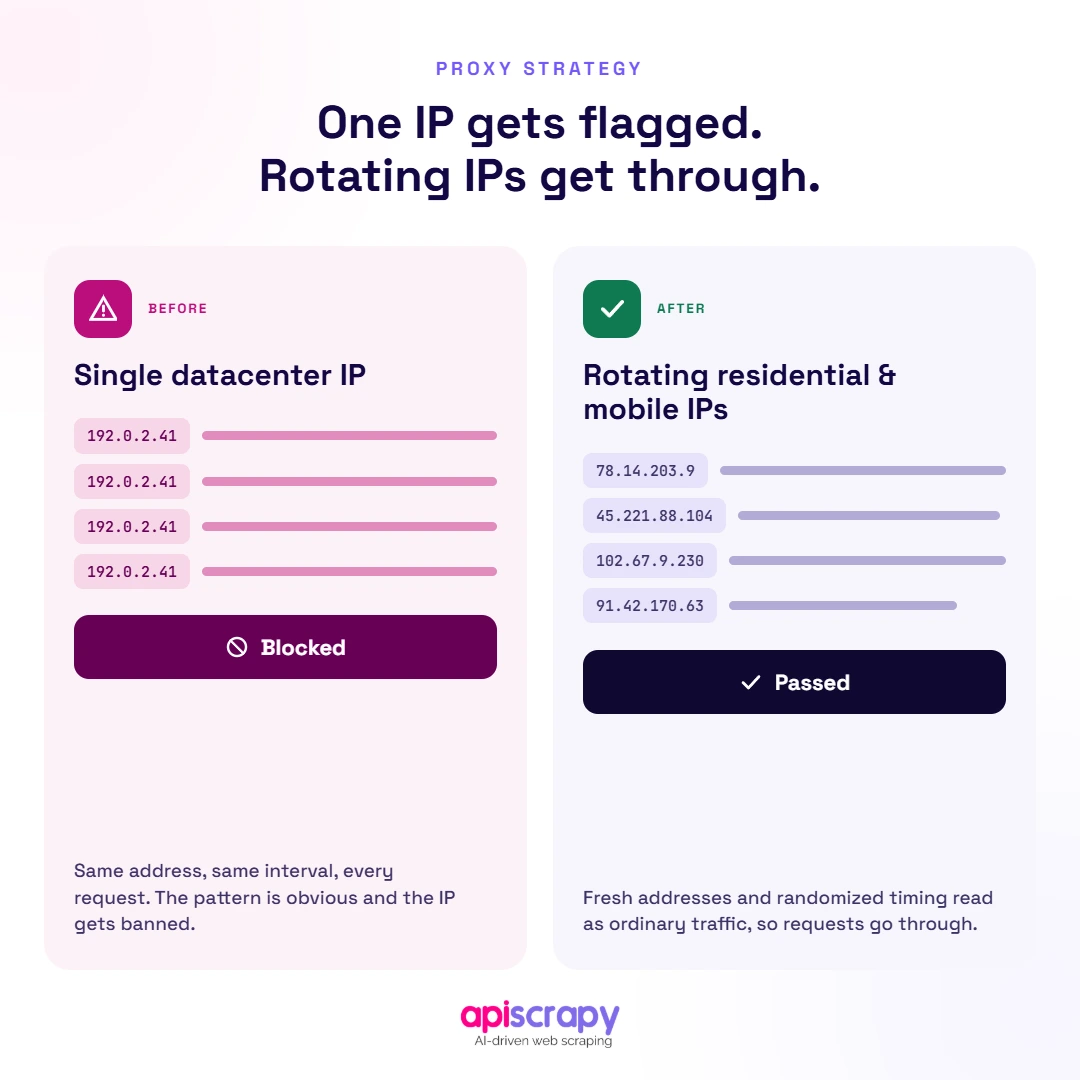
- Rotate through residential and mobile IP pools rather than a single datacenter address, since concentrated traffic from one IP is the fastest way to get flagged.
- Keep TLS handshake, HTTP headers, and browser fingerprint consistent within a session, since mismatched signals are exactly what modern detection systems correlate.
- Maintain session persistence on a single proxy identity for the duration of a browsing session instead of rotating mid-session.
- Randomize request timing and navigation patterns so traffic does not follow the fixed intervals typical of unmanaged scripts.
- Monitor response codes continuously, since a rising rate of 403 or 429 responses is an early warning sign of an approaching block.
Practitioner Note
Developers discussing anti-bot workarounds in technical communities frequently note that mixing request timing and avoiding predictable patterns matters as much as the proxy quality behind it.
Why It Matters
- Fewer blocks mean higher uptime and more complete datasets, which directly improves the reliability of any downstream analysis.
- Avoiding repeated block-and-retry cycles reduces wasted compute and proxy spend across large-scale collection jobs.
How Can You Prepare for Real-World Web Scraping Challenges?
Scrapers that work perfectly in a test environment often behave very differently once pointed at live, unpredictable production websites.
Legal and compliance preparation matters early: review robots.txt, terms of service, and applicable privacy rules like GDPR or CCPA before any large-scale collection begins.
Build technical resilience through retry logic, timeout handling, and fallback selectors so a single page change does not break an entire pipeline.
Prepare your team as much as your code, assigning clear ownership for monitoring alerts and a defined escalation path when a target site changes.
Preparation on all three fronts turns scraping from a fragile experiment into dependable, repeatable infrastructure your business can rely on.
How Can You Follow Responsible and Efficient Web Scraping Practices?
Responsible scraping is both an ethical obligation and a practical safeguard, since sites that view you as a good actor are far less likely to escalate against you.
Respect robots.txt directives, rate limits, and published terms of service, and courts have increasingly treated this compliance as evidence of good faith.
Practice data minimization by collecting only the fields you actually need, especially avoiding personal data unless you have a clear, lawful basis for processing it.
Improve efficiency through caching, incremental scraping, and avoiding redundant requests, which reduces both server load on the target and cost on your side.
Teams that scrape responsibly tend to keep long-term access to the sources they depend on, while aggressive scrapers frequently lose it entirely.
Start Building Your Web Crawler Today
Conclusion
Web scraping in 2026 rewards teams that pair technical rigor, like fingerprint consistency and resilient architecture, with genuinely responsible data practices. Neither alone is enough anymore.
If you would rather hand off the infrastructure, proxy management, and compliance overhead to a dedicated team, book a demo with APISCRAPY and see how a managed extraction service can simplify your data pipeline.
Frequently Asked Questions About Web Scraping Best Practices
What are the best practices for successful web scraping?
The core practices are respecting robots.txt and rate limits, using consistent and realistic browser fingerprints, and validating extracted data against expected schemas on every run.
How can you prevent your web scraper from getting blocked?
Rotate through residential or mobile IP pools, keep TLS and header fingerprints consistent within a session, and randomize request timing to avoid predictable automated patterns. Monitor 403 and 429 response rates closely, since a rising trend is an early signal that a target site is starting to flag your traffic as a bot.
What challenges should you expect when scraping websites at scale?
Expect rising proxy and rendering costs, increasingly layered anti-bot defenses, and data quality issues from unannounced layout changes, so build monitoring and validation in from day one.
How can you handle dynamic websites, JavaScript, and changing page structures?
Use headless browser automation to fully render JavaScript-heavy pages, build selectors with fallback logic, and lean on AI-assisted parsing to handle layout changes with less manual rework.
How can you make web scraping more responsible, reliable, and efficient?
Respect robots.txt, rate limits, and terms of service, avoid personal data without a lawful basis, and use caching and incremental collection to cut redundant requests.