What Is a Managed Web Scraping Service?
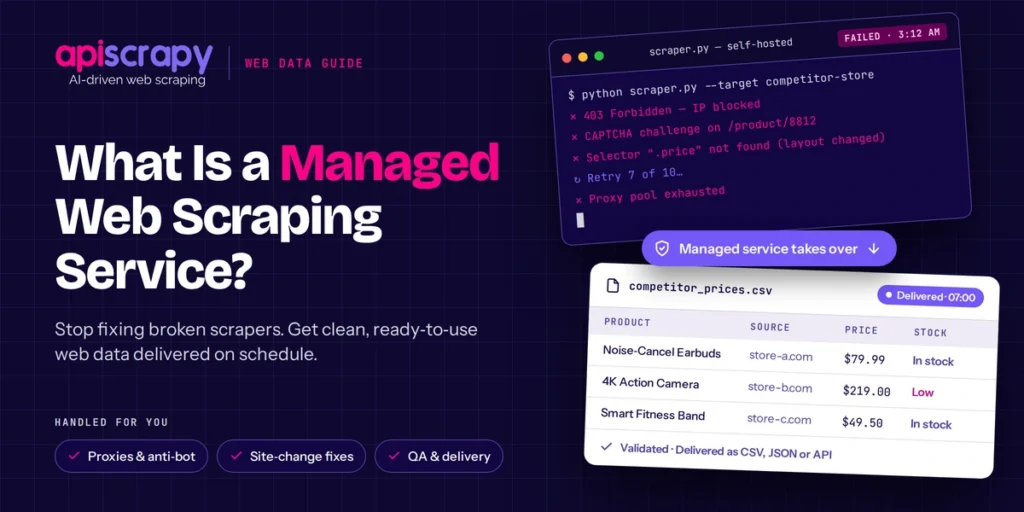
Managed web scraping is a service model where a provider handles the entire data extraction process for a business, from building and maintaining scrapers to cleaning, structuring, and delivering the final data, so the business never has to manage the scraping infrastructure itself.
Businesses need fresh, structured web data to price products, track competitors, and generate leads. Building and maintaining scrapers in-house takes engineering time most teams cannot spare, especially as target sites change layouts or add anti-bot defenses.
This guide breaks down what a managed web scraping service actually does, how the process works end to end, and what separates a strong provider from a weak one. It’s written for teams weighing whether to build scraping capability internally or hand off extraction to a specialized partner.
- Provider manages proxy rotation, browser rendering, and anti-bot handling (CAPTCHAs, IP blocks, fingerprinting) end to end
- Raw HTML gets cleaned and structured into JSON, CSV, or direct database delivery
- Data is validated for completeness and accuracy before reaching your dashboard, API, or storage bucket
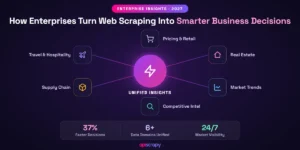
- Common uses include price monitoring, lead generation, market research, real estate listings, travel fare aggregation, and MAP/brand monitoring
- Website layout changes and blocking attempts are resolved by the provider, not your internal team
- Best suited for teams that need reliable web data without dedicating engineering headcount to scraper maintenance
Here’s what this guide covers:
- How managed web scraping works behind the scenes
- Where businesses put scraped data to use most often
- What to weigh before choosing a provider
- Managed vs. self-hosted scraping, compared directly
By the end, you’ll have a clear framework for deciding which approach fits your team.
How Does a Managed Web Scraping Service Work?
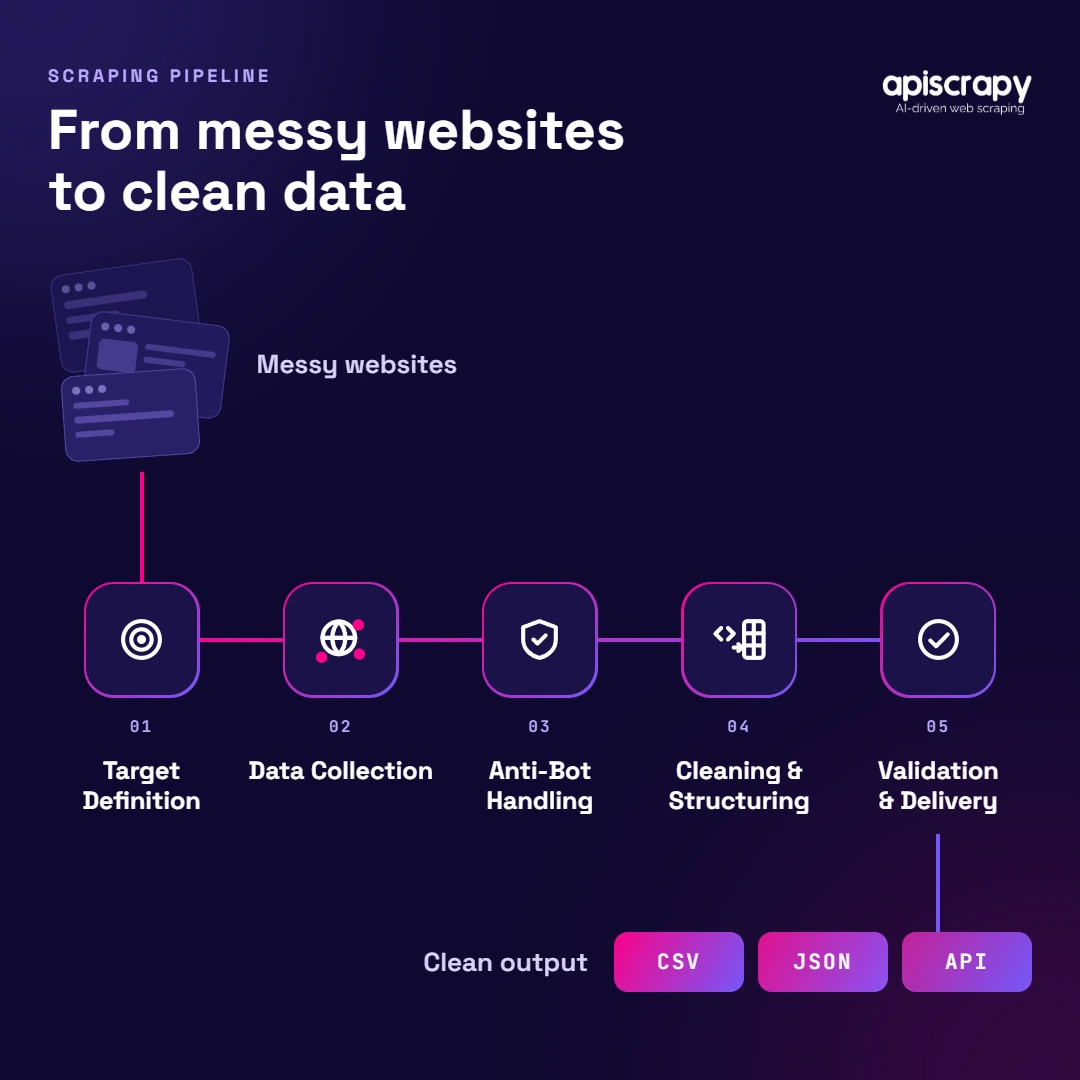
A managed web scraping service takes over the entire extraction pipeline, from identifying target websites to delivering clean, structured data in the format your team needs.
The provider handles proxy rotation, browser rendering, anti-bot handling, and ongoing maintenance, so your team never touches scraping infrastructure directly.
Here is how the process typically flows:
- Target definition: you specify the websites, data fields, and update frequency you need tracked.
- Data collection: the service sends requests through rotating proxies and headless browsers to retrieve page content, even on JavaScript-heavy sites.
- Anti-bot handling: CAPTCHAs, IP blocks, and browser fingerprinting checks are managed automatically, without manual intervention.
- Cleaning and structuring: raw HTML is parsed into structured formats like JSON, CSV, or direct database delivery.
- Validation and delivery: data is checked for completeness and accuracy before it reaches your dashboard, API, or storage bucket.
Because the provider owns this entire chain, website layout changes and blocking attempts get resolved on their end, not yours.
What Are the Common Use Cases for Web Scraping Services?
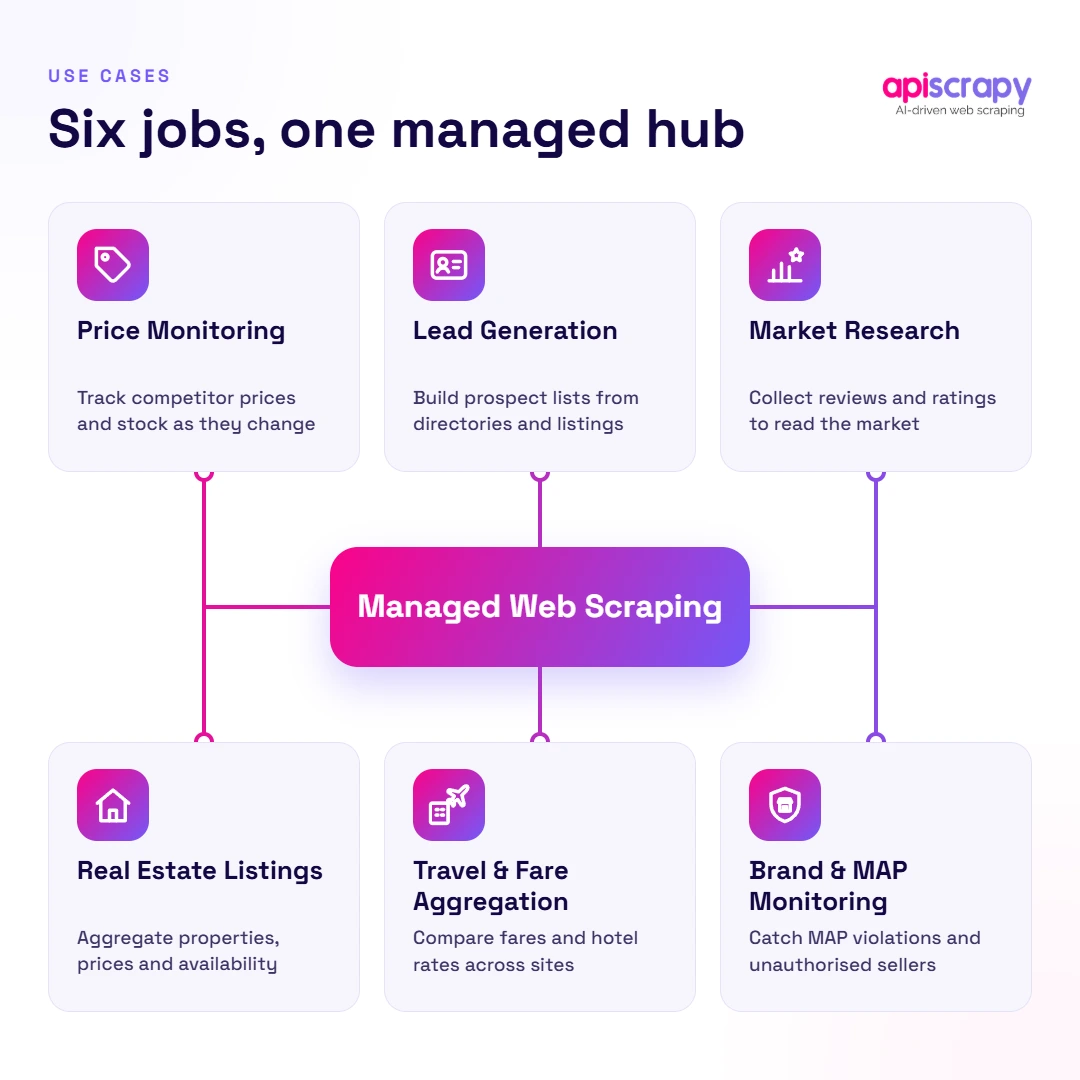
Companies across nearly every industry rely on web scraping services to power decisions that depend on external, real-world data.
- Price monitoring: retailers and manufacturers track competitor pricing and MAP violations across thousands of product listings daily.
- Lead generation: sales and marketing teams extract business contact data and firmographic details from public directories.
- Market research: analysts pull product reviews, ratings, and sentiment data to spot trends before they show up in reports.
- Real estate listings: property platforms aggregate listings, pricing, and availability from multiple sources into one feed.
- Travel and fare aggregation: booking services collect fare, availability, and schedule data across airlines and hotels in real time.
- Brand and MAP monitoring: brands track unauthorized sellers and pricing violations across marketplaces to protect margins.
Each use case shares one requirement: accurate, current data delivered on a schedule the business can rely on.
What Are the Key Factors to Consider When Choosing a Web Scraping Service?
Data Accuracy and Freshness
Ask how often data refreshes and what validation steps catch errors before delivery, since stale or incorrect data leads directly to bad decisions.
Scalability
Confirm the service can handle sudden spikes in data volume or new target websites without requiring you to renegotiate infrastructure or contracts.
Compliance and Ethical Sourcing
Check that the provider respects robots.txt directives, rate limits, and data privacy regulations, since compliance failures create legal and reputational risk for your business.
Support and SLAs
Look for documented response times and a dedicated support contact, not just a ticketing queue that takes days to respond.
Pricing Transparency
Review whether pricing scales predictably with usage, or whether hidden fees for proxies, retries, or custom fields appear later.
What Is the Difference Between Managed vs Self-Hosted Web Scraping?
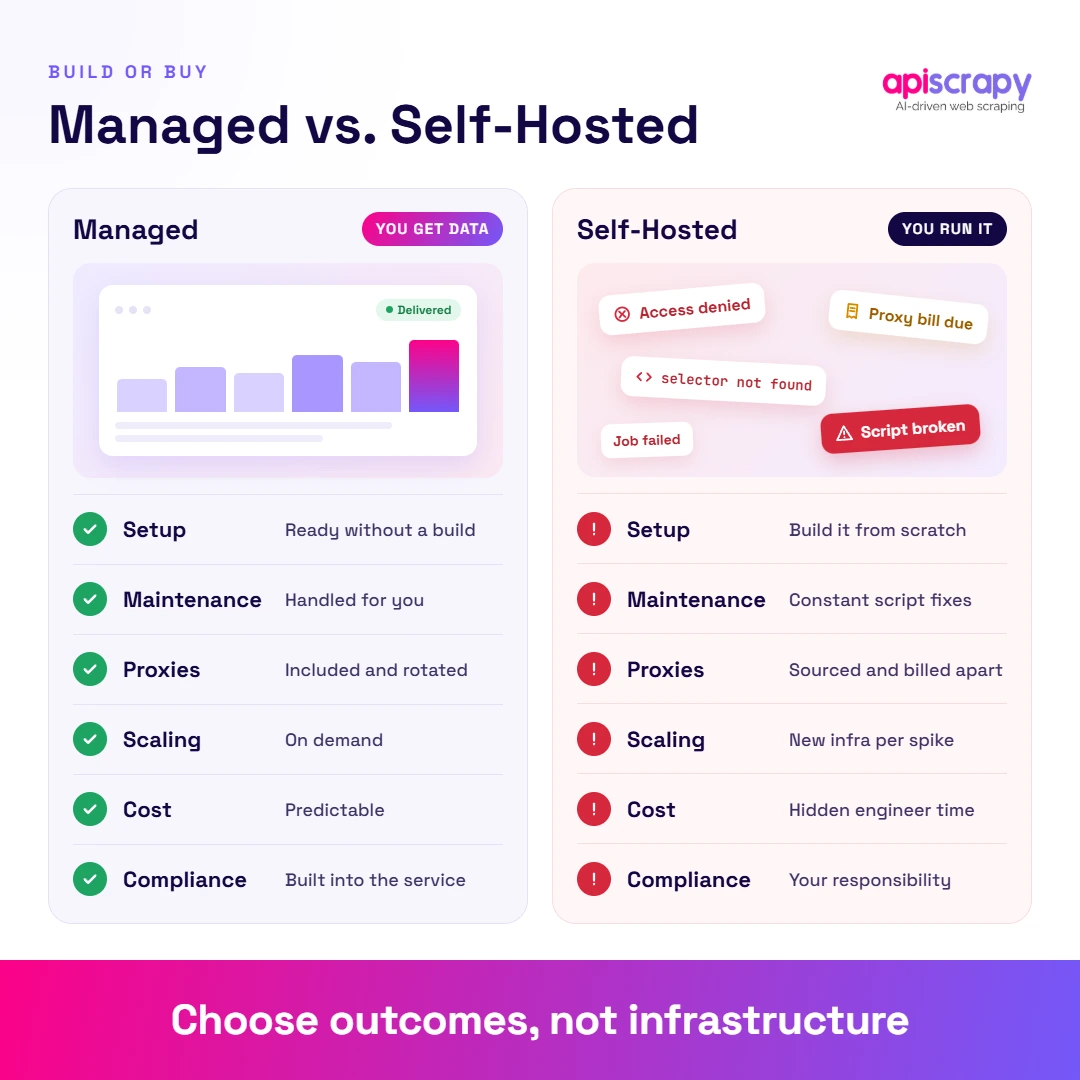
Choosing between managed and self-hosted scraping comes down to a trade-off between control and reliability versus setup time and ongoing maintenance cost.
| Aspect | Managed Service | Self-Hosted |
|---|---|---|
| Setup effort | Minimal, ready in days | High, requires engineering buildout |
| Maintenance | Handled by the provider | Ongoing internal responsibility |
| Proxy and anti-bot handling | Built in | Must be sourced and managed separately |
| Scalability | Elastic, provider-managed | Limited by internal infrastructure |
| Cost structure | Predictable subscription or usage fee | Variable, includes hidden engineering time |
| Compliance handling | Provider-managed | Fully your responsibility |
Self-hosting suits teams with dedicated engineering resources and highly custom requirements, while managed services suit teams that want reliable data without building infrastructure.
Choosing the Right Web Scraping Service for Your Business
A managed web scraping service is best suited for teams that need reliable data without dedicating engineering headcount to scraper maintenance.
The strongest providers combine broad site coverage, consistent uptime, and responsive support, so your data pipeline keeps running even as target websites change.
Managed services clearly outperform DIY scraping for non-technical teams and growing businesses that cannot absorb constant maintenance overhead.
They fit best for teams past the early testing stage that now depend on web data for daily or weekly business decisions.
Ready to see how a managed web scraping service can simplify your data pipeline? Book a demo and see how AI-powered extraction fits your workflow.
Start Building Your Web Crawler Today
Conclusion
Choosing between building your own scrapers and partnering with a managed web scraping service depends on how much engineering time your team can dedicate to infrastructure versus outcomes.
If your business depends on accurate, timely web data but not on owning the extraction pipeline itself, a managed service removes the maintenance burden. Book a demo to see how a managed web scraping service can fit into your data strategy.
Frequently Asked Questions
1. Is a managed web scraping service worth it compared to building scrapers in-house?
For most teams, yes: in-house scraping demands ongoing engineering time for maintenance and anti-bot workarounds, while a managed service like APISCRAPY delivers structured data without that overhead.
2. How much does a managed web scraping service typically cost?
Pricing is usually subscription-based and scales with data volume and complexity, ranging from a few hundred dollars a month for smaller projects to enterprise-level custom quotes for high-volume extraction.
3. Is it legal to outsource web scraping to a third-party provider?
Yes, as long as the provider only collects publicly available data and follows applicable regulations like GDPR and CCPA along with each target site's robots.txt and terms of service.
4. What data formats and delivery methods do managed scraping services support?
Most providers deliver data as CSV, JSON, or XML through channels like S3, SFTP, REST API, or direct database integration.
5. Can a business switch from an in-house scraper to a managed service without losing existing data pipelines?
Yes, most managed providers can take over an existing scraper setup or rebuild it to match current requirements without disrupting the data flow already feeding your systems.