How to Build a Real Estate Web Scraper to Grow Your Business
Real estate teams that once relied on manual listing checks now build a real estate web scraper to track prices, inventory, and competitor activity in real time. Search interest in real estate web scraping has grown alongside PropTech adoption, as agencies and investors compete on data speed rather than data access alone.
This guide covers how to define your data goals, choose the right scraping method, clean and store what you collect, and scale a pipeline that keeps working as source sites change.
- Start with the decision, not the data. Pricing, lead generation, market research, and benchmarking each need a different dataset, and a narrow scope is easy to expand later.
- Expect source sites to break. JavaScript-heavy portals, anti-bot defenses, and layout changes hit before your scraper logic does, so plan for proxies, headless rendering, and alerts.
- Clean before you store. Deduplicate listings by address or MLS number and standardize price formats, since skipping this step is the most common reason real estate data projects stall.
- Choose build or buy on maintenance, speed, and compliance. In-house gives you control, while a managed service such as APISCRAPY handles scheduling, cleaning, and delivery.
How Do You Define Your Real Estate Data Goals?
Before writing a single line of code, decide what decision the data will support. Pricing strategy, lead generation, market research, and portfolio benchmarking each need a different dataset.
Agencies typically track competitor listings and days-on-market. Investors track price history and neighborhood trends. PropTech teams often need both, plus agent and transaction data feeding a product.
Vague goals produce bloated pipelines that collect everything and use little of it. Narrow the scope early, since it is far easier to expand later than to unwind an overbuilt system.
Which Real Estate Scraping Method Should You Choose?
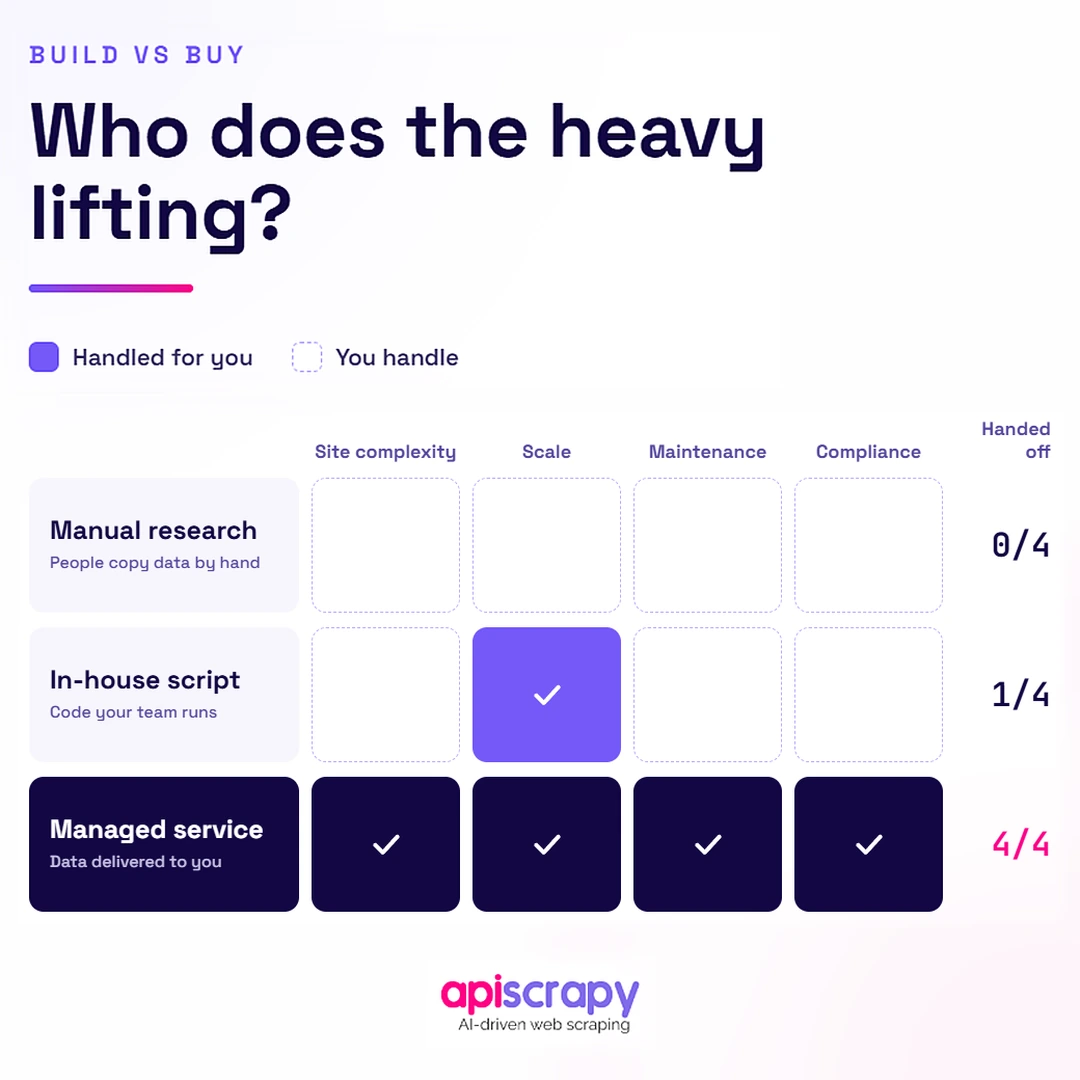
Three broad paths exist: manual research, custom scripts built in-house, and a managed data service that delivers structured output on a schedule.
Key Considerations
- Site complexity: modern listing portals render content with JavaScript, which breaks simple script-based scrapers within weeks.
- Scale: tracking a handful of pages is a different problem than monitoring thousands of listings daily.
- Maintenance: every scraper breaks when a source site changes its layout, and someone has to fix it.
- Compliance: MLS-sourced data carries licensing restrictions that survive being scraped from a downstream portal.
- Cost over time: in-house scripts look inexpensive at first, then absorb ongoing engineering hours as sites change.
Small, one-off research projects can survive with manual work or basic scripts. Continuous pricing intelligence or lead pipelines almost always outgrow that setup within a year.
How Do You Clean and Store Real Estate Data?
Raw scraped data rarely arrives usable. Duplicate listings, inconsistent price formats, and missing fields are the norm rather than the exception.
Structured storage options include relational databases for transactional queries, data warehouses for analytics at scale, and structured exports such as CSV or JSON for smaller teams.
Deduplication and validation rules, matching listings across sources by address or MLS number where available, keep downstream reports and models accurate. Skipping this step is the most common reason real estate data projects stall.
How Do You Build and Scale a Real Estate Data Pipeline?
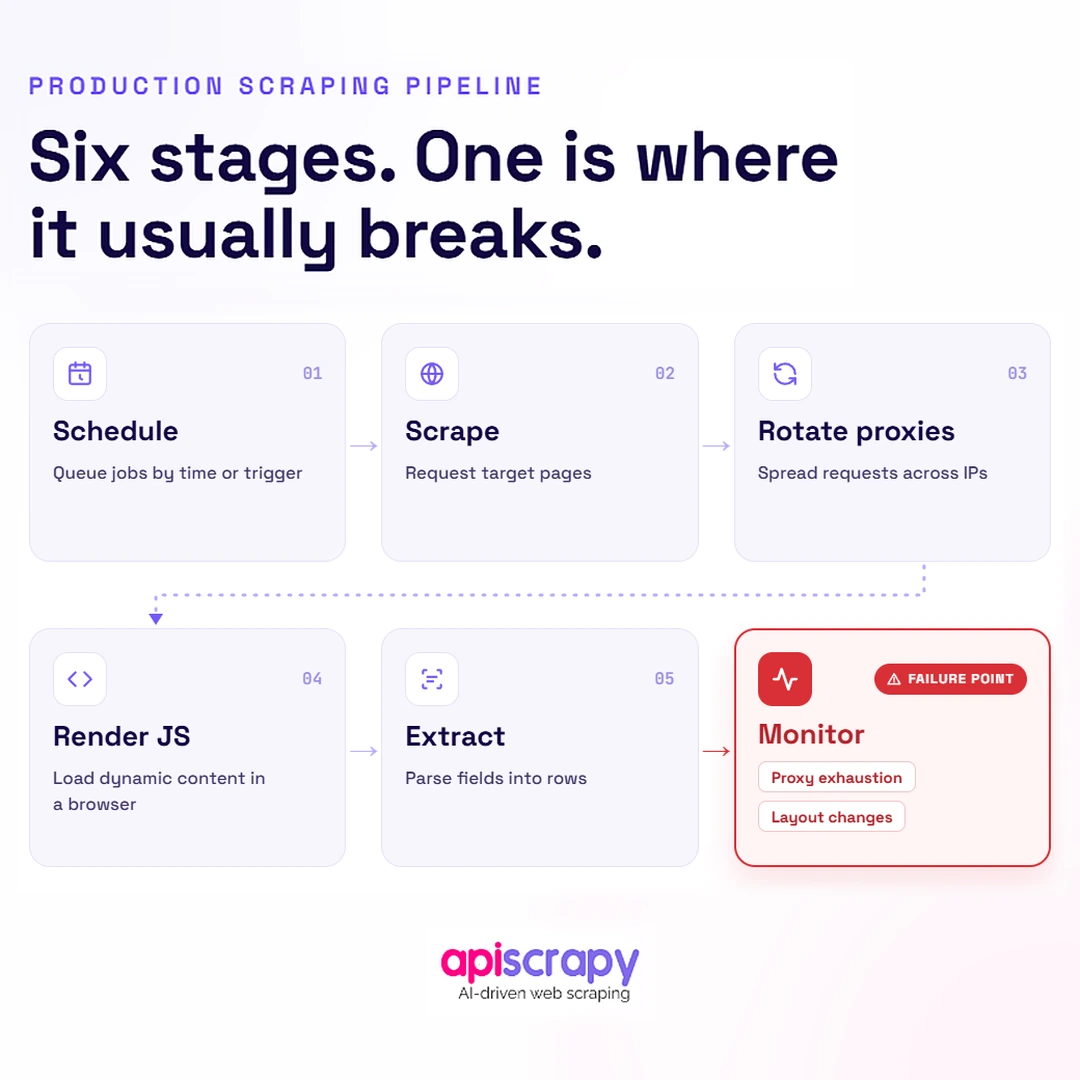
A pipeline means more than a single scraper. It includes scheduling, monitoring, storage, and delivery of data on a cadence your business can actually act on.
At scale, three problems surface first: anti-bot defenses that block or slow requests, site layout changes that silently break field extraction, and proxy management to avoid IP blocks.
- Rotating residential or datacenter proxies to distribute request volume across many IP addresses.
- Headless browser rendering for JavaScript-heavy listing pages.
- Automated retry logic and alerting, so a broken scraper is flagged immediately instead of discovered a week later.
- Rate limiting requests to avoid degrading the source site’s performance.
Teams that build in-house often underestimate maintenance load. A scraper that runs flawlessly at launch typically needs updates within three to six months as target sites redesign pages.
Practitioner note: the first thing that breaks when real estate scraping scales past a few hundred listings a day is rarely the scraper logic itself. It is almost always proxy exhaustion or a layout change nobody was watching for.
What Types of Real Estate Data Can You Scrape?
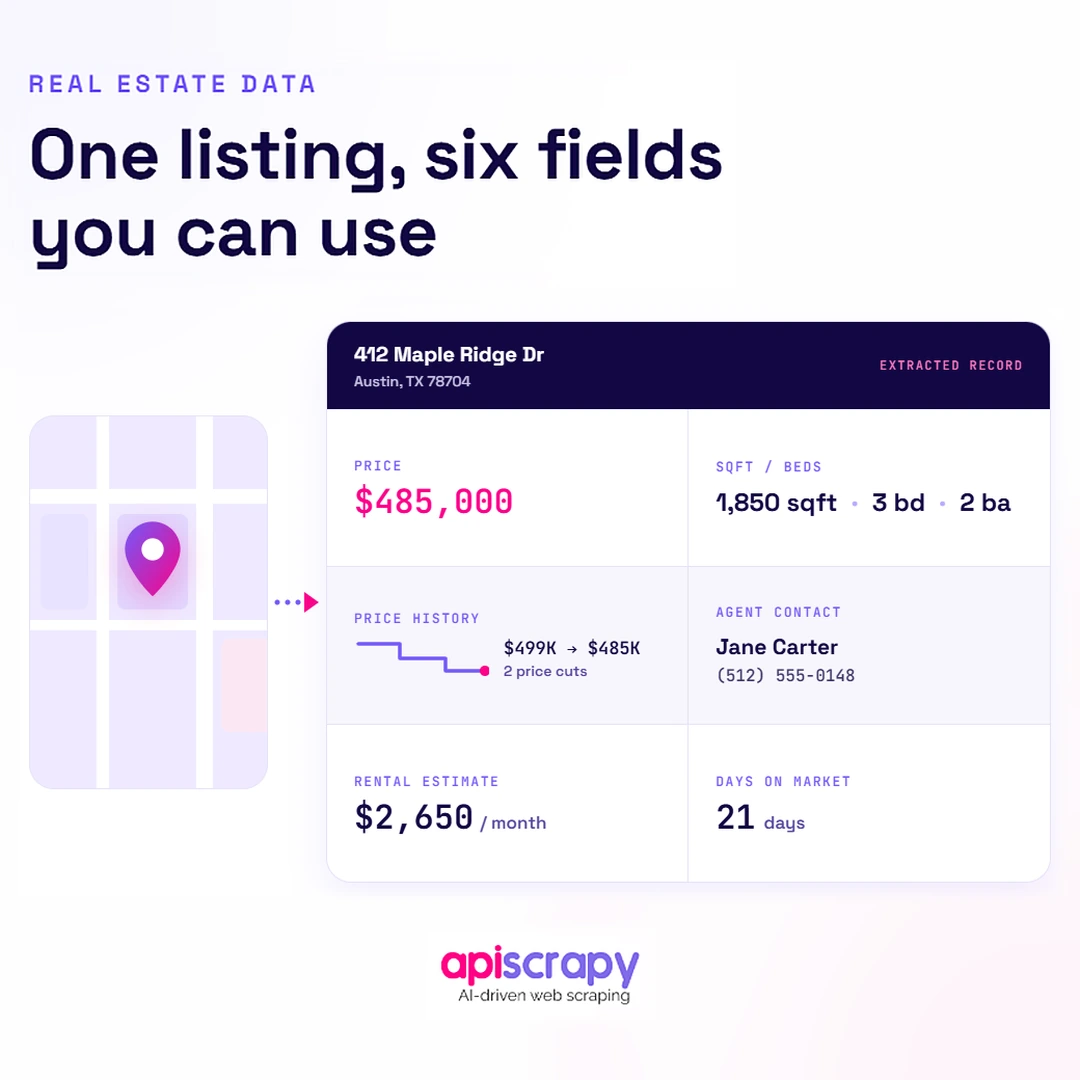
- Listing details: price, square footage, bedrooms, bathrooms, and lot size for comparison and valuation.
- Historical price data: prior listing prices and price-change timelines that reveal market direction.
- Agent and broker information: publicly listed contact details for outreach and lead generation.
- Rental data: rent estimates, vacancy signals, and lease terms across neighborhoods.
- Market and neighborhood statistics: days-on-market, inventory counts, and amenity data tied to listings.
- Property attributes: year built, property type, and renovation status where disclosed.
What Are the Benefits of Web Scraping for Real Estate Businesses?
- Competitive pricing intelligence that shows how comparable listings are priced in real time.
- Faster market entry, since new inventory and price changes surface before manual research would catch them.
- Lead generation built from publicly listed agent and property contact data.
- Trend forecasting based on historical price and inventory patterns rather than guesswork.
- Portfolio benchmarking that compares owned properties against the broader local market.
Should You Build a Real Estate Scraper or Use a Web Scraping Service?
The build-versus-buy decision usually comes down to three factors: how much engineering time you can dedicate to maintenance, how fast you need the data, and how much compliance work you can manage directly.
Building in-house gives full control over logic and schema, which suits teams with dedicated engineering capacity and unusual data requirements.
A managed data service shifts maintenance, proxy management, and much of the compliance groundwork off your team, which shortens time to usable data considerably.
APISCRAPY offers a managed real estate data service that handles scheduling, cleaning, and delivery, so teams receive structured listing data without maintaining scraper infrastructure themselves.
Teams with in-house engineering capacity and highly custom needs often build. Teams that need reliable data without ongoing maintenance overhead are usually better served by a managed service.
Start Building Your Web Crawler Today
Conclusion
A real estate web scraper can power pricing strategy, lead generation, and market research, but the value depends on clear goals, clean data, and a pipeline built to survive site changes.
Whether you build in-house or work with a managed data service, the businesses that win treat real estate data as an ongoing operation rather than a one-time project.
Book a demo with APISCRAPY to see how a managed real estate data service can deliver structured listing data on your schedule, without the maintenance burden.
Frequently Asked Questions About Real Estate Web Scraping
Can I Build a Real Estate Web Scraper Without Coding?
Yes, no-code options and managed data services let non-technical teams collect real estate listings without writing scripts. These options handle the technical work of extraction and formatting, though they typically offer less customization than a custom-built scraper for unusual data needs.
How Do I Scrape Real Estate Listings Without Getting Blocked?
Rotate proxies, rate-limit requests, and respect robots.txt directives to reduce the chance of IP blocks. Using a real, identifiable user agent and spacing out requests by one to two seconds also signals good-faith access rather than aggressive automated traffic.
What Real Estate Data Should My Business Collect?
Collect data tied directly to your decision, whether that is pricing, lead generation, or market trend analysis. Agencies typically prioritize competitor listings and days-on-market, while investors focus more on price history and neighborhood-level trend data.
How Can I Keep My Real Estate Scraper Running When Websites Change?
Monitor extraction accuracy continuously and rebuild selectors quickly when a source site changes its layout. Automated alerting that flags a drop in successful extractions catches breakage early, before it silently corrupts downstream reports or pricing models.
Is It Better to Build a Real Estate Scraper or Use a Web Scraping Service?
It depends on your engineering capacity and how much ongoing maintenance your team can absorb. A managed data service suits teams that need reliable, structured data without maintaining infrastructure, while in-house builds suit teams with unusual, highly custom requirements.