Scrape Redfin Data Like a Pro: Guide for 2027
In today’s fast-moving real estate market, Redfin Data has become a valuable resource for investors, analysts, researchers, and businesses looking to understand what is really happening in the housing market. From property listings and sale prices to market trends, inventory, and neighborhood-level insights, Redfin provides a wealth of information that can reveal opportunities hidden beneath the surface. As this data continues to grow in volume and value across the United States and Canada, businesses are increasingly looking for reliable ways to collect, organize, and analyze it at scale—turning raw real estate information into meaningful insights that support smarter investment decisions, accurate market analysis, and competitive strategies.
This guide covers the practical methods for scraping Redfin, the data fields worth targeting, and how to collect that data without getting blocked or running into legal trouble.
Here is what this guide covers:
- Step by step scraping methods, from headless browsers to managed data services
- The data fields that matter most for real estate analysis
- Best practices to avoid bans, CAPTCHAs, and rate limits
- The current legal picture around scraping public real estate listings
A quick note on sourcing. This article draws on Redfin’s own data quality documentation, published court rulings on web scraping, and current anti bot research. Nothing here should be treated as legal advice for your specific situation.
The goal is straightforward: give you a working understanding of how Redfin scraping actually works in 2027, so you can choose the right approach for your project and avoid the most common mistakes.
- Pick the method by scale: headless browsers for control, scraper APIs or managed services for uptime.
- Parse embedded JSON first when available. It breaks less often than HTML selectors.
- Target the fields that drive decisions: price, status, price history, days on market, and school and walkability data.
- Avoid blocks by rotating IPs and user agents, spacing requests, and adding retries and checkpoints.
- Legal risk sits in the terms of service more than in federal law, per hiQ v. LinkedIn.
- Decide early between property-level, market-level, or geographic data to keep the project focused.
What Is Redfin and Why Scrape It?
Redfin is a licensed real estate brokerage that operates its own consumer website and mobile apps across the United States and Canada. Unlike media portals such as Zillow, Redfin’s brokerage status gives it direct membership in local Multiple Listing Services, so its listings tend to update within minutes rather than through a delayed syndicated feed.
Investors, PropTech teams, market researchers, and data driven brokerages scrape Redfin to build comparable sales analyses, track pricing trends, and monitor inventory shifts by neighborhood. Lead generation teams and appraisal tools rely on the same data to spot opportunities before they show up in slower channels.
In practice, this data feeds automated valuation models, investment underwriting spreadsheets, neighborhood market reports, and price alert systems, use cases that go well beyond what a single agent browsing the site by hand could ever keep up with.
What Are the Methods for Scraping Redfin (Step by Step)
Bypass Anti-Bot Measures
Redfin runs bot detection systems that flag unusual traffic patterns, unfamiliar browser fingerprints, and requests arriving faster than a human could click. Getting past this reliably usually means combining several signals rather than relying on one trick.
At a high level, that means rotating IP addresses and user agents, spacing out requests to mimic natural browsing, and rendering pages the way a real browser would rather than sending bare HTTP requests.
Target URL Structure
Redfin organizes search results and listing pages around predictable URL patterns built from city, state, and property identifiers, which makes it possible to construct search URLs programmatically for a given market.
Understanding this structure lets a scraper paginate through search results systematically, rather than guessing at page numbers or relying only on links discovered by chance.
Parse JSON or HTML
Much of Redfin’s listing detail loads through JavaScript and often includes structured data embedded directly in the page source, which can be more stable to parse than visually scraping rendered HTML elements.
Where that structured data is available, extracting it directly is usually faster and less fragile than writing selectors against HTML that can change with every front end update.
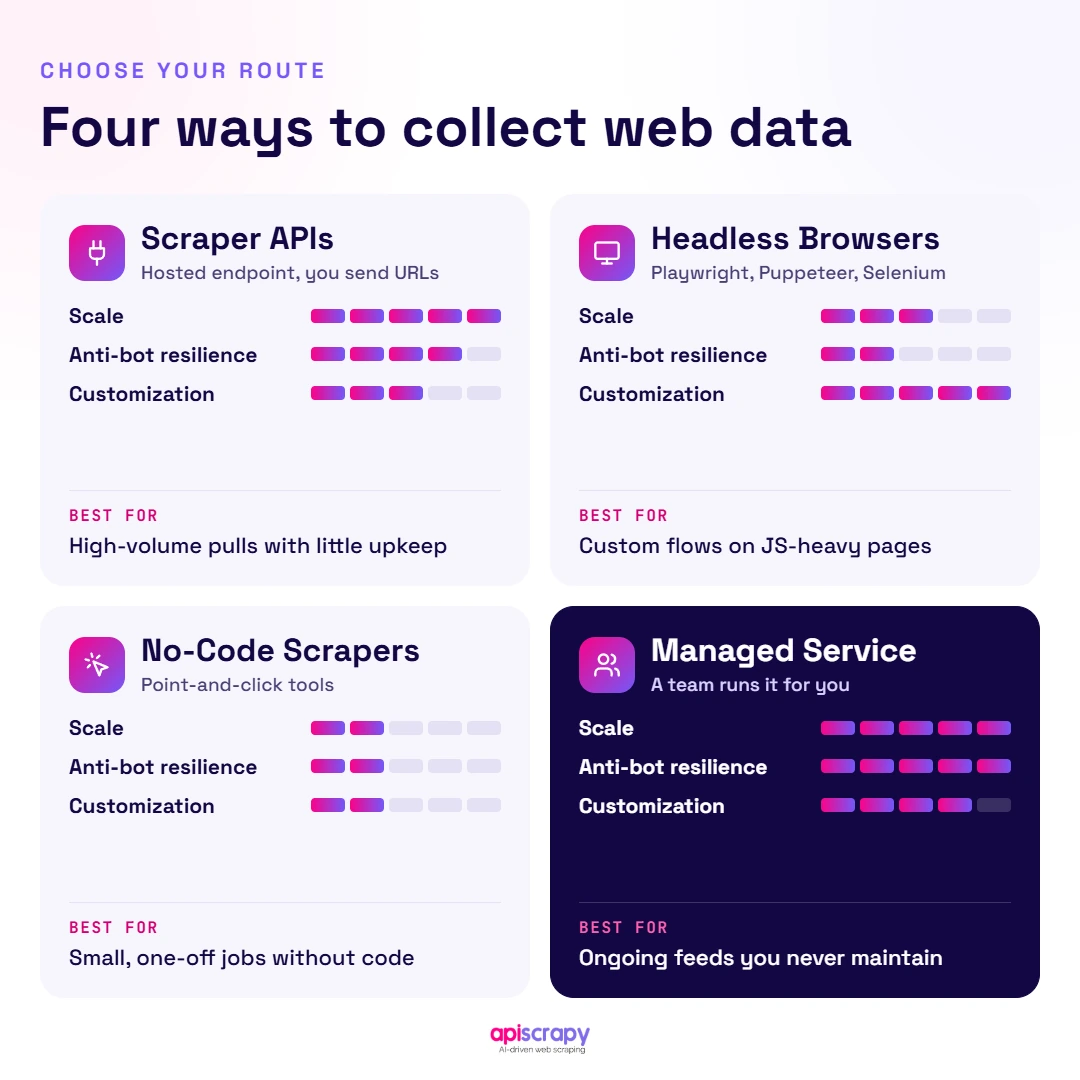
Scraper APIs / Proxy Services
- Handle IP rotation automatically so a single source address never sends an unusual volume of requests
- Solve or route around CAPTCHAs and other bot challenges without manual intervention
- Offer geo targeted proxies so requests appear to originate from the market being searched
- Provide uptime and retry logic so a single failed request does not break an entire collection run
Headless Browsers (Python/Playwright or Selenium)
Because Redfin renders much of its listing detail with JavaScript, tools like Playwright or Selenium drive a real browser engine in the background, letting the page fully load before any data is extracted.
A typical workflow opens the target URL, waits for the listing content to render, then extracts the needed fields before moving to the next page in the queue.
No-Code Scrapers
No code scraping tools let non technical users point and click to define what data to extract, which lowers the barrier for smaller, one off collection projects.
They tend to struggle with the scale, anti bot resilience, and customization that ongoing, high volume Redfin monitoring requires compared to a purpose built script or managed service.
What Are the Essential Data Fields to Target?
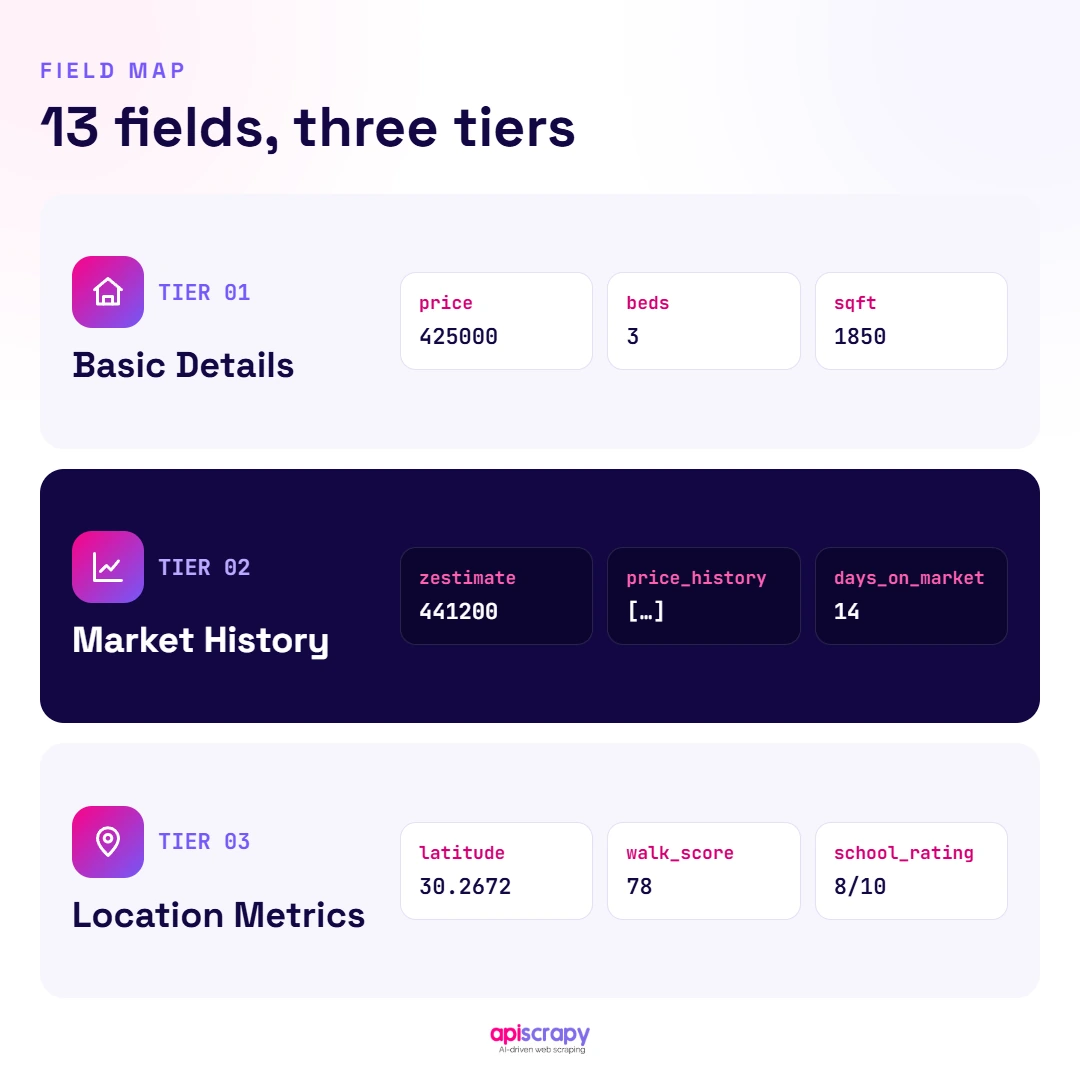
Basic Details
- Full property address and geographic coordinates
- List price and current listing status
- Bedroom and bathroom counts
- Square footage and lot size
- Property type, such as single family, condo, or multi family
Market History
- Price change history and days on market
- Past sale dates and sold prices, where available
- Listing agent and brokerage information
Location Metrics
- School district ratings and nearby school assignments
- Walkability, transit, and bike scores
- Neighborhood level price trends and comparable sales
Best Practices to Avoid Getting Blocked
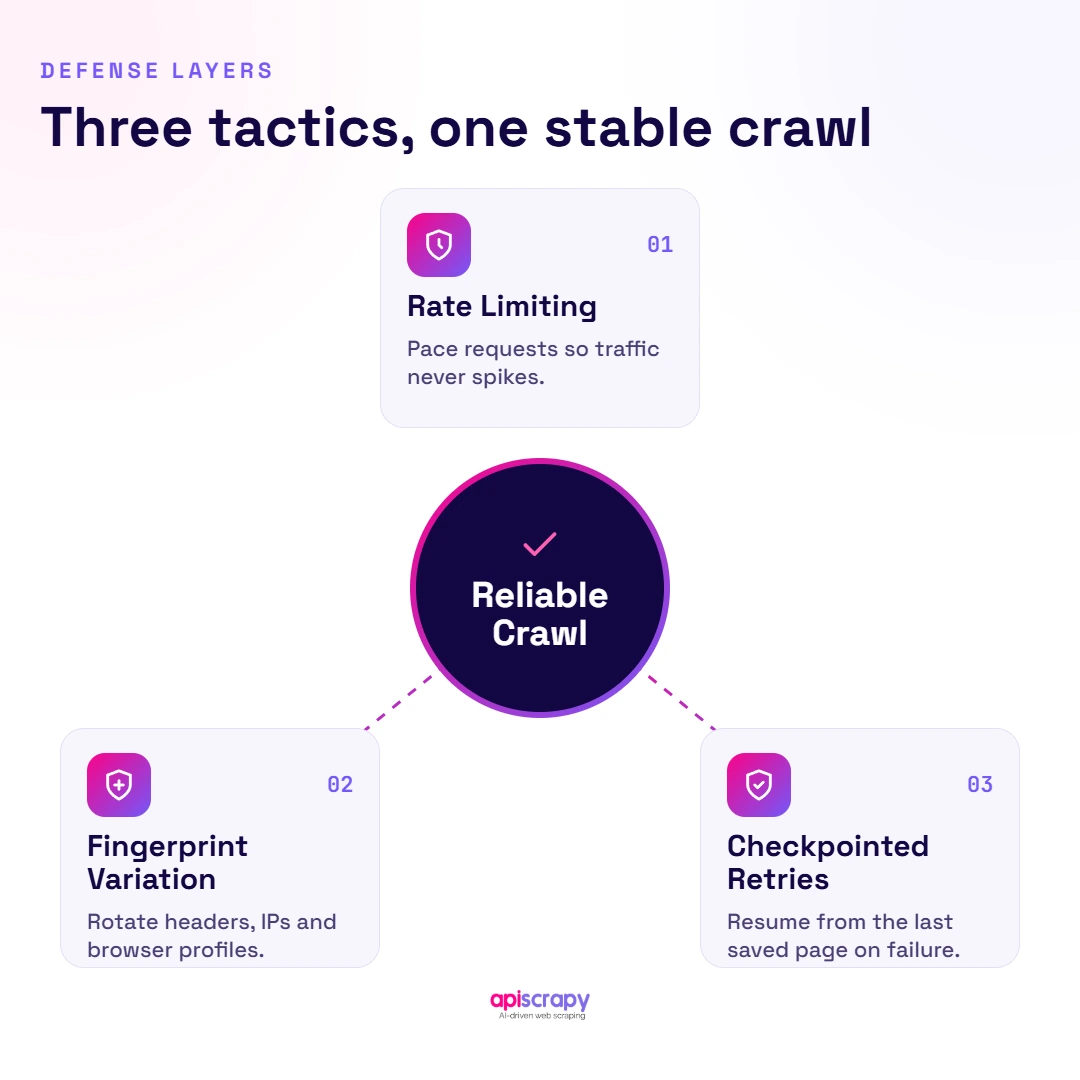
Rate Limiting
Space out requests so they resemble normal browsing rather than a burst of automated traffic, and slow down further if response times start to increase, since that is often an early sign of throttling.
Browser Fingerprinting
Vary user agents, headers, and browser characteristics across sessions, since a scraper that looks identical on every single request is one of the easiest patterns for detection systems to flag.
Deep Scraping Workflows
Build in retry logic, checkpointing, and incremental saves so a blocked or failed request does not force a full restart, and so partial progress is never lost mid run.
Is It Legal to Scrape Redfin?
In short: scraping publicly visible Redfin listings is unlikely to trigger federal computer hacking law, but it can still breach Redfin’s terms of service, which explicitly prohibit automated data extraction.
The clearest reference point is hiQ Labs v. LinkedIn, where the Ninth Circuit ruled that scraping publicly accessible data likely does not violate the Computer Fraud and Abuse Act. hiQ still went on to lose the broader case on breach of contract and related claims, which is the more realistic risk with a site whose terms explicitly restrict scraping, so treat robots.txt and the terms of service as real boundaries and consult legal counsel before any large scale or commercial collection effort.
What Data Can You Realistically Get From Redfin?
Beyond individual fields, it helps to think in three broad categories: property level records (the specifics of one home), market level aggregates (median prices, inventory, and days on market by area), and geographic context (schools, walkability, and commute data).
Most Redfin scraping projects only need one or two of these categories. Deciding that upfront keeps a collection project focused and makes the resulting dataset easier to maintain over time.
Start Building Your Web Crawler Today
Conclusion
Scraping Redfin data can unlock faster comparables, sharper market timing, and richer investment models, but it only works reliably when the collection method respects rate limits, keeps up with anti bot changes, and stays inside the legal boundaries Redfin has set.
Whether you build this in house with Playwright and rotating proxies, or hand it off to a team that manages the entire pipeline, the priority is the same: clean, current, and trustworthy data.
If maintaining a scraper is not where your team wants to spend its time, APISCRAPY’s managed web data service handles the collection, anti bot resilience, and delivery for you. book a demo with APISCRAPY to see how it fits your Redfin data needs.
Frequently Asked Questions About Scraping Redfin
Does Redfin have a free API?
Redfin does not publish an official public API for listing data. It does offer a free Redfin Data Center where anyone can download aggregate market statistics, such as median sale price and inventory trends, as CSV files by metro, city, or zip code.
Can I download data from Redfin?
Yes, but only in a limited way through official channels. The Redfin Data Center allows free downloads of pre aggregated market trend files, and individual listing pages can be saved or exported one at a time for personal reference.
Where does Redfin pull data from?
As a licensed brokerage rather than a media portal, Redfin pulls most of its listing data directly from roughly a hundred local Multiple Listing Services across the United States, giving it faster and more complete updates than syndicated sites. It supplements this with public county records through data partners for older sold prices, plus its own for sale by owner and foreclosure listings where local rules allow it.
Who is more accurate, Zillow or Redfin?
Redfin generally has an edge on listing freshness and completeness because it receives MLS data directly as a brokerage, while Zillow depends more heavily on syndicated feeds and agent uploaded listings in many markets.
Is scraping Redfin data actually profitable for investors?
Redfin data itself does not generate profit. Its value comes from what teams build with it, such as faster comparables, automated deal screening, or price trend alerts that shorten the time between a listing appearing and an offer going out.