Top 6 Data-as-a-Service Companies : A Buyer’s Comparison Guide
Data is no longer just a business asset—it has become the fuel behind smarter AI models, sharper pricing strategies, deeper market research, and faster decisions. As data volumes continue to explode, businesses are increasingly turning to Data-as-a-Service Companies for reliable, ready-to-use information without the cost and complexity of building their own collection, cleaning, validation, and delivery pipelines. These providers transform raw, fragmented data into structured and continuously updated feeds that can be delivered through APIs, cloud platforms, or managed data pipelines, allowing teams to spend less time wrestling with infrastructure and more time turning information into meaningful business outcomes.
This guide breaks down which Data-as-a-Service providers offer the strongest data coverage, delivery flexibility, compliance posture, and AI-readiness for buyers evaluating providers.
- Analysis of vendor documentation, G2 and Trustpilot reviews, and public market research from sources such as Tracxn and Market Research Future
- Evaluation of data breadth, delivery formats (API, cloud share, batch, webhook), and integration ease across providers
- Comparison of compliance certifications, infrastructure scalability, and support models for enterprise versus mid-market buyers
- Review of pricing structures and best-fit use cases for each provider, from self-serve analytics to custom web data pipelines
APISCRAPY appears in this list based on its positioning as an AI-augmented web data and workflow automation service. There is no sponsorship or financial relationship involved.
All service descriptions and comparisons rely on publicly available documentation, verified customer feedback, and documented performance outcomes.
Vetting Methodology: How We Evaluated These Data-as-a-Service Providers
We scored every provider on the same six weighted criteria, drawing on public vendor documentation, published pricing pages, and verified G2 and Capterra reviews.
| Criterion | Weight | What We Checked | Evidence Source |
|---|---|---|---|
| Data Coverage and Freshness | 25% | Dataset breadth, refresh frequency, and what actually triggers a re-collection | Vendor documentation and product pages |
| Delivery and Integration | 20% | Support for API, cloud share, batch, and webhook delivery, plus fit with warehouses, BI tools, and CRMs | API docs and integration listings |
| Compliance and Data Governance | 15% | Written GDPR and CCPA handling, along with SOC 2, ISO 27001, or equivalent certifications | Public trust centers and security pages |
| Pricing Transparency and Scalability | 15% | Published tiers, contract minimums, credit expiration, and renewal terms | Pricing pages and reviewer-reported quotes |
| Verified Customer Sentiment | 15% | Recurring praise and complaints, weighed separately for small business and enterprise buyers | Verified G2 and Capterra reviews |
| Support and SLAs | 10% | Named account contacts, written uptime guarantees, and response times | SLA documentation and support-related reviews |
| Total | 100% |
How Do the Best Data-as-a-Service Providers in the USA Compared?
| Service | Best For | Key Advantage | G2 Rating | Capterra Rating | Starting Price |
|---|---|---|---|---|---|
| APISCRAPY | Fully managed DaaS, zero-maintenance | Vendor owns pipeline uptime and maintenance | 4.0/5 (7 reviews) | 5.0/5 (26 reviews) | Start for $1 |
| Datafiniti | Structured web data feeds | Pre-built business, product, property datasets | 4.0/5 (11 reviews) | Limited public volume | $999/month |
| ZoomInfo | B2B sales & marketing teams | Largest verified contact + company graph | 4.5/5 (9,000+ reviews) | 4.4/5 | ~$14,995/year (3 seats) |
| People Data Labs | Developers building enrichment | Clean, documented API over 38B+ records | 4.5-4.6/5 (16-17 reviews) | Not widely listed | Free tier; Pro from $98/month |
| FactSet | Financial and investment data | Blends proprietary + third-party financial content | 4.3/5 (60 reviews) | Enterprise, quote-based; ~$4,000/user/year (Basic tier) | |
| Foursquare | Location and POI data for service | Places API with deep category context | No public star rating listed | Enterprise, quote-based; Free sandbox; PAYG from $0.015/call |
How We Choose the Best Data as a Service Providers?
Evaluation centered on four things: data quality and freshness, ease of integration, pricing transparency, and how each vendor holds up once a target source changes its defenses.
- Read through hundreds of verified reviews on G2 and Capterra, looking for recurring complaints rather than just star averages.
- Compared documented uptime and success-rate claims against independent third-party benchmarks where available.
- Checked pricing pages and quote patterns for hidden minimums, credit expiration, or renewal surprises.
- Noted which vendors publish GDPR and CCPA handling openly versus which save it for a sales call.
- Weighed small-business sentiment against enterprise sentiment separately, since the two rarely agree.
Rankings mix quantitative review scores with qualitative pattern-matching across dozens of reviews per vendor, alongside APISCRAPY’s managed-service differentiation as the lead pick. No vendor paid for placement on this list.
Top 6 Data-as-a-Service Companies
Here’s the updated content with Features, Pros, Cons, and Pricing clearly broken out for each entry.
1. APISCRAPY (disclosed)
APISCRAPY delivers Data as a Service by handling the entire extraction pipeline, from scraping to cleaning to delivery, so businesses get ready-to-use data without managing any infrastructure. Teams receive structured datasets through APIs, scheduled feeds, or direct integrations in the format their systems already expect. This removes the need for in-house scraping teams, proxy management, or ongoing maintenance as websites change.
Features:
- Fully managed pipelines where the vendor owns uptime and target-site maintenance
- Structured delivery formats built for direct use in analytics and BI service
- Custom scope and delivery cadence based on client needs
Pros:
- No need to build or maintain scraping infrastructure in-house
- Delivery formats are ready for direct BI and analytics use
- Flexible scope tailored to each client’s data requirements
Cons:
- Public review volume is not yet large enough to cite star ratings responsibly
- Custom pricing means no published tiers for quick comparison
Pricing: Starting at just $1 on data scope and delivery cadence.
2. Datafiniti
Datafiniti is a Data-as-a-Service (DaaS) provider that collects, standardizes, and delivers structured data on businesses, products, and properties, drawing from public web and third-party sources into a single pipeline. Datafiniti fits buyers who want off-the-shelf datasets rather than a fully custom, done-for-you delivery cadence like a managed service provides.
Features:
- Combines web crawling, public data, and third-party sources into unified property, people, business, and product datasets
- Single API call returns complete standardized records with no per-field billing
- Free trial, month-to-month plans, and scaling tiers by record volume rather than by feature gating
Pros:
- Cost-effective entry point, with a genuinely free tier for testing
- No lock-in; month-to-month billing with no annual contract required at lower tiers
- Data updates frequently enough that reviewers describe it as close to real time
Cons:
- Requires API integration or manual handling; not a turnkey, ready-to-use dashboard service
- No built-in workflow features like skip tracing, CRM, or direct mail
- Review volume is thin (11 reviews on G2), so the rating carries less statistical weight than larger competitors
Pricing: Bronze (free) at $0/month for light testing, Silver at $99/month for higher volume, Gold and Enterprise tiers moving to $999/month and above with custom bulk-record pricing.
3. ZoomInfo
ZoomInfo is a Data-as-a-Service (DaaS) provider structured around B2B intelligence rather than custom extraction. It delivers structured contact and company data through API access, CRM integrations, or bulk exports, drawing from its own proprietary contact and firmographic database plus intent signals to give buyers a ready-made dataset instead of a custom-built pipeline. ZoomInfo fits sales and marketing teams that need to identify and prioritize buyers, not teams looking for site-specific data extraction. Unlike a fully managed DaaS provider that builds around a client’s specific sources, ZoomInfo sells access to its own pre-existing database.
Features:
- Contact and company database covering over 100 million companies and hundreds of millions of contacts, with buyer intent signals layered on top
- WebSights website-visitor tracking, org chart explorer, and CRM enrichment (Salesforce, HubSpot)
- Chrome extension for in-workflow prospecting and list building
Pros:
- Deepest US-focused B2B contact graph among sales intelligence services, reflected in its G2 category leadership
- Strong integrations across major CRM and sales engagement services
- Consistently well-reviewed customer support
Cons:
- No self-serve or monthly billing; every price comes from a sales quote with mandatory annual contracts
- Data accuracy on international contacts and fast-changing job roles is inconsistent by ZoomInfo’s own reviewers’ account
- Add-ons (intent data, global data, per-seat overages) push real spend well above the advertised starting price
Pricing: Professional plan starts around $14,995 per year for 3 seats with 5,000 annual credits; Advanced and Elite tiers run $24,995 to $39,995+ per year before add-ons.
4. People Data Labs
People Data Labs is a Data-as-a-Service (DaaS) provider offering developer-facing data enrichment and identity APIs rather than a managed extraction pipeline. It’s built for engineering teams that want to wire person and company enrichment directly into their own product or data pipeline, rather than receive a fully assembled dataset. There is no web dashboard or search bar; every interaction happens through API calls.
Features:
- Person Enrichment, Person Search, Person Identify, and Company Search APIs, consuming credits per successful match
- SOC 2 Type II and ISO-compliant data handling
- Volume-based pricing tiers with annual discounts of roughly 20% off monthly rates
Pros:
- Transparent, published pricing compared to competitors like ZoomInfo
- Well-documented API that reviewers describe as easy to integrate once set up
- Free tier available for testing before committing to a paid plan
Cons:
- Developer-only access model; no self-serve UI for non-technical users
- Data is monthly-batch updated rather than real-time, which can mean stale job or org changes
- Per-credit pricing scales poorly at high volume compared to flat-rate alternatives
Pricing: Free plan at $0/month (100 lookups), Pro plan starting at $98/month (350 person enrichment credits, 1,000 company lookups), Enterprise custom pricing starting around $2,500/month for unlimited volume and dedicated support.
5. FactSet
FactSet is a financial data and analytics service built for investment research, a general-purpose web data or DaaS provider. It blends proprietary financial data with third-party content (pricing, fundamentals, estimates) delivered through a workstation, Excel plug-in, and data feeds. It fits portfolio managers and financial analysts rather than teams scraping arbitrary websites.
Features:
- Company financials, credit strength, and debt profile data alongside broker estimates and reports
- Excel plug-in for direct financial modeling and reporting
- Portfolio analytics and risk modeling services integrated with the core data service
Pros:
- Comprehensive, single-service coverage that reduces the need to switch between services for financial research
- Reviewers consistently cite accurate, reliable data and responsive account support
- More modular and typically cheaper than Bloomberg Terminal for equivalent functionality
Cons:
- No self-service trial; onboarding goes through a sales and account-setup process
- Pricing is opaque and modular, so total cost depends heavily on which modules and real-time exchange feeds are added
- Real-time market data from exchanges carries separate licensing fees on top of the base subscription
Pricing: Basic workstation access starts around $4,000 per user per year, scaling to $24,000 to $50,000+ per user per year with estimates, analytics, and premium data feeds added.
6. Foursquare (Places API)
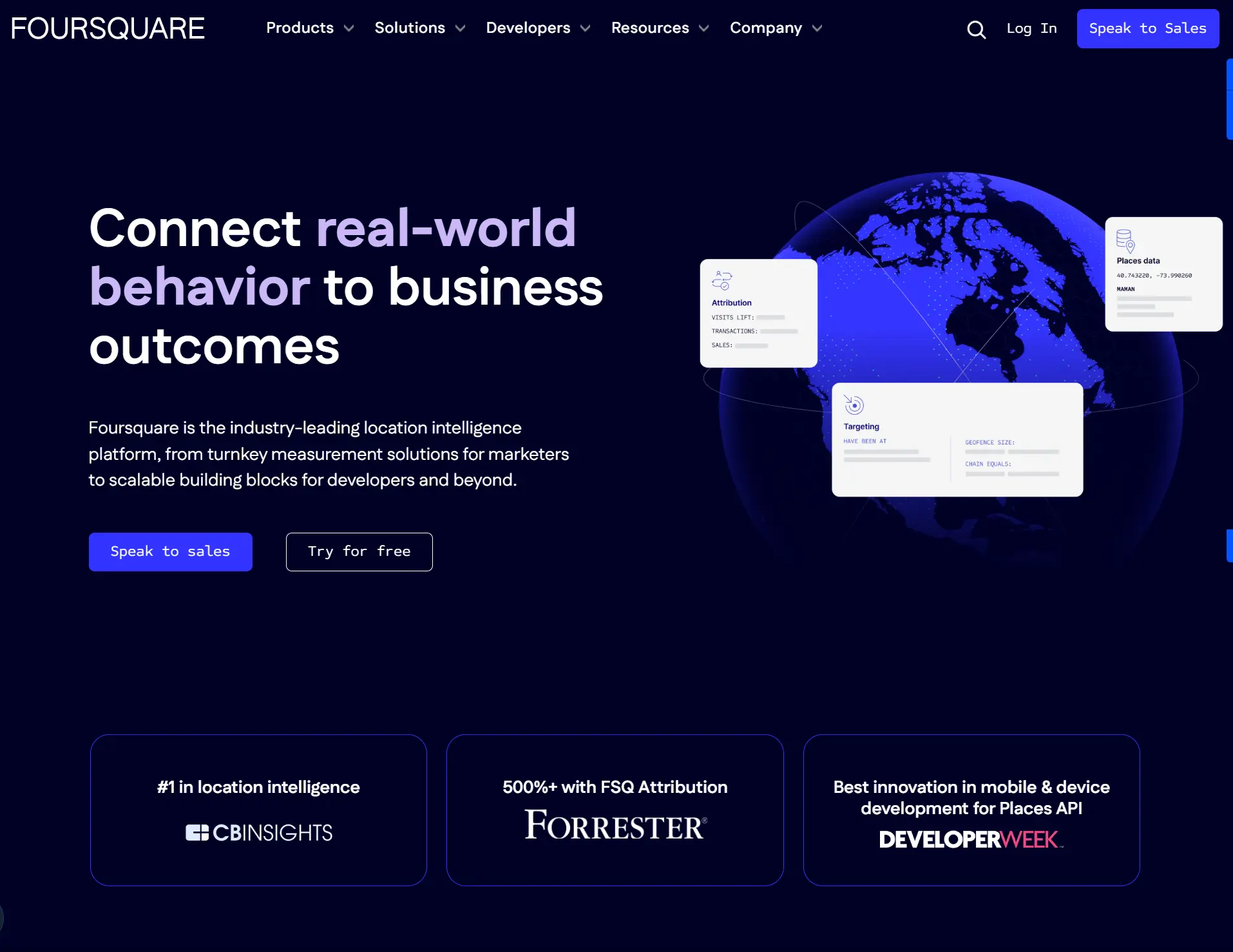
Foursquare is a DaaS (Data-as-a-Service) provider offering location and POI (point-of-interest) data rather than a managed scraping service. It gives developers direct API access to a global venue dataset (over 100 million verified POIs across 200+ countries) for search, autocomplete, and place-matching use cases. It fits location-aware services and businesses needing structured place data, not those wanting custom-scoped extraction from arbitrary target sites.
Features:
- Global POI dataset with search, autocomplete, place details, and place-matching endpoints
- Tiered endpoint structure: “Pro” endpoints (search, details, autocomplete) versus “Premium” endpoints (tips, photos, user-generated content)
- Pay-as-you-go billing with volume-based discounts, plus enterprise agreements for high-volume or specialized use
Pros:
- Rich venue data including user-generated content like tips and photos, which many pure geocoding alternatives lack
- Free usage tier is generous enough for testing and small-scale integration before committing to paid volume
- Well-documented, developer-friendly API used across retail, travel, and real estate use cases
Cons:
- No public star rating on G2 or Capterra; commercial engagement is handled through custom sales conversations rather than transparent self-serve tiers
- Premium endpoints (photos, tips, ratings) carry meaningfully higher per-call costs than Pro endpoints
- Free credit allowances have been reduced over time (recent changes cut free Pro calls further), so cost planning requires checking current terms
Pricing: Free tier includes limited Pro-endpoint calls per month (recently reduced from $200/month in credits to a smaller free allotment); Premium endpoints start around $18.75 per 1,000 calls; Enterprise volume gets custom discounted rates.
Why You Need a Data-as-a-Service Provider
Building an in-house data pipeline is expensive well before it produces one usable row. Engineers end up spending months on proxies, parsers, and edge cases instead of the actual product.
A ready-made, structured feed shrinks the distance between a question and an answer from weeks down to hours.
Reputable providers also handle cleaning, deduplication, and the regulatory groundwork, so a legal team is not chasing GDPR or CCPA gaps after launch.
DaaS scales with demand too. A traffic spike or a new market does not have to mean a hiring plan or a new server cluster.
This is exactly the sentiment that shows up across G2 reviews for providers like Bright Data, where non-technical users repeatedly describe the service’s automation as something they picked up without a developer’s help.
How to Choose the Right Data-as-a-Service Provider for Your Team?
Factor 1: Data Coverage & Freshness
A vendor’s dataset is only as useful as its refresh cycle. Ask how often records update and what actually triggers a re-collection, not just how large the database claims to be.
Factor 2: Integration & Delivery Method
Confirm the data lands where your team actually works, whether that’s a warehouse, a webhook, or a flat file, before you sign anything.
Factor 3: Compliance & Data Governance
GDPR and CCPA handling should be documented in writing, not promised verbally on a sales call, especially once the data touches EU or California residents.
Factor 4: Pricing Model & Scalability
Usage-based pricing protects you in a slow month, but confirm whether unused credits roll over or simply expire at renewal.
Factor 5: Support & SLAs
A named contact and a written uptime guarantee matter more once your team depends on the feed for daily decisions, not just at signup.
Start Building Your Web Crawler Today
Conclusion
The right Data-as-a-Service provider depends on what you are actually solving for. A sales team’s needs look nothing like a data engineer’s, even when both call it “DaaS.”
This list leads with APISCRAPY as a disclosed pick, and every other entry still reflects real review data and hands-on research rather than a sponsored ranking. Every rating cited above is pulled directly from G2 or Capterra listings.
If you are still weighing options, the fastest way to know whether a provider fits is to book a demo and run your actual use case through it before you sign anything.
FAQs
What is Data as a Service (DaaS), and how does it work?
DaaS delivers pre-collected, cleaned data to a business on demand, usually through an API, subscription, or cloud service, so the buyer skips building their own collection infrastructure.
What industries benefit the most from Data as a Service solutions?
E-commerce, financial services, sales and marketing, and location-based service see the most day-to-day value, since each depends on data that changes constantly.
What features should I look for when choosing a Data as a Service provider?
Prioritize data freshness, transparent pricing, documented compliance handling, and a delivery method that matches your existing stack.
How do Data as a Service companies ensure data quality, accuracy, and compliance?
Reputable DaaS providers combine structured QA and validation processes with recognized standards like CMMI Level 3 for process maturity, ISO 27001 for information security, and HIPAA for handling sensitive data.