Top 7 E-Commerce Scrapers : Features, Pricing, and Comparison
E-commerce data has become one of the most valuable sources of competitive intelligence, but collecting it reliably is no longer as simple as extracting information from a product page. Today’s marketplaces constantly update prices, inventory, product catalogs, reviews, and promotions while using increasingly sophisticated anti-bot technologies to protect their data. This is where reliable E-Commerce Scrapers make a real difference. Modern scrapers need to handle JavaScript-rendered pages, changing website structures, dynamic pricing, and large-scale data extraction while delivering clean, structured information that businesses can actually use. Choosing the right scraper is therefore about far more than speed—it can determine whether you get accurate competitor pricing, complete product catalogs, and timely market insights or end up with blocked requests, missing products, and unreliable data.
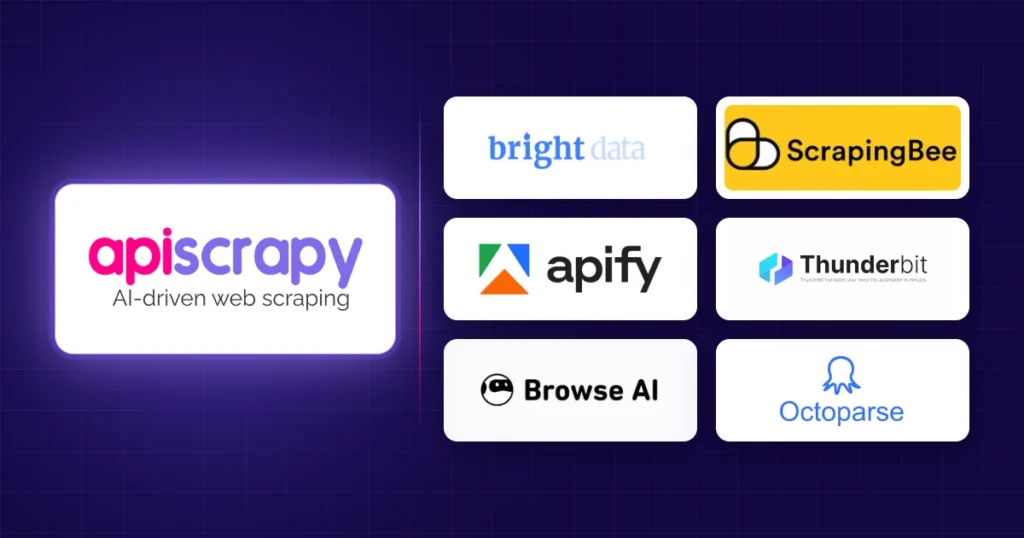
This guide breaks down the seven strongest e-commerce scraping service, based on:
- Analysis of vendor documentation, pricing pages, and verified reviews across G2, Trustpilot, and developer communities
- Evaluation of anti-bot handling, JavaScript rendering, and structured product data output (price, availability, reviews, variants)
- Comparison of AI readiness, no-code versus developer-first workflows, and marketplace coverage across Amazon, Walmart, Shopify, and general retail sites
- Review of pricing models and scalability for solo sellers, growing brands, and enterprise data teams
APISCRAPY is the service we build and maintain ourselves, made for teams that want scraping handled end to end without adding headcount. Its placement reflects our documented feature set, not a paid slot, and every comparison made against the other six services below relies on their public pricing pages, documentation, and independently verified customer reviews rather than our own opinion of them.
All service descriptions and comparisons rely on publicly available documentation, verified customer feedback, and documented performance outcomes.
Vetting Methodology: How We Evaluated These E- Commerce Scrapers
We scored every provider on the same six weighted criteria, drawing on public vendor documentation, published pricing pages, and verified G2 and Capterra reviews.
| Criterion | Weight | What We Checked | Evidence Source |
|---|---|---|---|
| Data Coverage and Freshness | 25% | Dataset breadth, refresh frequency, and what actually triggers a re-collection | Vendor documentation and product pages |
| Delivery and Integration | 20% | Support for API, cloud share, batch, and webhook delivery, plus fit with warehouses, BI tools, and CRMs | API docs and integration listings |
| Compliance and Data Governance | 15% | Written GDPR and CCPA handling, along with SOC 2, ISO 27001, or equivalent certifications | Public trust centers and security pages |
| Pricing Transparency and Scalability | 15% | Published tiers, contract minimums, credit expiration, and renewal terms | Pricing pages and reviewer-reported quotes |
| Verified Customer Sentiment | 15% | Recurring praise and complaints, weighed separately for small business and enterprise buyers | Verified G2 and Capterra reviews |
| Support and SLAs | 10% | Named account contacts, written uptime guarantees, and response times | SLA documentation and support-related reviews |
| Total | 100% |
Comparison Table
| Service | Best For | G2 Rating | Capterra Rating | Starting Price |
|---|---|---|---|---|
| APISCRAPY | Managed e-commerce scraping with zero maintenance overhead | 4/5 | 5/5 | Start for $1 |
| Bright Data | Enterprise-scale scraping with heavy anti-bot needs | 4.6 | 4.7 | $49/mo (Growth plan) |
| ScrapingBee | Developers who want a single API call for HTML or JSON | 4.8 | 4.9 | $99/month |
| Apify | Teams building custom scrapers on a hosted service | 4.7 | 5 | $29/month |
| Octoparse | Non-technical teams using template-based scraping | 4.8 | 4.7 | Free plan, paid from ~$75/mo |
| Browse AI | Monitoring competitor sites for price or stock changes | 4.8 | 4.7 | Free plan, then from $48/mo |
| Thunderbit | Browser-based scraping for quick, small-batch jobs | 4.8 | 4.5 | From $25/mo |
A quick read on the table above: ScrapingBee and Bright Data lead on raw review scores, largely because both have been battle-tested across millions of e-commerce requests. Octoparse and Browse AI sit close behind, popular with teams that want templates over code.
How do we choose the best E-commerce scrapers ?
- Hands-on testing against live product pages, category listings, and price pages on major retail sites, checking for JavaScript rendering and anti-bot resistance.
- Direct conversations with teams running price monitoring, catalog enrichment, or MAP compliance workflows day to day.
- Cost-per-successful-request comparisons, since list prices rarely reflect what a scraper actually costs once retries and failed requests are counted.
- Community sentiment checks, including practitioner discussion threads where sellers and analysts compare notes on what actually holds up at scale.
- Review analysis across G2, Capterra, and Trustpilot, weighted toward verified e-commerce use cases rather than general scraping reviews.
1. APISCRAPY
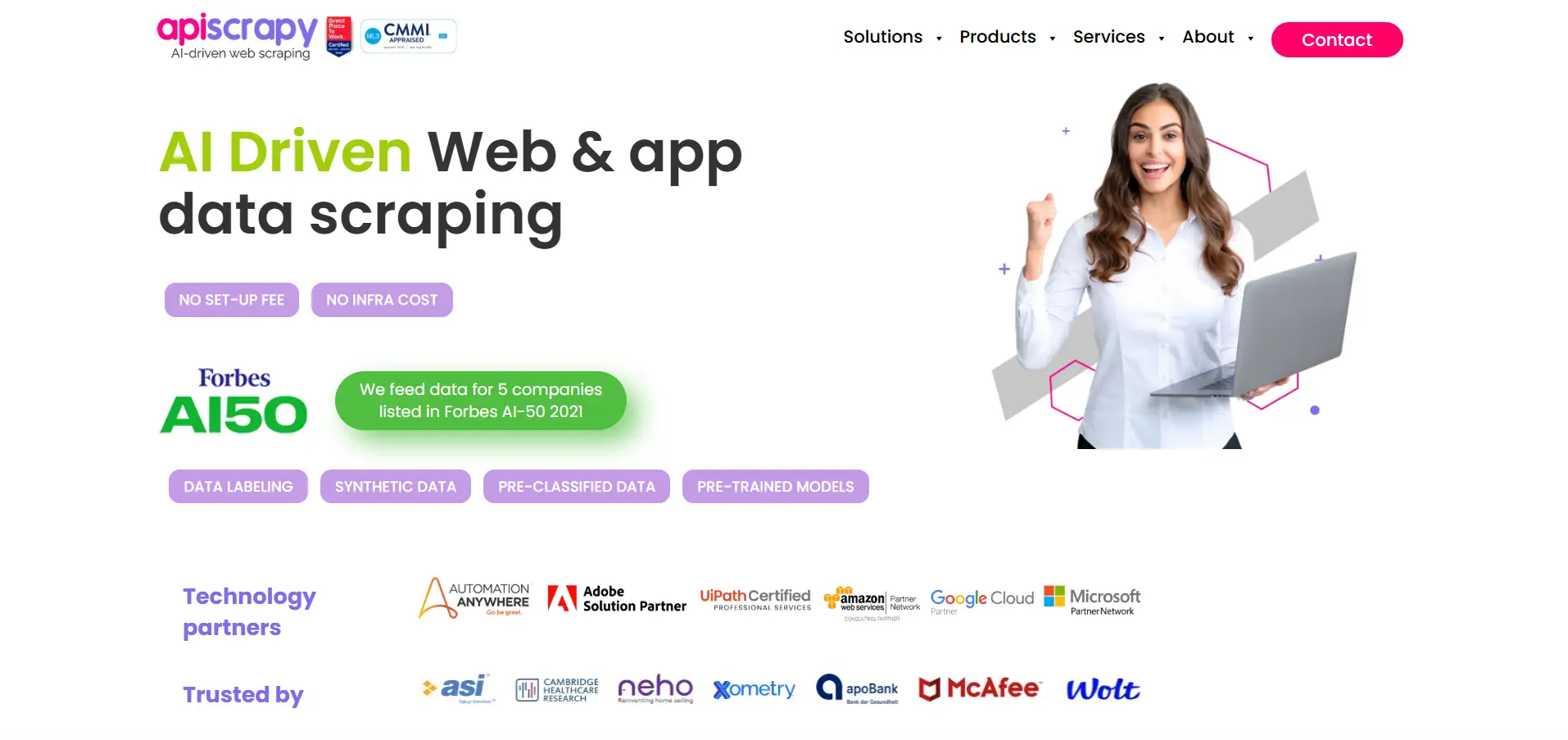
A fully managed e-commerce data extraction service that handles scraping, cleaning, and delivery end to end. Built for businesses that want ready-to-use product data without managing scrapers or infrastructure.
Features:
- Fully managed e-commerce scraping with zero maintenance overhead
- AI-powered data extraction pipelines built for large-scale product catalogs
- Custom workflows tailored to specific e-commerce data needs
- Data-as-a-Service model with structured, ready-to-use output
Pros:
- No infrastructure or maintenance burden on the client team
- Scales easily for high-volume e-commerce projects
- Tailored setup rather than a one-size-fits-all service
Cons:
- Reviews are 4 on G2 and Capterra as 5
- Custom pricing means no fixed entry point for quick comparison
Pricing: Start for $1
2. Bright Data
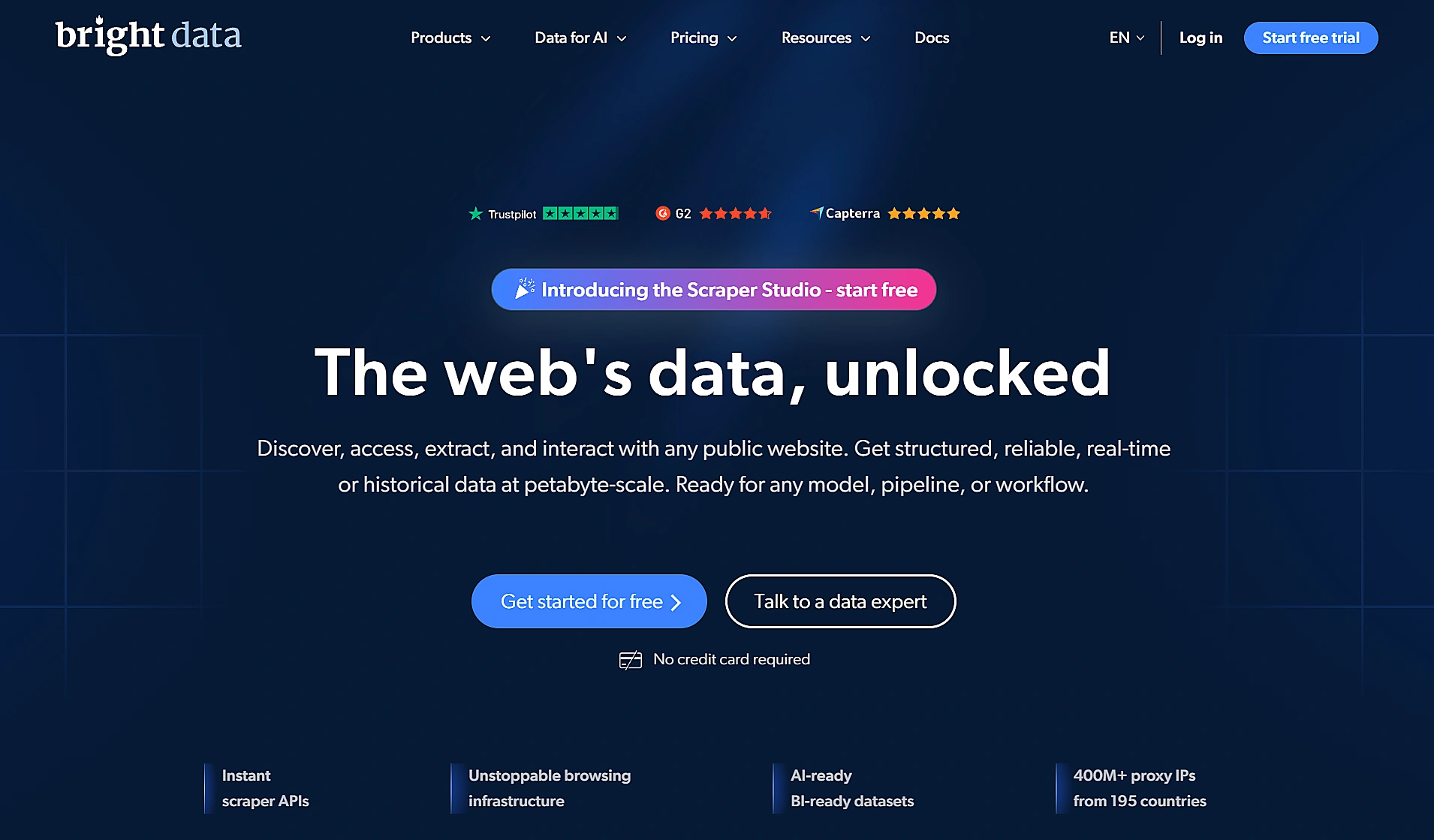
An enterprise-grade e-commerce scraping service known for its massive proxy network and ability to bypass strict anti-bot systems on major marketplaces. A strong fit for large organizations with heavy, high-volume product data extraction needs across Amazon, Walmart, Shopify, and other retail sites.
Features:
- Large-scale proxy network built for enterprise scraping
- Strong anti-bot bypass and IP rotation capabilities
- Pre-built scrapers and data collection services for e-commerce
Pros:
- Handles heavy anti-bot protection reliably
- Well suited for enterprise-scale data collection
- Backed by strong ratings (4.6 G2, 4.7 Capterra)
Cons:
- Higher starting price compared to most competitors
- Can be more complex to set up for smaller teams
Pricing: Starts at $49/mo (Growth plan)
3. ScrapingBee
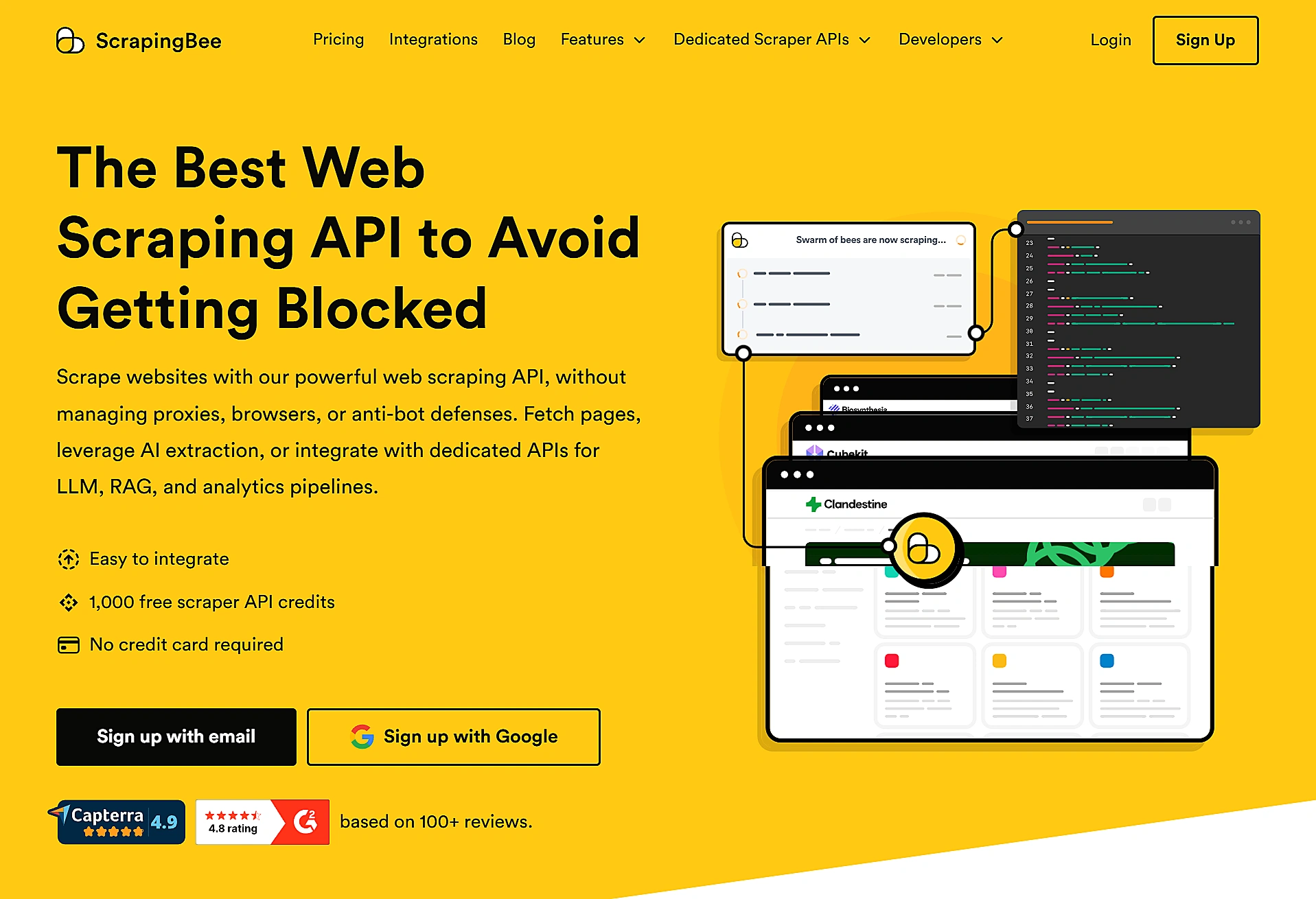
A developer-focused e-commerce scraping API that returns clean, structured HTML or JSON with a single call. Built for engineers who need reliable product, pricing, and availability data from online stores without managing their own proxy pools or headless browser infrastructure.
Features:
- Single API call for HTML or JSON extraction
- Built-in JavaScript rendering and proxy rotation
- Developer-first documentation and integration
Pros:
- Simple for developers to integrate quickly
- Low barrier to entry for small projects
- Top ratings among the group (4.8 G2, 4.9 Capterra)
Cons:
- Less suited for non-technical users
- Costs can add up at high request volumes
Pricing: $99/month
4. Apify
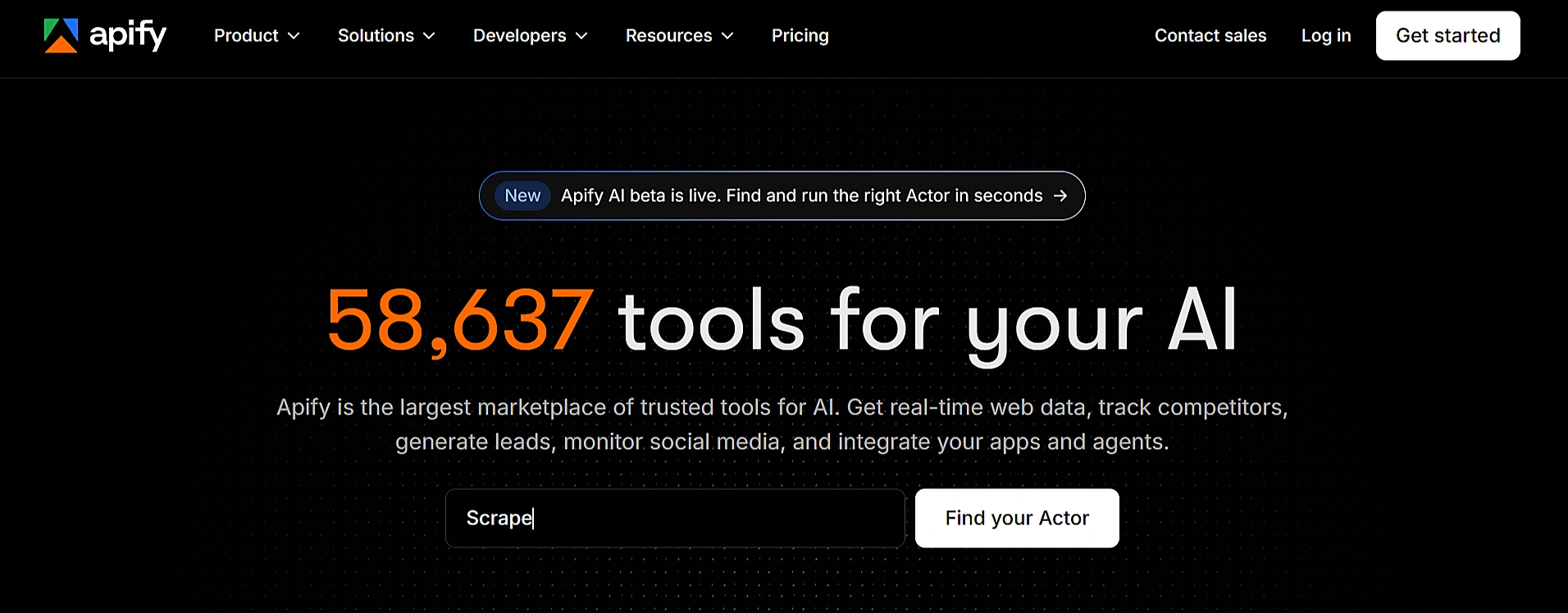
A hosted e-commerce scraping Service where teams can build, run, and scale custom scrapers to extract product data, pricing, and inventory details from online stores using pre-built or self-made scraping actors. Ideal for developers who want flexibility for e-commerce data extraction without managing their own servers.
Features:
- Hosted service for building and running custom scrapers
- Large marketplace of pre-built scraping actors
- Supports scheduling, storage, and integrations
Pros:
- Flexible for teams that want to build their own scrapers
- Strong developer community and reviews
- Free tier makes it easy to test before committing
Cons:
- Requires more technical setup than plug-and-play services
- Usage-based costs can be unpredictable at scale
Pricing: $29/month
5. Octoparse
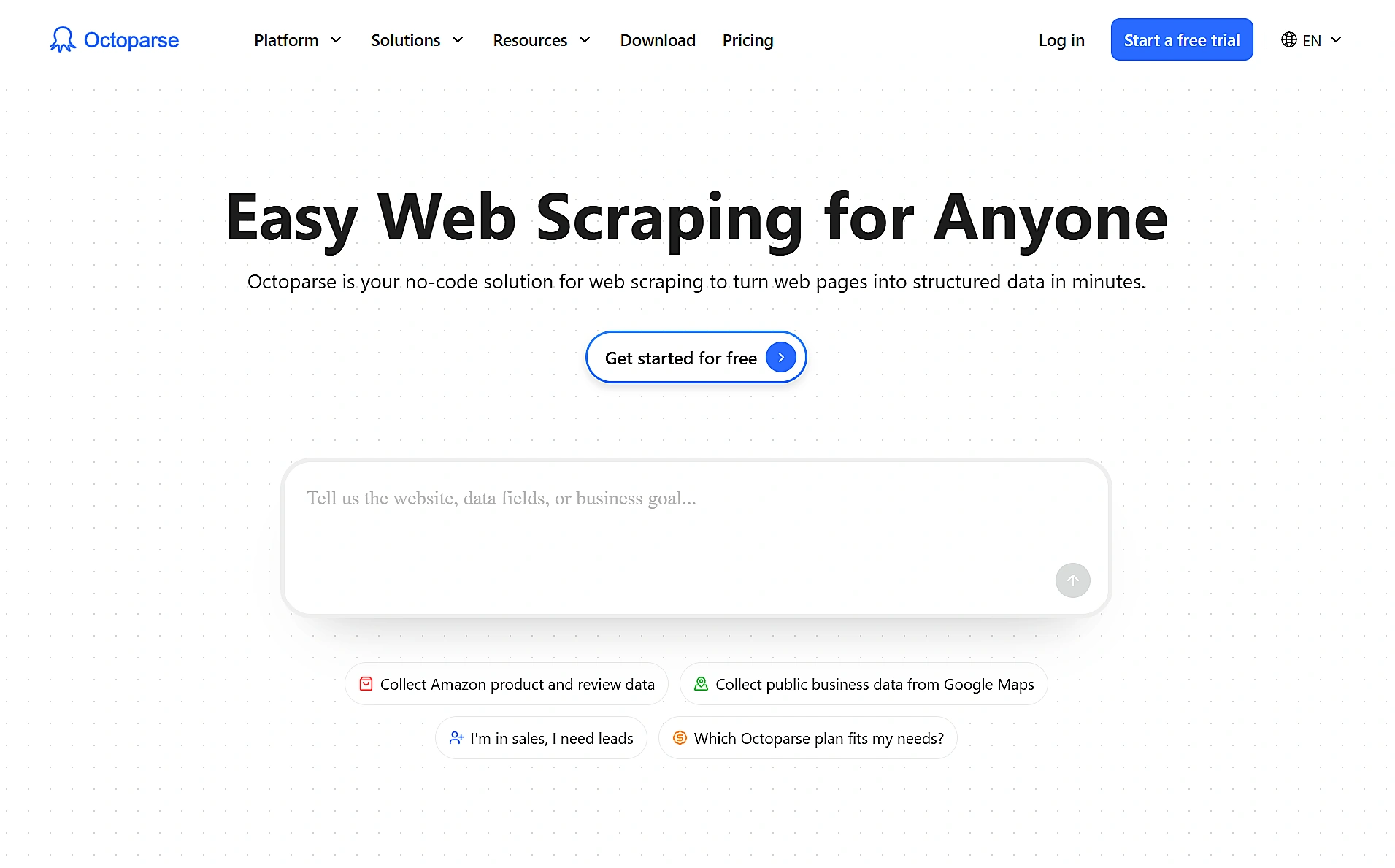
A no-code scraping service built around ready-made templates for popular e-commerce websites. Designed for non-technical teams who want quick results without writing scripts.
Features:
- Template-based scraping for popular e-commerce sites
- Point-and-click interface with no coding required
- Cloud-based extraction and scheduling
Pros:
- Accessible for non-technical teams
- Strong ratings (4.8 G2, 4.7 Capterra)
- Good balance of ease of use and functionality
Cons:
- Less flexible for complex or custom scraping needs
- Paid plans jump in price compared to entry-level services
Pricing: Free plan available, paid plans from ~$75/month
6. Browse AI
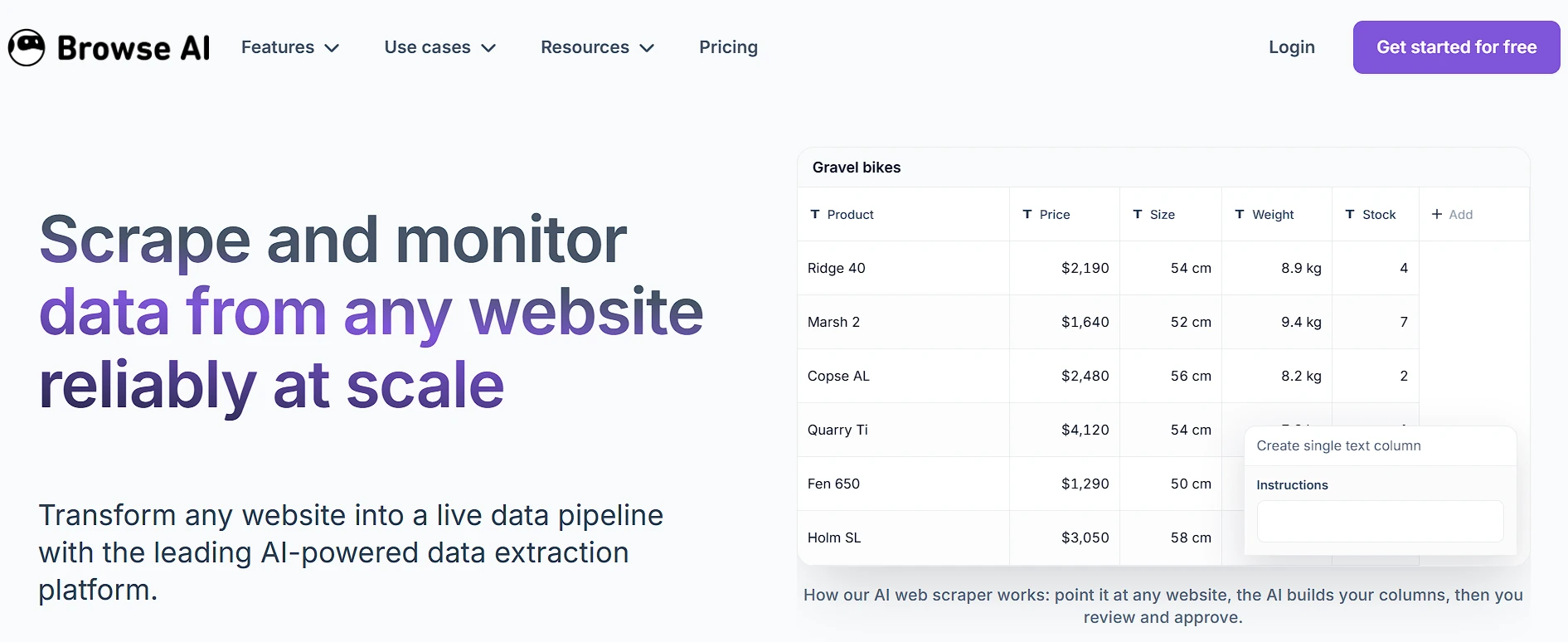
A no-code e-commerce scraping tool built specifically to track competitor prices, stock levels, and website changes across online stores and marketplaces. Best suited for teams focused on ongoing competitive intelligence and price monitoring rather than one-time bulk product data pulls.
Features:
- Built for monitoring competitor websites for price and stock changes
- No-code robot builder for repeatable scraping tasks
- Alerts and scheduled monitoring built in
Pros:
- Purpose-built for ongoing competitor monitoring
- Easy for non-developers to set up
- Solid ratings (4.8 G2, 4.7 Capterra)
Cons:
- Less suited for large-scale, one-time data extraction
- Monitoring focus limits broader scraping use cases
Pricing: Free plan available, paid plans from $48/mo
7. Thunderbit
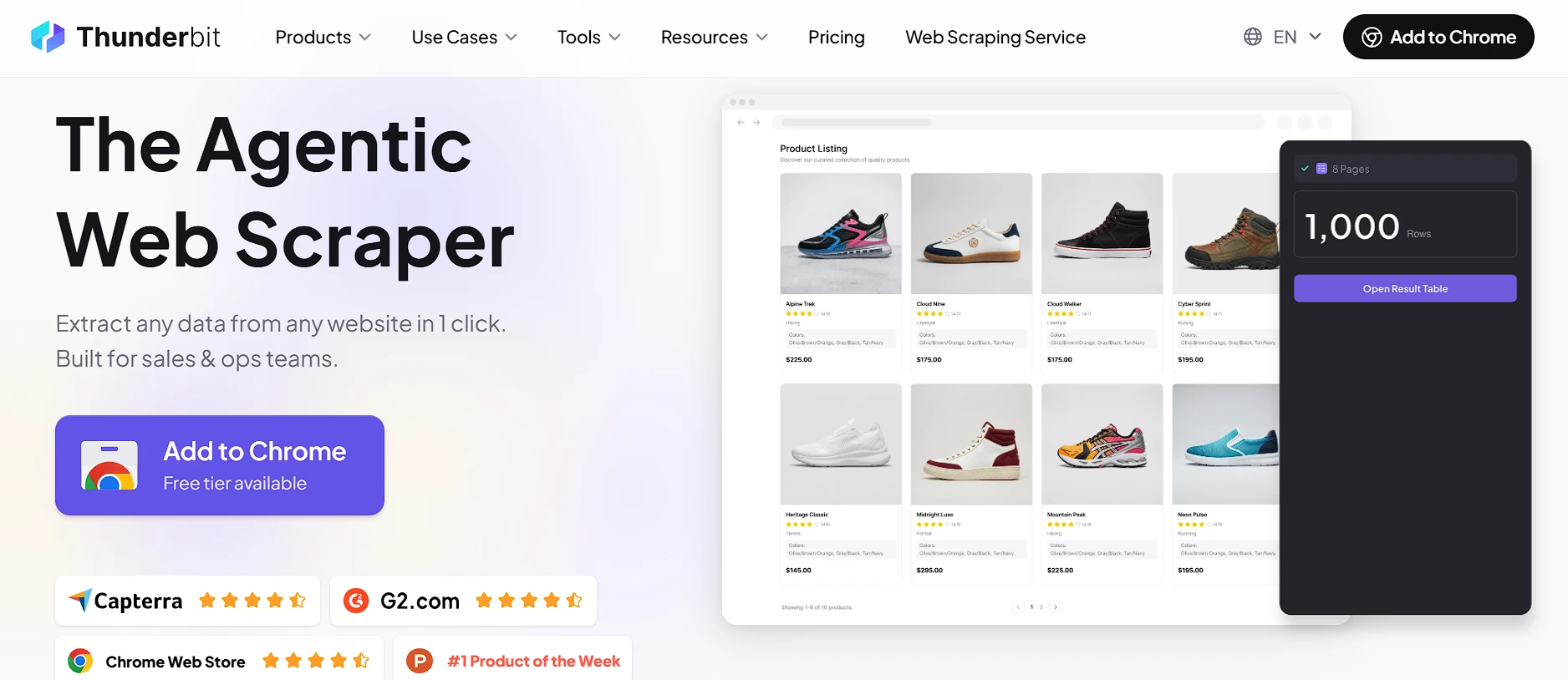
A lightweight, browser-based e-commerce scraper designed for quick, small-batch product data extraction. A practical choice for sellers who need occasional pricing, listing, or inventory pulls from online stores rather than large, ongoing catalog scraping projects.
Features:
- Browser-based scraping for quick, small-batch jobs
- Lightweight setup with minimal configuration
- Suited for one-off or occasional data pulls
Pros:
- Lowest starting price in the group
- Fast to set up for small tasks
- Good ratings (4.8 G2, 4.5 Capterra)
Cons:
- Not built for large-scale or enterprise scraping
- Browser dependency limits automation at scale
Pricing: Starts from $25/mo
Is E-Commerce Scraping Legal?
Scraping publicly available product pages is generally legal in most jurisdictions, and courts have repeatedly leaned that way. The hiQ Labs v. LinkedIn case is the most cited precedent, where the court found that scraping public data does not, by itself, violate the Computer Fraud and Abuse Act.
That said, legality has real limits. A site’s terms of service, its robots.txt file, and any rate limits it sets are worth respecting, even where a court might not strictly enforce them.
If the data you are pulling includes personal information, such as reviewer names or seller contact details, GDPR or CCPA rules can apply depending on where your business and your customers sit. Most e-commerce scraping, focused on prices, stock, and product specs, sits well outside that concern.
None of this is legal advice, and rules shift by country and by site. If you are scraping at scale or touching anything personal, a quick check with counsel is worth the hour it takes.
A practical rule most experienced teams follow: scrape at a human-like pace, avoid logging into gated accounts to pull data, and stay away from anything sitting behind a paywall.
Why pay for an E- Commerce website scraper?
- Free scrapers and browser extensions work fine for a one-off pull of fifty products. The moment volume climbs into the thousands, most break against modern anti-bot defenses, CAPTCHAs, and IP blocks within days.
- Keeping a DIY script alive means proxies, CAPTCHA-solving services, and someone on the team fixing broken selectors every time a target site redesigns. That maintenance cost adds up faster than most teams expect, and it rarely shows up in the original budget.
- Paid, managed scrapers handle thousands of SKUs across dozens of competitor sites without someone babysitting the pipeline. They also tend to deliver clean, structured feeds rather than raw HTML that still needs parsing on your end.
- Reliability matters just as much as scale. A price feed that silently breaks for three days can mean a retailer competing on stale numbers without even knowing it.
- It is not unusual to see review comments describing exactly this pattern, where a team switched from a free service to a paid one after losing a week of pricing data to a broken script.
- Support is the other quiet factor. When a scraper fails at 2am before a flash sale, a vendor with a support team beats a GitHub issue thread every time.
Ready to scrape E-Commerce sites with APISCRAPY?
- APISCRAPY is built for teams that want e-commerce data without owning the scraping infrastructure behind it. That includes retailers tracking competitor pricing, brands monitoring MAP violations, and marketplaces enriching catalog listings at scale.
- The core strength is the managed, DaaS approach: no proxies to rotate, no selectors to maintain, no infrastructure to babysit when a target site changes its layout overnight.
- It fits best for teams running recurring price monitoring, catalog enrichment, or multi-marketplace tracking who would rather focus on the data than the pipeline.
- That includes mid-market retailers who cannot justify a full data engineering hire but still need pricing feeds refreshed daily, if not hourly, across dozens of competitor storefronts.
- If your team is spending more time fixing scrapers than using the data they produce, it may be time to see what a managed pipeline looks like.
Start Building Your Web Crawler Today
Conclusion: Choosing the Right E-Commerce Scraper for Your Business
There is no single best e-commerce scraper for every team. Developers running high-volume, custom pipelines will lean toward ScrapingBee or Bright Data, while non-technical teams often prefer the template-driven simplicity of Octoparse or Browse AI.
For teams that want the scraping handled end to end, without hiring someone to maintain it, a managed service is built specifically for that gap in the market.
The right choice comes down to your catalog size, your team’s technical bandwidth, and how much ongoing maintenance you are willing to own. Whichever direction you lean, it is worth testing before committing to an annual contract.
If a managed, maintenance-free e-commerce data pipeline sounds like the fit, book a demo with APISCRAPY and see the data flow before you decide.
FAQs
What is the best free e-commerce scraping service?
APISCRAPY does not run on a free tier, since its model is built around managed delivery rather than self-serve limits. Octoparse and Browse AI offer functional free plans worth testing first.
Can e-commerce scrapers track competitor pricing in real time?
Yes. Most modern e-commerce scraping services support scheduled and near-real-time price monitoring across competitor sites, built for teams running this as a recurring workflow rather than a one-off pull.
Do I need coding skills to use an e-commerce scraper?
Not necessarily. Fully managed scraping services handle the code and scraper logic on the vendor's side, so your team doesn't need to write or maintain anything. Self-serve service, by contrast, typically require at least some setup or scripting.
How much does an e-commerce scraper cost?
Pricing varies by volume and use case, since a fixed monthly plan rarely fits every catalog size fairly. Services generally range from around $25 a month for smaller self-serve service to $499 or more per month for enterprise-grade managed services.