How to Scrape Amazon Product Data?
This guide walks through three practical methods for pulling Amazon product data, how to keep those methods running with proxies, and the most common failure points teams hit along the way.
The approaches covered here are:
- Scraper APIs for developers building custom pipelines
- No-code and low-code tools for non-technical teams
- Pre-built actors for one-off or narrow use cases
Amazon’s Conditions of Use prohibit automated access to the site, even though scraping publicly visible pages is generally treated as legal under US case law. We cover what publicly visible actually means further down, since the boundary moved in 2025 and 2026.
The goal here is not to push one method over another. It is to help you match the approach to your team’s technical resources and the scale of data you actually need.
- Developers: Use a scraper API. It handles rendering, proxy rotation, and CAPTCHAs, and returns structured JSON on a schedule.
- Non-technical teams: Use a no-code tool. Setup takes under an hour, but reliability drops past a few thousand products.
- Quick, narrow checks: Use a pre-built actor. Setup is near zero, but per-run costs climb at scale.
- Avoid blocks: Rotate residential proxies, match realistic headers and timing, and geo-target every region you monitor.
- Catch silent failures: Layout changes can return blank prices without an error, so monitor output quality, not just uptime.
- Stay safe: Public data is generally treated as lawful under US case law, but it breaches Amazon’s Conditions of Use, so avoid login-walled pages.
- Outgrown DIY? A managed service like APISCRAPY removes the maintenance load.
How to Scrape Amazon Product Data (Step-by-Step)
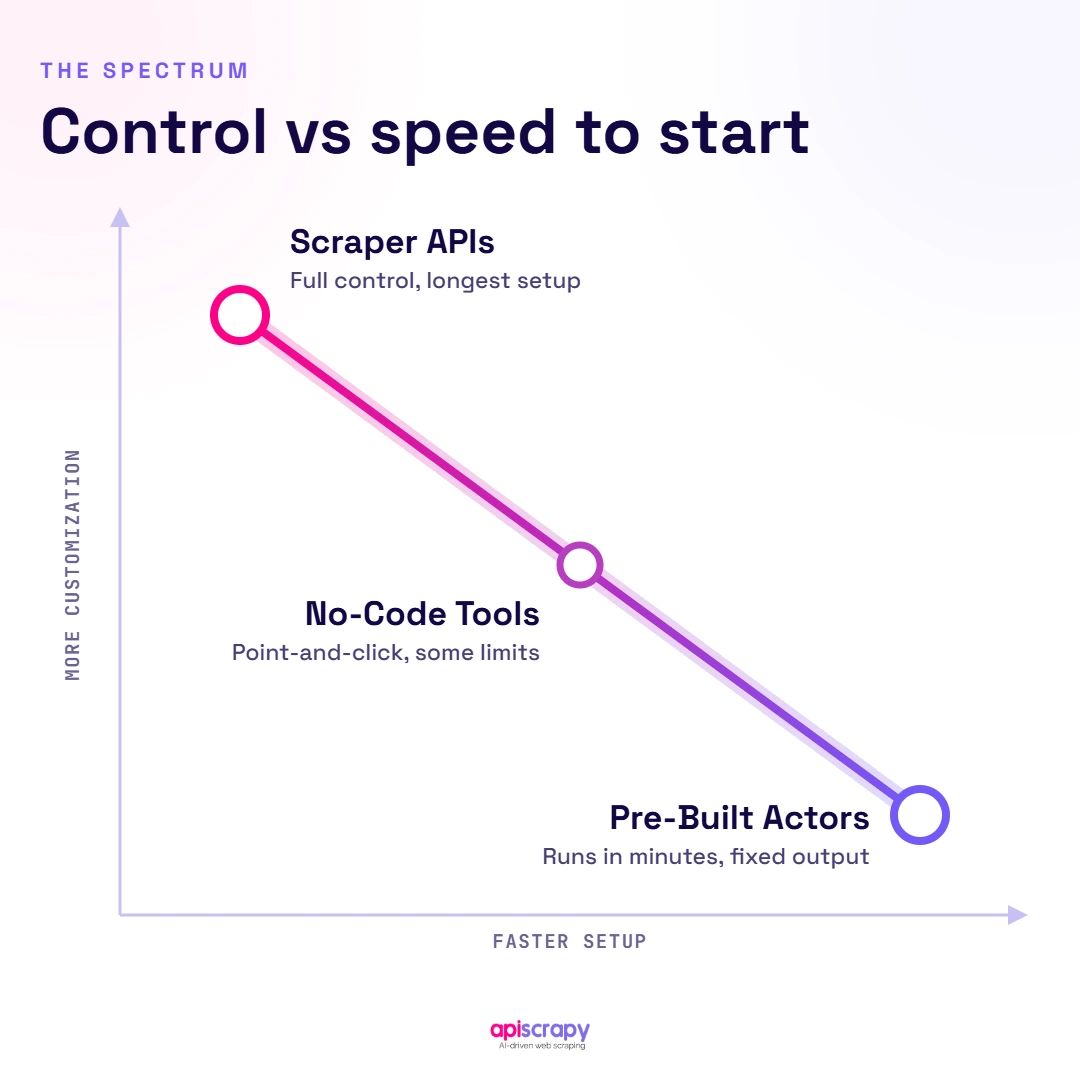
The three methods below sit on a spectrum. Scraper APIs give the most control and the steepest setup curve. No-code tools trade some flexibility for speed, and pre-built actors trade customization for near-zero setup time.
Which one fits depends on three things: whether you have engineering resources, how many products you need to track, and how often that data needs to refresh.
Scraper APIs
A scraper API sits between your code and Amazon’s pages, handling browser rendering, proxy rotation, and CAPTCHA challenges so your code only has to request a URL and parse structured JSON back. This differs from firing raw HTTP requests at Amazon, which gets blocked almost immediately because key product data loads through JavaScript.
This method suits development teams building a pricing engine, a catalog sync job, or any pipeline that needs to run on a schedule without a person checking on it.
What actually matters when picking one:
- IP rotation across residential and datacenter pools so requests do not cluster from one address
- Built-in CAPTCHA and bot-challenge handling, since Amazon serves these inconsistently by region and traffic pattern
- JavaScript rendering support, because price and Buy Box data often load client-side
- Structured output mapped to fields like ASIN, price, rating, and variation, not raw HTML you parse yourself
No-Code / Low-Code Tools
No-code scraping tools let you point at a page, select the fields you want, and get a scrape running without writing a parser. Most work as browser extensions or hosted web apps with visual, click-based field selection.
This fits marketers, analysts, and small teams that need product data on a recurring basis but do not have a developer to maintain a pipeline.
Where these tools help and where they fall short:
- Fast to set up, with a working scrape running in under an hour for a small product list
- Templates exist for common Amazon page types, cutting setup time further
- Scale and reliability drop off past a few thousand products, since most were not built for high-volume, high-frequency jobs
Pre-Built Actors
Pre-built actors are ready-made scraping templates configured for a specific, common task, like pulling a single product page or a search results list. You supply the URL or ASIN and run it, with no configuration beyond that.
These suit teams that need a fast answer to a narrow question, such as the current price across 200 ASINs or how a search results page ranks right now.
Trade-offs worth weighing:
- Near-zero setup, which is the main appeal
- Little to no customization if your required fields do not match the actor’s defaults
- Ongoing costs typically run per execution, which adds up fast at real scale compared with a self-managed pipeline
How to Include Proxies for Amazon Product Data Scraping
Amazon rate-limits and blocks IP addresses that send too many requests too quickly, which makes proxies close to mandatory once a job goes past a handful of pages a day. Without rotation, a single IP gets flagged and blocked within a short scraping session.
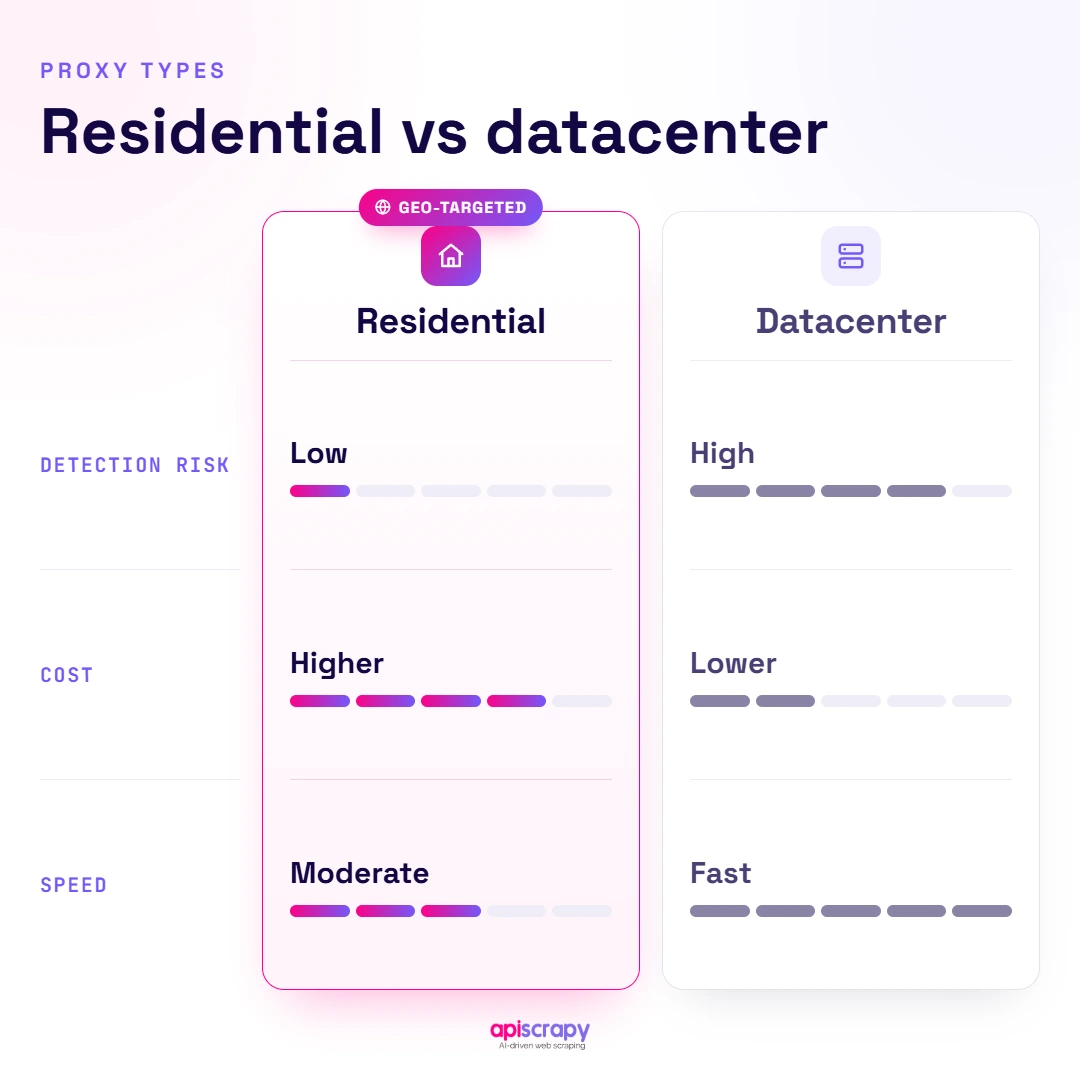
Residential proxies route requests through real ISP-assigned IP addresses, which makes them far harder for Amazon’s bot detection to distinguish from ordinary shoppers. Datacenter proxies are faster and cheaper but get flagged more easily, since detection systems maintain lists of known datacenter ranges.
Rotation strategy matters as much as proxy type. Some jobs, like adding an item to a cart to confirm final pricing, need a stable IP through a session, while product-page scraping usually works better with a fresh IP per request.
Geo-targeted proxies matter for a separate reason: Amazon shows different prices, stock levels, and sometimes different listings depending on the shopper’s location. A pricing team monitoring multiple regions needs proxies that can request from each target region specifically, not just any residential IP.
Getting a proxy setup working reliably comes down to:
- Matching proxy type, residential or datacenter, to how aggressively the target pages are protected
- Pairing rotation with realistic request headers and timing, not just changing the IP
- Building retry logic for the requests that fail even with rotation in place
- Budgeting for proxy costs to scale with request volume, since residential proxies bill by bandwidth
What Are the Difficulties and Solutions in Scraping Amazon?
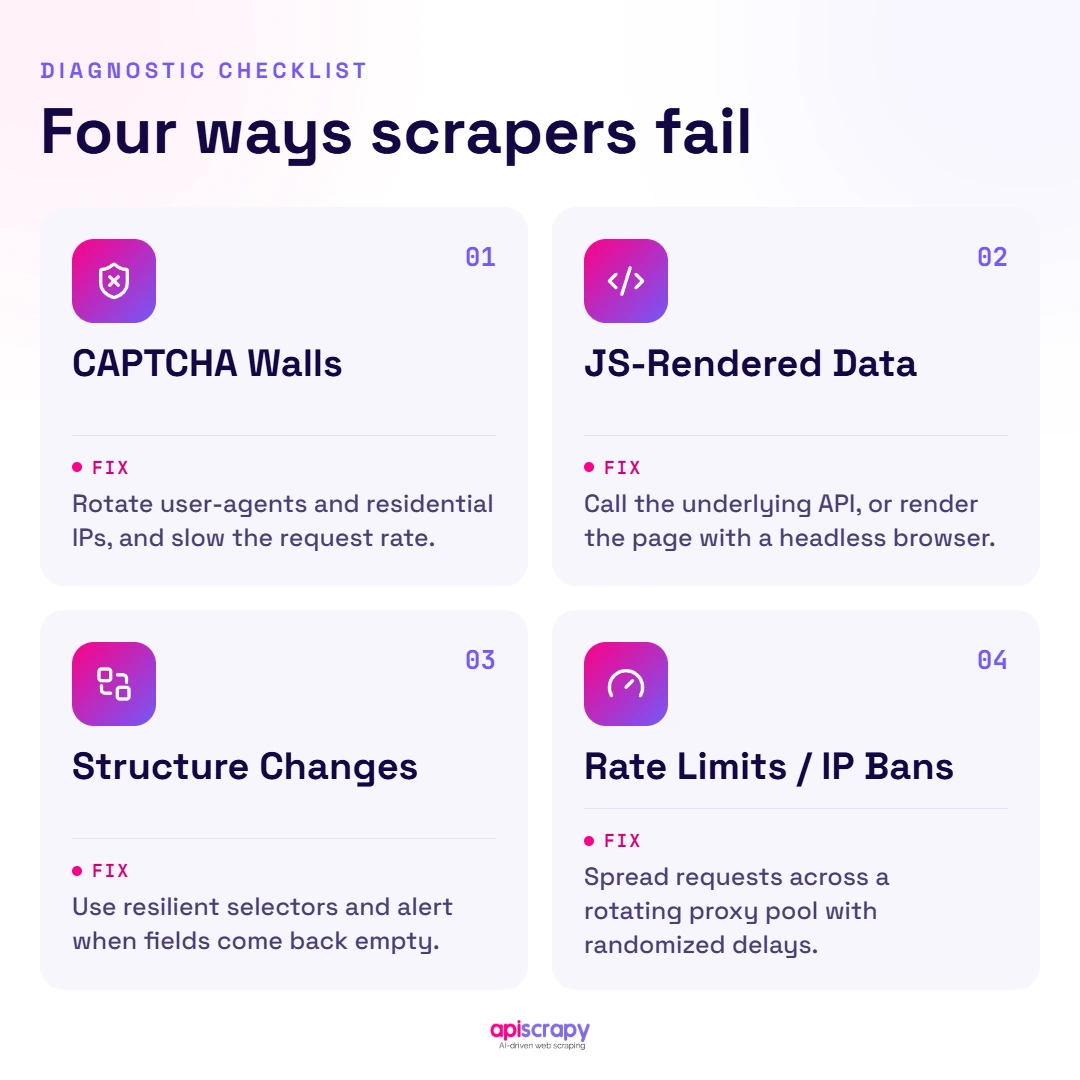
CAPTCHA and Bot Detection
Amazon serves CAPTCHA challenges and bot-detection walls when it flags a request pattern as automated, based on request frequency, header consistency, and IP reputation. This escalates the more aggressively a scraper pulls pages.
The practical fix is combining proxy rotation with human-like request pacing and realistic browser headers, rather than trying to solve CAPTCHAs after they appear.
Dynamic, JavaScript-Rendered Content
Amazon loads pricing, Buy Box seller data, and stock status through JavaScript after the initial page load, so a basic HTTP request often returns a page missing the exact data you need.
Headless browser rendering, or a scraper API that handles rendering internally, solves this by waiting for the page to fully load before extracting data.
Frequent HTML Structure Changes
Amazon updates its page layout and HTML structure often enough that scrapers built around fixed CSS selectors break without warning, sometimes returning incomplete data silently instead of an outright error.
The fix is monitoring output quality, not just uptime. A scraper that runs successfully but quietly returns blank prices for a share of products is a bigger risk than one that fails loudly.
Rate Limiting and IP Bans
Sending too many requests from one IP in a short window triggers rate limits first, then outright IP bans if the pattern continues.
Spacing requests, rotating IPs, and keeping request volume proportional to what a real user session would generate keeps most jobs under the threshold that triggers a ban.
How to Scrape Amazon Product Pages with APISCRAPY?
Teams that have tried the DIY methods above and hit a maintenance ceiling, whether that is proxy costs climbing, CAPTCHAs multiplying, or engineering time going into scraper repair instead of using the data, usually move to a managed service at that point.
APISCRAPY runs the scraping infrastructure, proxy rotation, and CAPTCHA handling as a managed service, so a team submits a product list or set of ASINs and receives structured data back without maintaining scraper code.
This fits teams that need Amazon product data as an input to a pricing, catalog, or research process, not as an engineering project in its own right. The trade-off is straightforward: less infrastructure control in exchange for not carrying the maintenance burden of the anti-bot arms race.
One pricing team spent close to a full week each month manually checking competitor listings across a few hundred ASINs before automating the process. Moving to a managed scraping pipeline cut that manual work down to a review-only task, freeing the time for pricing strategy instead of data collection.
Start Building Your Web Crawler Today
Conclusion
Manual product tracking on Amazon breaks down fast, and even a well-built DIY scraper eventually runs into CAPTCHA walls, structure changes, or proxy costs that outweigh the engineering time saved. The method that fits your team depends on your technical resources, your target scale, and how much ongoing maintenance you are willing to own.
If maintaining a scraper is not the best use of your team’s time, book a demo with APISCRAPY to see how the managed pipeline handles Amazon product data at scale.
FAQs
Is Amazon product scraping legal?
Scraping publicly visible Amazon data, such as prices, titles, and ratings, is generally treated as lawful under US case law, but it violates Amazon's Conditions of Use, so the real risk is account or IP-level enforcement rather than criminal liability. This is not legal advice, and the safest practice is staying clear of anything behind a login wall.
How do you scrape Amazon without getting blocked?
Rotate IPs through residential proxies, space out requests to mimic normal browsing, and use a scraper API or headless browser that handles CAPTCHA and JavaScript rendering. Consistency in headers and timing matters as much as the IP rotation itself.
What is the best Amazon product scraper?
There is no single best option, since it depends on technical resources and scale. Developers building custom pipelines are usually better served by a scraper API, small teams without engineering support do better with no-code tools, and teams that want to skip infrastructure entirely tend to move to a managed service.
Can you scrape Amazon prices and reviews?
Prices and the review excerpts visible on product pages can be scraped, but Amazon restricted access to the full paginated review pages behind a login wall in late 2024, so bulk historical review scraping is far more limited than it used to be.
How do you export Amazon data to Excel?
Most scraper APIs and no-code tools return data as CSV or JSON, both of which open directly in Excel, and many no-code tools include a built-in export-to-spreadsheet option.
How do you scrape Amazon without getting blocked?
Rotate IPs through residential proxies, space out requests to mimic normal browsing, and use a scraper API or headless browser that handles CAPTCHA and JavaScript rendering. Consistency in headers and timing matters as much as the IP rotation itself.