Web Scraping vs Web Crawling: What’s the Difference
Web scraping vs web crawling get used as interchangeable buzzwords, but they solve different problems, and picking the wrong approach wastes budget as data needs scale.
This guide breaks down the actual difference between the two, then walks through the best managed web scraping service providers worth considering in 2026 for teams that want data delivered, not infrastructure to run.
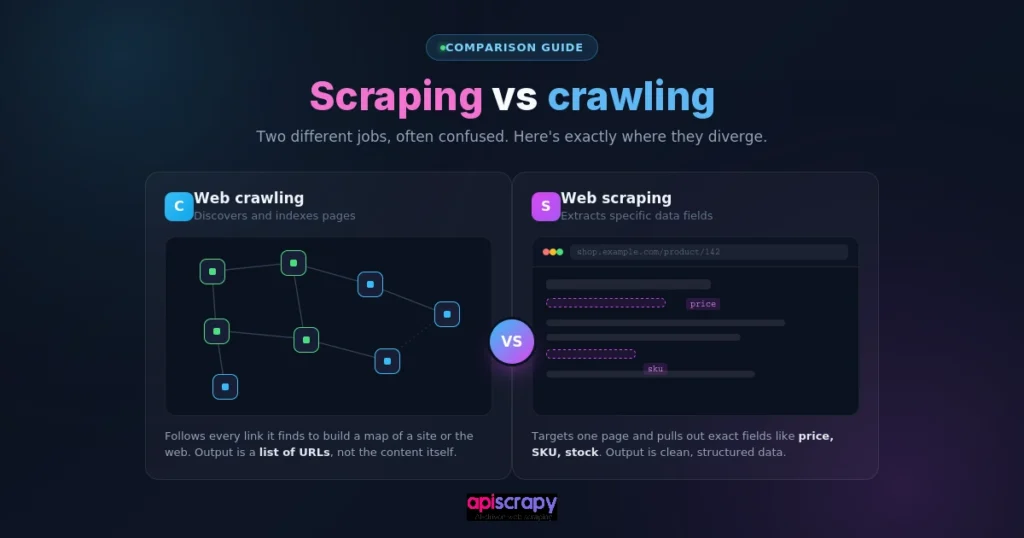
The core distinction is simple: crawling discovers, scraping extracts.
| Aspect | Web Crawling | Web Scraping |
|---|---|---|
| Primary Goal | Discover and map URLs | Extract structured data |
| Scope | Broad, often unbounded | Narrow, targeted pages |
| Output | Index or sitemap | Dataset (CSV, JSON, database) |
| Typical Services | Googlebot, custom spiders | Parsers, extraction APIs |
| Frequency | Continuous or scheduled | Based on business need |
| Common Use Cases | SEO indexing, site audits | Price monitoring, market research |
In everyday industry conversation, the two terms often get used loosely and interchangeably. But the technical distinction still matters, since it determines what infrastructure and skills a project actually requires.
How they work together: In a managed pipeline, a crawler first builds the list of relevant URLs, then a scraper is pointed at each one to pull the specific fields needed, like price, stock, or product name. For example, tracking competitor pricing across a growing e-commerce catalog requires crawling to find new product pages, then scraping to extract live pricing from each.
A fully managed provider like APISCRAPY handles both stages internally, so businesses get structured, ready-to-use data without managing crawlers and scrapers separately.
- Crawling discovers, scraping extracts. The two solve different problems: crawling maps which URLs exist, while scraping pulls the specific data points you actually need from pages you’ve already identified.
- Most real projects need both, not one or the other. A crawler finds relevant product or listing pages first, then a scraper extracts pricing, stock, or contact details from each one. Treating them as competing choices wastes setup time.
- Maintenance ownership is the real differentiator between providers. Pricing models vary widely, from usage-based plans around $40 per site to fully custom enterprise contracts, but the deciding factor is whether the provider or your own team fixes the pipeline when a target site redesigns its layout.
- The right approach depends on four quick questions. Do you need a list of URLs or the data inside them, one site or hundreds, a one-time pull or a recurring feed, and in-house build or managed pipeline. Answering these narrows the decision fast.
- Managed providers turn maintenance into someone else’s problem. Services like APIScrapy combine crawling, extraction, cleaning, and delivery into one workflow, so teams spend time using data instead of babysitting broken selectors.
Overview: Best Web Scraping Service Providers in 2026
- APISCRAPY is a managed, no-code Data-as-a-Service built for teams that want extraction handled end to end.
- Ficstar has run fully managed, project-based enterprise scraping since 2005 and is rated close to 5.0 stars on G2.
- ScrapeHero is a US-based, fully managed provider with published pricing starting at $199 per month per website.
- Grepsr runs a cloud-based managed service with tag-and-mark extraction, rated 4.8 on Capterra across 84 reviews.
- PromptCloud operates on a Data-as-a-Service model built for large-scale, ongoing crawl and extraction feeds.
- Datahut specializes in marketplace and retail intelligence with usage-based pricing starting at $40 per website.
- DataHen is positioned as a dedicated data-pipeline partner for teams needing custom-built extraction workflows.
What is Web Crawling?
Web crawling is the automated process of systematically discovering and browsing web pages across the internet, primarily to index content for search engines. A crawler, often called a spider or bot, starts with a set of seed URLs and follows hyperlinks from page to page. It does not necessarily extract or store the actual content in a structured way; its core job is discovery and mapping.
Crawlers like Googlebot or Bingbot traverse websites to build a map of the web’s structure. They read robots.txt files to understand which pages are allowed to be visited. They track link relationships between pages, essentially building a graph of the internet.
Key characteristics of web crawling:
- Purpose: Discovery and indexing, not necessarily data extraction
- Scope: Broad and often unbounded, following links across many domains
- Output: An index or sitemap of URLs and their relationships
- Frequency: Continuous or scheduled re-crawls to catch updates
- Respect for rules: Follows robots.txt and crawl-delay directives
- Common use cases: Search engine indexing, site health audits, broken link detection, SEO monitoring
For managed service providers, crawling often forms the first layer of a larger pipeline. It identifies which URLs exist and are worth visiting before any scraping or extraction begins. Without crawling, a scraper has no map of where to look.
What is Web Scraping?
Web scraping is the automated extraction of specific data from web pages once they have been located, whether through crawling or a predefined list of target URLs. Unlike crawling, scraping focuses on pulling structured information such as prices, product details, reviews, or contact data. The output is a clean, usable dataset rather than a map of links.
A scraper sends requests to specific pages, parses the HTML (or renders JavaScript-heavy pages), and extracts targeted fields based on rules or selectors. This can involve handling pagination, login walls, CAPTCHAs, and anti-bot measures depending on the target site’s defenses.
Key characteristics of web scraping:
- Purpose: Structured data extraction from known or targeted pages
- Scope: Narrow and specific, focused on particular data points or fields
- Output: Structured datasets in formats like CSV, JSON, or databases
- Frequency: Often scheduled based on business needs, such as daily price checks
- Complexity: Requires handling dynamic content, rate limits, and site-specific structures
- Common use cases: Price monitoring, competitor tracking, lead generation, market research, MAP compliance
For managed service, scraping is the value-delivery layer. It transforms raw web pages into decision-ready data feeds that businesses can act on directly.
Scraping vs Crawling: Which One Does Your Project Actually Need?
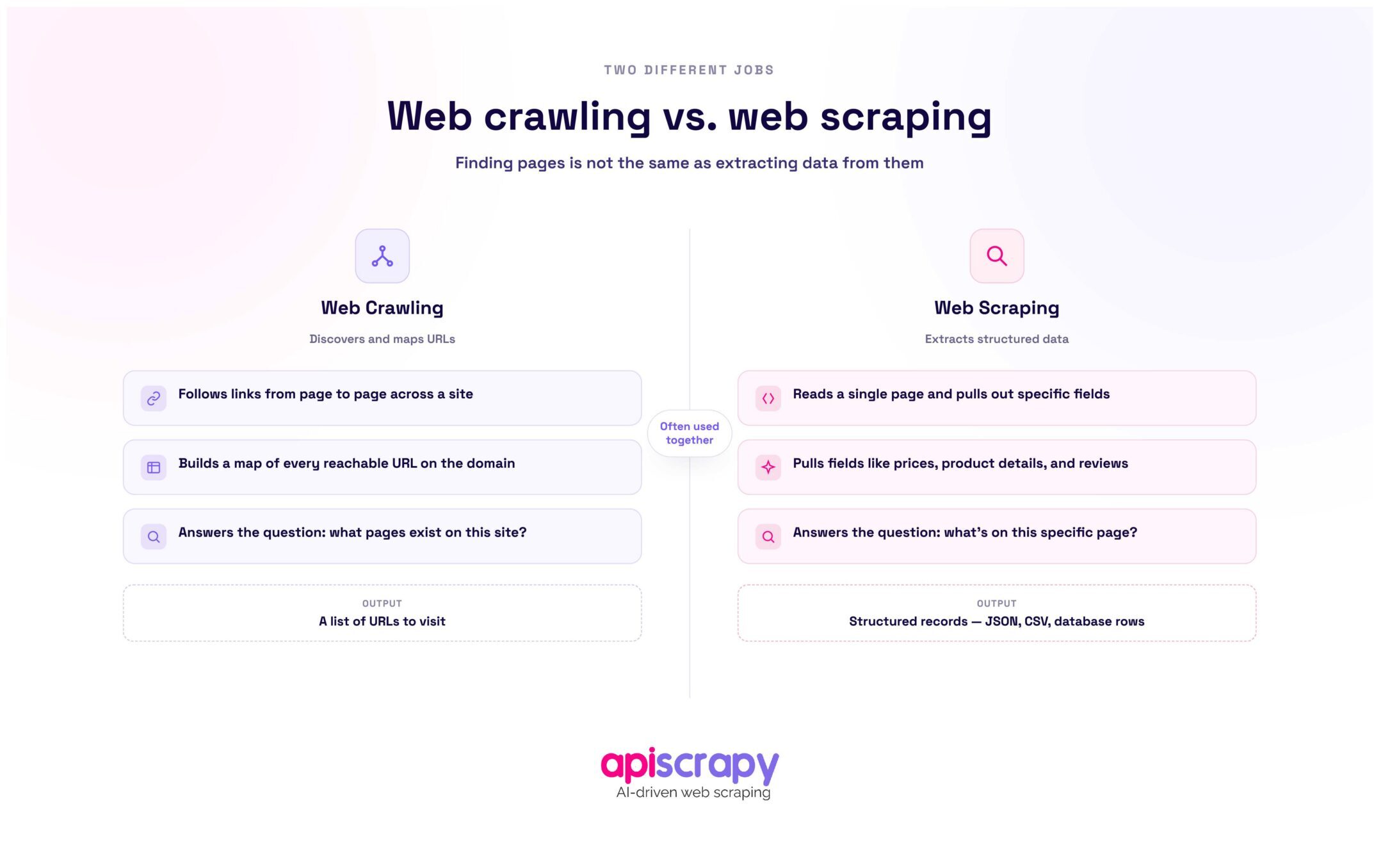
Most teams use “web scraping” and “web crawling” interchangeably, but each solves a different technical problem depending on project goals. This section helps you match your actual data need to the right approach before choosing a web scraping vs web crawling solution.
If your goal is discovery: Crawling alone works when you need sitemap building, broken-link audits, monitoring structural changes, or general SEO health checks across a site.
If your goal is structured data: Scraping is the right call for price monitoring, lead generation, competitor tracking, and review aggregation, anything that ends in a usable dataset.
If your goal is both: Most real-world projects need crawling first to map and discover relevant URLs, then scraping second to extract the actual data points from those pages.
Quick decision checklist:
- Do you need a list of URLs, or the data inside them?
- Is your target one site, or hundreds of unknown sources?
- Do you need this once, or on a recurring schedule?
- Will you build this in-house, or need a managed pipeline?
Crawling and scraping aren’t competing choices. They’re complementary steps in the same data pipeline.
Where Web Scraping Stops and Web Crawling Begins
Web crawling means systematically visiting pages and following links to discover what exists, the way search engines build an index. Web scraping means going to specific, already-known pages and pulling out defined pieces of data, like prices or product titles.
Search and SEO teams typically need crawling, since the goal is coverage and discovery across a site. Data, pricing, and ecommerce teams typically need scraping, since the goal is a clean, structured dataset ready for analysis.
In most production pipelines the two work together. A crawler discovers which URLs are worth visiting, then a scraping service extracts the actual data from each one.
Key Differences Between Web Scraping and Web Crawling
- Purpose: crawling discovers and maps pages, while scraping pulls specific, predefined data points from pages you already know.
- Scope: crawling typically runs across an entire site or domain, while scraping targets a narrower, defined set of pages.
- Output: crawling usually produces an index of URLs and links, while scraping delivers structured data in JSON, CSV, or a database.
- Ownership: crawling is often run in-house for indexing, while scraping is increasingly handed to a managed service provider.
- Frequency: crawling often runs on a broad recurring schedule for discovery, while scraping tends to run on demand against known targets.
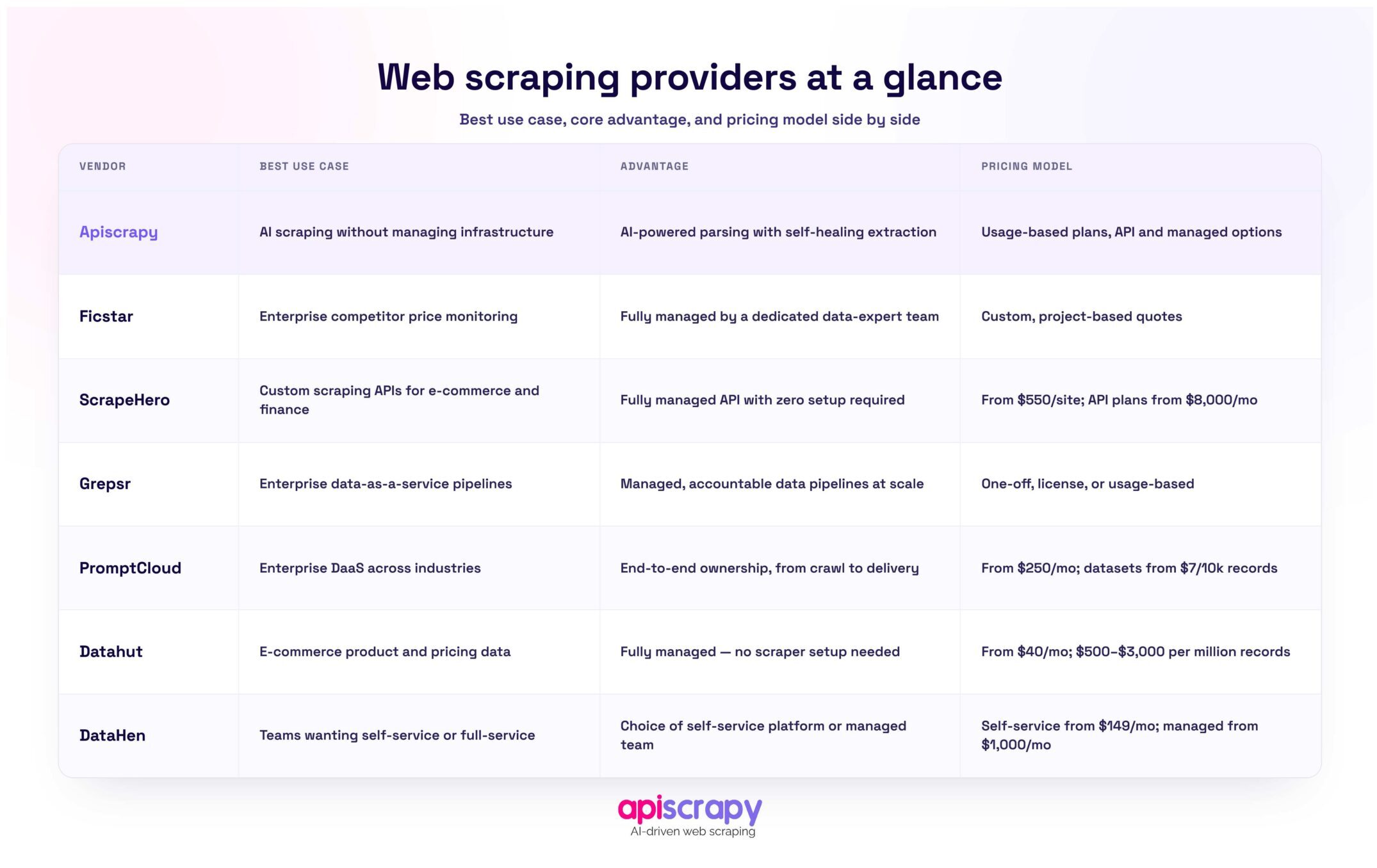
How Do You Choose the Right Web Scraping Service Provider?
| Provider | Best For | Key Advantage | Starting Price |
|---|---|---|---|
| APISCRAPY | Best for Enterprise AI web scraping | End-to-end managed extraction, cleaning, and delivery | Start for $1 |
| Ficstar | Enterprise clients wanting a full hands-off partner | Fully managed since 2005, rated ~5.0 on G2 | ~$1,000/month |
| ScrapeHero | Teams that want a published starting price | Fully managed, enterprise-grade, rated ~4.7 on G2 | From $199/mo per website |
| Grepsr | Teams that want a self-serve managed dashboard | Tag-and-mark extraction, 4.8 on Capterra (84 reviews) | Starting price: $350/month |
| PromptCloud | Large-scale, ongoing Data-as-a-Service feeds | ML-based extraction on a Hadoop and Cassandra stack | Starting price: ~$49–69/site/month |
| Datahut | Marketplace, retail, and pricing intelligence | Usage-based pricing tied to site complexity | From $40 per website |
| DataHen | Teams needing custom-built extraction pipelines | Positioned as a dedicated data-pipeline partner | $149/month |
Factors to Consider When Choosing a Web Scraping Service Provider
- Ownership of maintenance: confirm the provider, not your team, is responsible for fixing breaks when a target site changes.
- Pricing model fit: compare per-website, usage-based, and custom project pricing against your real data volume and frequency.
- Delivery format and schedule: check that the provider delivers data in the format and cadence your downstream systems expect.
- Compliance and ethical sourcing: confirm the provider only accesses publicly available data and follows GDPR or CCPA where relevant.
- Turnaround on changes: ask how quickly the provider adapts extraction logic when a target site redesigns its layout.
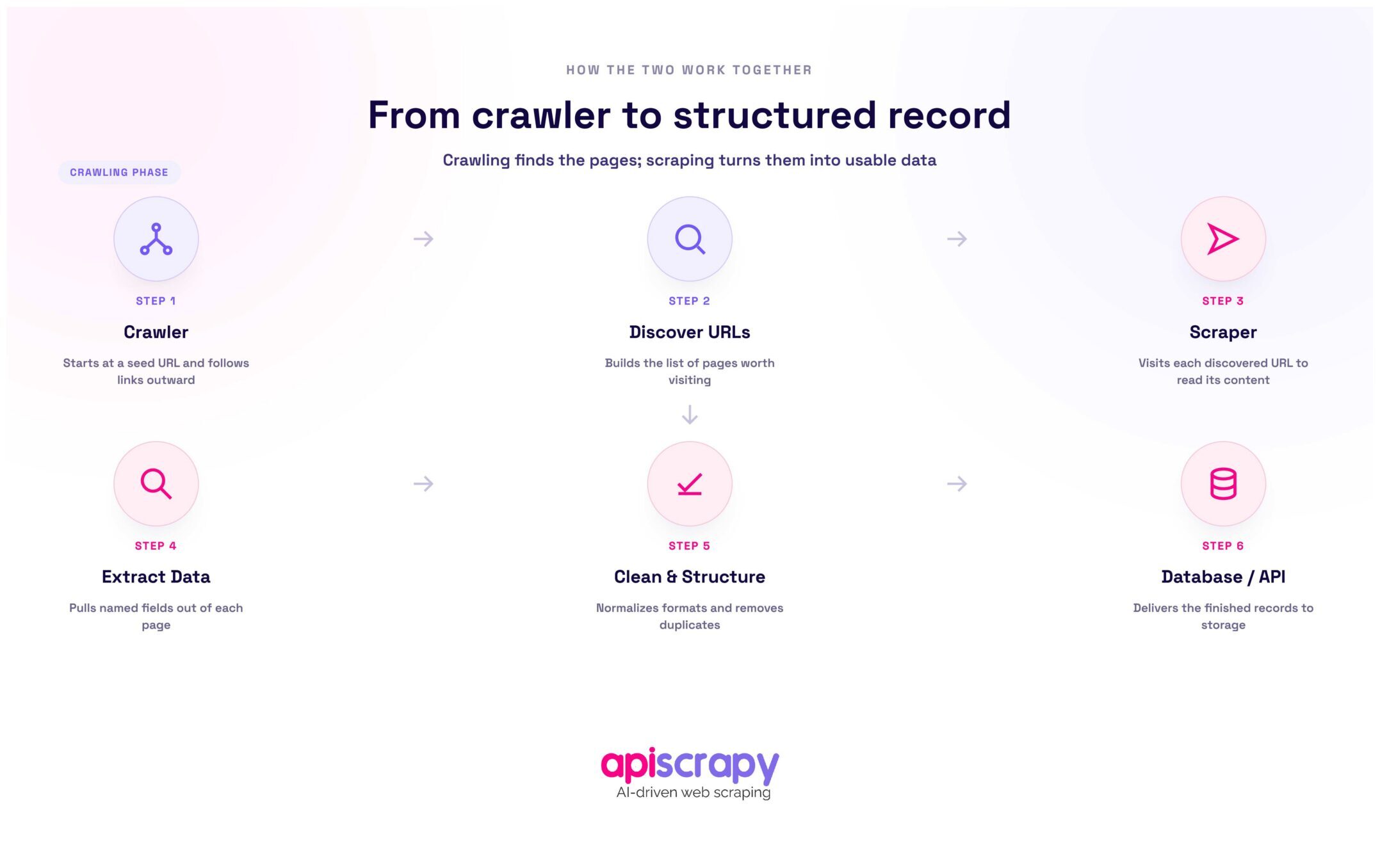
Why APIScrapy Is a Strong Choice for Managed Scraping and Data Needs
APISCRAPY is best suited for teams that want data delivered as a finished product rather than infrastructure they have to maintain themselves. Its core strength is combining extraction, cleaning, and delivery into one managed workflow instead of separate services stitched together.
Where it clearly outperforms a DIY crawl-and-scrape setup is maintenance. Teams are not the ones fixing broken selectors when a target site changes its layout overnight.
It fits teams anywhere from early-stage to established programs that would rather focus on using data than babysitting the pipeline that produces it.
Voices from the Reddit Community
One recurring theme on r/webscraping is how often teams underestimate ongoing maintenance time until a target site redesigns its layout mid-quarter, which is exactly the burden a managed service is built to absorb.
Start Building Your Web Crawler Today
Conclusion
Web crawling and web scraping solve different problems, and most real data pipelines need both working together rather than one instead of the other. The right web scraping service provider depends on your target sites, budget, and how much of the pipeline your team wants to own versus hand off entirely.
If you would rather review clean data than maintain scraper infrastructure, book a demo with APISCRAPY and see how a managed approach fits your pipeline.
Frequently Asked Questions
Is a web scraping service the same as a web crawler?
No. A managed web scraping service extracts specific, predefined data from known pages and delivers it to you. A crawler discovers and maps pages across a site, usually to build an index rather than a finished dataset.
How much does a managed web scraping service typically cost?
Pricing varies widely by provider and model, from usage-based plans starting around $40 per website to published per-website plans near $200 per month, up to fully custom enterprise pricing.
Can a web scraping service handle CAPTCHAs and anti-bot systems for you?
Yes. That is the core promise of a managed provider: the vendor's own team handles CAPTCHAs, IP rotation, and layout changes, so your team never touches the underlying scraper.
Do you need both a crawler and a scraping service for large-scale data projects?
Often yes. Large projects typically use crawling to discover relevant URLs first, then hand the actual extraction and delivery over to a managed scraping service provider.
What is the main advantage of a managed service over a self-serve scraping service?
A managed service takes on maintenance. When a target site redesigns its layout, the provider's team fixes the pipeline, instead of your own engineers debugging a broken script.